
I’ve spent more nights in travel trailers than I can count and Jayco’s the one mid-market brand I keep watching evolve. If you’re scoping out a first or second trailer for road life, here’s what both the research and the road told me.
Key takeaways
- The 2-year bumper-to-bumper plus 3-year structural warranty is the longest in the mid-market, well past the 1-year standard from Forest River and Keystone.
- The lineup ladders cleanly from the Jay Flight SLX (around $22,000 to $32,000) up to the full-luxury Eagle (up to $95,000).
- Vacuum-bonded laminated walls and the Magnum Truss roof on mid-tier and higher models matter for cold-weather and snow-load camping.
- Standard Goodyear Endurance tires are a quiet but real safety upgrade over the off-brand tires most competitors ship.
- Built in Middlebury, Indiana by Amish and Mennonite craftsmen, owned by Thor Industries since 2016, but Jayco still runs as it’s own design division.
Jayco Sits in the Rational Mid-Premium Spot Most Travelers Should Look at First
The way I describe Jayco to friends is this. It’s the brand that figured out how to ship a properly built trailer without charging Airstream money. Not the cheapest on the lot, not the fanciest, but the one where the build, the warranty and the resale all line up.
Started in 1968 by Lloyd Bontrager in Middlebury, Indiana. The name combines his middle initial “J” with his wife Bertha’s first initial “A”, with “co” tacked on the end. Small detail, but it tells you something. Family business, generational, anchored in one Midwestern town. Thor Industries bought them in 2016, which would normally worry me, but Jayco kept it’s design independence and the build quality held steady. There’s a Wikipedia entry on the company if you want the full corporate timeline.
What that means on the road is consistency. I’ve talked to plenty of Jayco owners at loops in Page, Arizona and outside the Tetons and the common thread isn’t “I love it”, it’s “it just works”. That’s the pitch and honestly that’s enough.
The 2+3 Warranty Matters More Than the Brochure Makes it Sound
Most travel trailer brands ship with a 1-year limited warranty. That’s the floor. Forest River, Keystone, the lot. Jayco offers 2 years bumper-to-bumper plus an additional 3 years on the structure.
Why this matters in practice. RV defects don’t show up in the first six weeks. They surface in month nine or month fourteen, after two seasons when a slide-out gasket starts weeping or a roof seam shifts. A 1-year warranty conveniently ends just before those issues appear. Jayco’s 2-year window catches them. The 3-year structural extension goes further, covering the bones of the unit through five summers of expansion and contraction cycles. Talk to anyone on r/GoRVing and the warranty conversation comes up fast.
The Jayco Price Ladder Runs From $22,000 to $95,000 and the Jumps are Logical
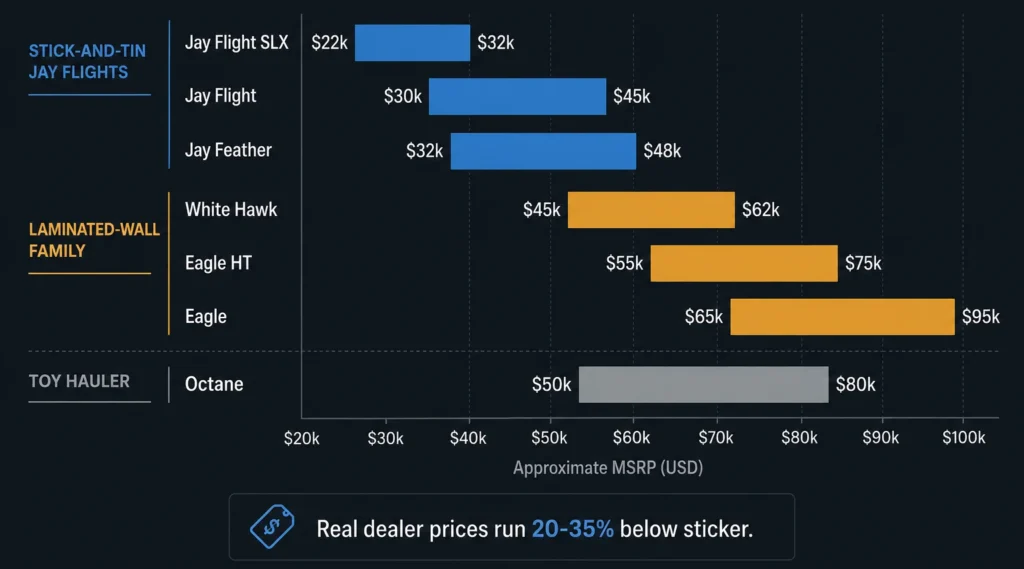
Most people walk onto a lot, see a Jay Flight, then see an Eagle and either overspend or underspend because one floorplan looked nicer in the showroom. The lineup actually has a real structure to it.
At the bottom is the Jay Flight SLX, $22,000 to $32,000 MSRP, stick-and-tin construction, floorplans aimed at weekenders, towable by half-ton trucks and most mid-size SUVs. Above it the Jay Flight itself, $30,000 to $45,000, the bestselling travel trailer in America for good reason. Then the laminated-wall family climbs the ladder: Jay Feather ($32,000 to $48,000), White Hawk ($45,000 to $62,000), Eagle HT ($55,000 to $75,000), Eagle ($65,000 to $95,000). The Octane toy hauler line ($50,000 to $80,000) sits off to the side for the ATV and side-by-side crowd.
Real dealer prices typically run 20 to 35 per cent below MSRP. Never pay sticker. The NHTSA towing safety guide is worth reading before you commit, because matching trailer weight to your tow vehicle is the single most-skipped step in this whole process.
The Construction Details That Matter When You’re Actually Out There
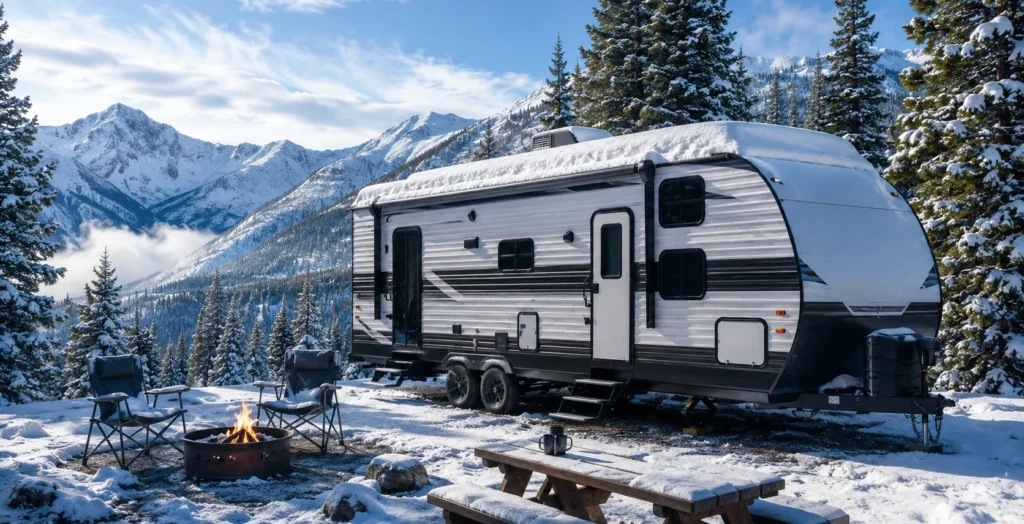
Two pieces of Jayco’s engineering have changed how I think about cold-weather and rough-road trips.
The Magnum Truss roof system is a self-supporting interlocking design that holds up under serious snow load. Parked at 8,000 feet in early October with four inches of wet snow on top, I’m not thinking about the roof, which is the point. The Climate Shield package on mid-tier models and up includes a heated and enclosed underbelly, radiant barrier insulation in the ceiling and floor and a higher-output furnace. Jayco actually tests these in a zero-degree climate chamber, which is more than most brands bother with. The vacuum-bonded laminated walls on the Jay Feather, White Hawk and both Eagles trade wood framing for an aluminum superstructure with block-foam insulation and a fiberglass skin, bonded under pressure. Lighter to tow, better insulated, no air pockets that turn into condensation problems in shoulder season.
The Two Small Details I’d Never Trade Away
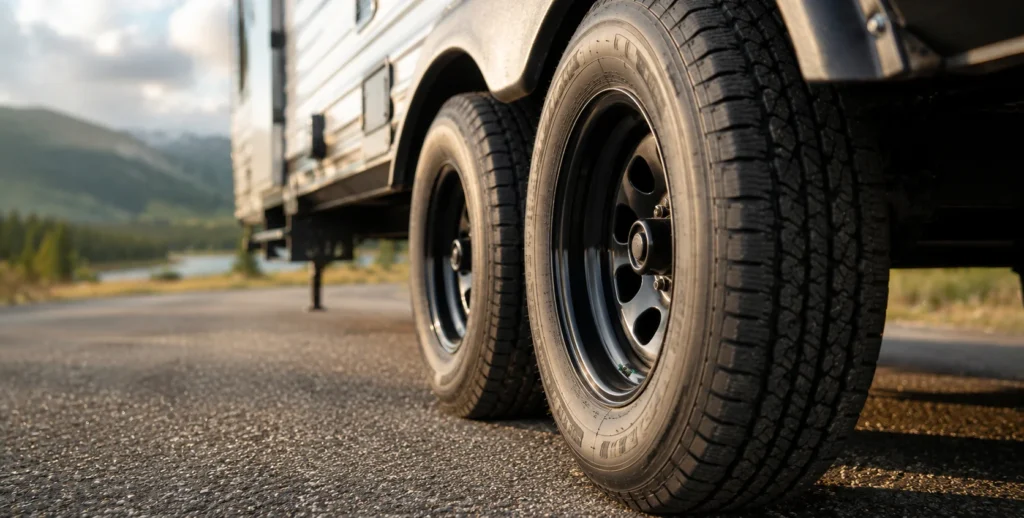
Standard Goodyear Endurance tires. Sounds boring until you’ve watched a trailer blow a cheap off-brand tire on I-40 in summer heat. Jayco ships Goodyears as standard equipment, which most competitors don’t and the NHTSA tire safety resources will tell you how much that decision actually matters for trailer safety.
The JAYCOMMAND system on Eagle HT and Eagle models lets you control lights, slides, awnings and tank monitoring from a touchscreen or your phone. Sounds gimmicky. Then you’re outside in the dark trying to remember if you left the water pump on and you check from your phone and you’re sold.