
Is Bocas del Toro safe right now? Bocas del Toro is open, visited by thousands annually and genuinely worth the trip – but it carries real, specific risks that catch underprepared travellers off guard. The archipelago sits under a US State Department Level 2 advisory and several incidents in 2024-2026 point to patterns worth knowing before you book.
5 Key Takeaways
- Petty theft, beach robbery and scooter accidents are the most statistically likely things to ruin your trip.
- Bocas del Toro province is a designated malaria transmission zone – prophylaxis is not optional.
- There are no lifeguards anywhere; rip currents at Wizard Beach, Red Frog and Bluff Beach have killed tourists including experienced swimmers.
- Water taxis operate with no standardised safety regime; life jackets are frequently absent or undersized.
- Medical facilities on the islands are basic – any serious emergency means an air ambulance to Panama City.
Quick Safety Checklist
- Comprehensive travel insurance with helicopter evacuation cover.
- Malaria prophylaxis prescribed before departure (confirm with a travel health specialist).
- DEET-based repellent, long sleeves at dawn and dusk.
- Hepatitis A vaccination.
- Cash in small US dollar notes – ATMs are unreliable and skimming is reported.
- Offline maps downloaded before arrival.
- Video documentation of every rental vehicle before you take it.
I’ll be honest – Bocas del Toro has pulled me back more than once. The water is that specific shade of Caribbean turquoise that makes you question every life decision that kept you inland and the pace of the islands is genuinely restorative. But I’ve also watched people have their trips collapse entirely because they arrived without malaria pills or left a bag on the sand at Wizard Beach for thirty seconds too long. The warnings here aren’t bureaucratic noise. They’re pattern recognition from real incidents. Here’s what actually matters.
Crime and Personal Safety
The dominant risk in Bocas isn’t violent crime – it’s opportunistic theft and it’s consistent enough to treat as near-certain if you’re careless. Thieves work in pairs, often by motorbike or by boat, targeting unattended bags on beaches while tourists swim. The stretch between Drago and Starfish Beach has seen a notable increase in this since 2024. I’ve seen multiple travellers return to where they left their things on the sand to find nothing there. The fix is simple and non-negotiable: nothing valuable leaves your hands on a public beach.
Armed robbery is less common but documented. The trail to Wizard Beach and the beach itself have seen repeated incidents over the past three years, including a case in December 2025 where three backpackers were robbed at gunpoint by assailants who arrived by boat at night while they were camping. Old Bank on Bastimentos is poorly lit and not somewhere to walk alone after dark. Bluff Beach after sunset is in a different risk category entirely – isolated, no phone signal and the site of multiple serious incidents.
The US State Department specifically flags an increase in sexual assaults involving female travellers in Bocas del Toro since 2023, often linked to unlicensed tour operators or water taxi drivers. In March 2026, Panamanian police arrested a local man connected to multiple assault cases involving foreign women in rental accommodation on Isla Colón. Book accommodation through verifiable platforms, keep doors locked and trust your instincts about any guide or operator who isn’t attached to a business you can verify through the official Bocas del Toro tourism office.
Health Risks You Can’t Ignore
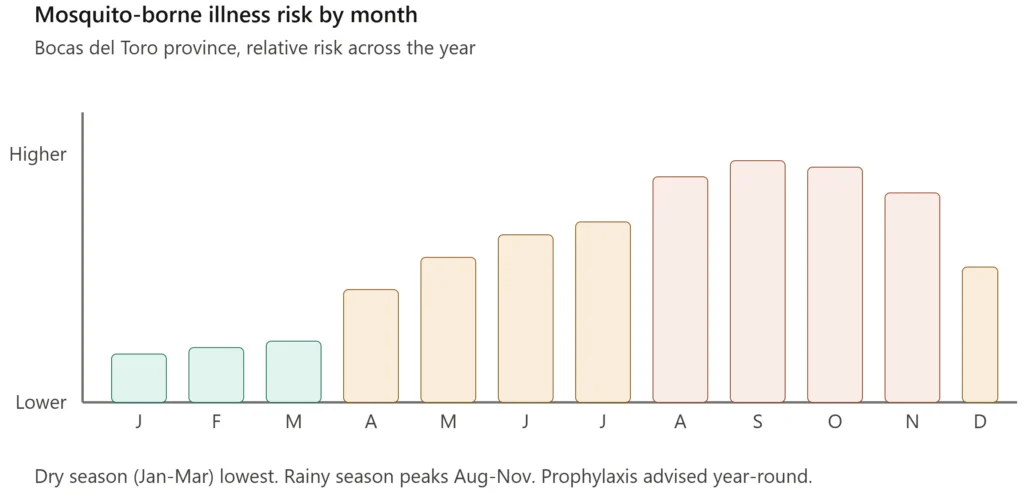
This is where I see the most dangerous complacency. People research crime before they travel. Far fewer research the mosquito situation and in Bocas del Toro that’s a meaningful gap. The entire province is a designated malaria transmission zone – Plasmodium vivax is the predominant strain – and the CDC explicitly recommends prescription prophylaxis for all travellers to the province. This isn’t the same advice they give for Panama City or the Canal Zone. Bocas is a specific exception and skipping prophylaxis because you’ve visited Panama before without taking pills is exactly the kind of reasoning that lands people in hospital.
Dengue, Zika and chikungunya are present year-round at varying levels, peaking during the rainy season which runs April through December. Zika still carries a pregnancy warning from the WHO. Long sleeves and DEET at dawn and dusk aren’t paranoia – they’re just the cost of being in a tropical archipelago during most of the calendar year.
Tap water in Bocas Town is treated but I wouldn’t recommend it for short-term visitors. On the outer islands and in rural areas it should be avoided entirely. Hepatitis A vaccination is advised and travellers’ diarrhea is common enough that carrying oral rehydration salts and knowing the nearest clinic is worth doing on arrival. The only public hospital – Hospital Dr. Raúl Dávila Mena in Bocas Town – is basic. Anything serious means an air ambulance to Panama City, which is why evacuation coverage in your travel insurance isn’t an upgrade, it’s the baseline.
The Hidden Dangers in the Water

Nobody talks about this one enough and it’s statistically the most lethal risk in Bocas del Toro. Rip currents have killed tourists at Red Frog Beach, Wizard Beach and Bluff Beach repeatedly, including experienced swimmers. There are no lifeguards anywhere in the archipelago. Warning signage is sparse or absent entirely. In June 2025, a US tourist drowned at Red Frog Beach – an incident that briefly reignited local debate about safety infrastructure, but as of mid-2026 nothing substantive has changed on the ground.
The Caribbean side beaches look inviting and calm from the shore. They aren’t always. Rips form quickly and without obvious visual cues. The standard advice applies: if you’re caught in one, don’t fight it. Float, signal and swim parallel to the shore until you’re out of the current’s pull. The problem is that most people don’t know this until after they need it. Read up on rip current self-rescue before you get in the water at any of these beaches – the US National Ocean Service has a clear explainer worth five minutes of your time.
Diving carries it’s own specific risk here. Bocas is genuinely good diving and I understand why people come for it. But the only hyperbaric chamber in the region is on Isla Colón and it has a documented history of intermittent operation and maintenance issues. Any serious decompression sickness may require evacuation to Panama City regardless. Dive only with operators who can confirm their safety protocols and emergency procedures – not the guy who approaches you on the dock with a laminated price list.
Crocodiles inhabit the mangrove estuaries around Bastimentos and the mainland shore. The risk is low but not theoretical. Fer-de-lance snakes are present in rainforest areas and are a genuine concern for anyone hiking off marked trails. Stingrays and jellyfish turn up in shallow water without much warning. None of these are reasons to avoid the islands – they’re reasons to pay attention to where you’re walking and swimming.
Transportation: The Risk Nobody Prices In
Water taxis are how you get everywhere in Bocas and they operate with essentially no standardised safety regime. Life jackets are frequently absent, undersized or stuffed under seats where they’re useless. Captains range from experienced to alarmingly casual and alcohol consumption by boat operators is anecdotally common among people who spend time on the water here. In February 2026 an overloaded water taxi capsized between Isla Carenero and Bocas Town during a sudden squall – everyone was rescued, but only because surfers happened to be nearby.
Before you board any vessel, physically count the life jackets and check they fit. If the boat looks overloaded, wait for the next one. Negotiate your fare before departure to avoid the kind of dispute that gets heated on open water. Avoid night travel by small boat entirely – unlit vessels and floating debris make it genuinely hazardous, not just uncomfortable.
On land, scooter rentals are the default way to explore Isla Colón and they’re responsible for a disproportionate number of injuries. Roads are narrow, potholed, poorly lit and frequently flooded in the wet season. Helmets are legally required and almost never enforced. If you rent one – and I’m not going to pretend it isn’t fun – go slowly, assume the road surface is worse than it looks and document every existing scratch on the vehicle with a timestamped video before you ride off. Rental operators claiming damage after the fact is one of the most consistently reported scams here.
The UK FCDO specifically flags unregulated water taxis and the absence of vessel safety standards – worth reading before you arrive.
Scams, Specific Areas and Leaving Bocas Smarter
A few patterns repeat often enough to be worth naming directly. Unlicensed tour operators selling trips to indigenous communities, dolphin watching or the Zapatilla Cays are common in Bocas Town. Payment upfront, no show, no recourse. Book through operators you can verify against the official tourism office listings – a Reddit thread on r/Panama will give you current name-checked recommendations from people who’ve been recently.
ATM skimming is reported at the few machines in Bocas Town. Several bars and restaurants have been flagged for unauthorised charges on card transactions. Carry cash in small US dollar denominations and treat your card as a backup rather than a primary. The “friendly local gift” opener – someone offers a bracelet or herb – is a distraction technique while an accomplice takes an unguarded bag. It’s low-tech and it works because people are relaxed and off-guard on holiday.
Drug possession carries severe penalties under Panamanian law and there are reports of undercover police targeting tourists for minor possession and demanding on-the-spot fines. This isn’t about moralising – it’s about knowing that the legal exposure here is significant and the consular support available on a remote island is minimal.
Bocas del Toro is worth the trip. The research just has to come before the flight. Thousands of people move through the archipelago every year without serious incident and almost all of them prepared, stayed aware and made sensible decisions about where they went after dark. That’s the whole formula, honestly – it’s not complicated, it just requires you to take it seriously before you arrive rather than after something goes wrong.
Stay curious, stay prepared and enjoy every minute of that water.