
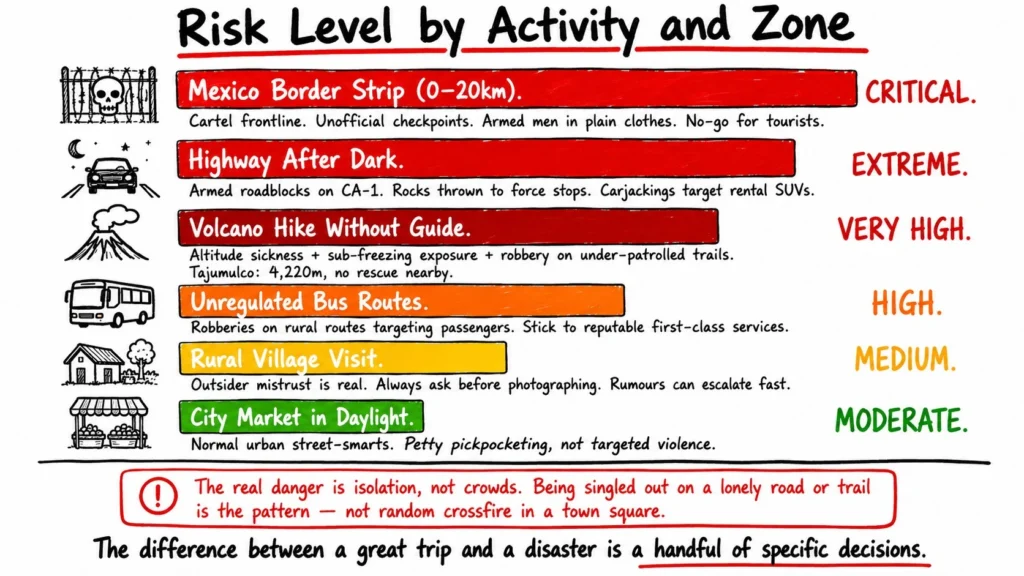
So, is it safe to travel there right now? Honest answer — it depends entirely on what you do and when you do it. Walk around San Marcos or Huehuetenango city in daylight, use a radio-taxi, keep your wits and you’re facing roughly normal urban caution. Drive a mountain road after dark, hike a volcano without a vetted guide or drift toward the Mexican border and the risk jumps from manageable to genuinely life-threatening. This isn’t a destination that’s “off-limits” — it’s one where the difference between a great trip and a disaster is a handful of specific decisions.
Key Takeaways
- The real threat isn’t random crossfire in a town square — it’s being deliberately targeted for your cash, phone and gear on a lonely road or trail, so isolation is the danger, not crowds.
- Never drive between cities after 4:00 PM — armed roadblocks and carjackings on the CA-1 spike after dark and late-model SUVs with tinted windows are exactly what gets targeted.
- The volcanoes (Tajumulco, Tacaná) carry a triple threat — altitude sickness with no nearby rescue, sub-freezing exposure and robbery on under-patrolled approaches — so guide-only, never solo.
- The Mexico border strip is a cartel frontline, not a crossing to wander near; unofficial checkpoints run by armed men in plain clothes are real and compliance is the only safe move.
- Highway blockades (bloqueos) can strand you for days with no food or water — never try to cross one, they turn violent.
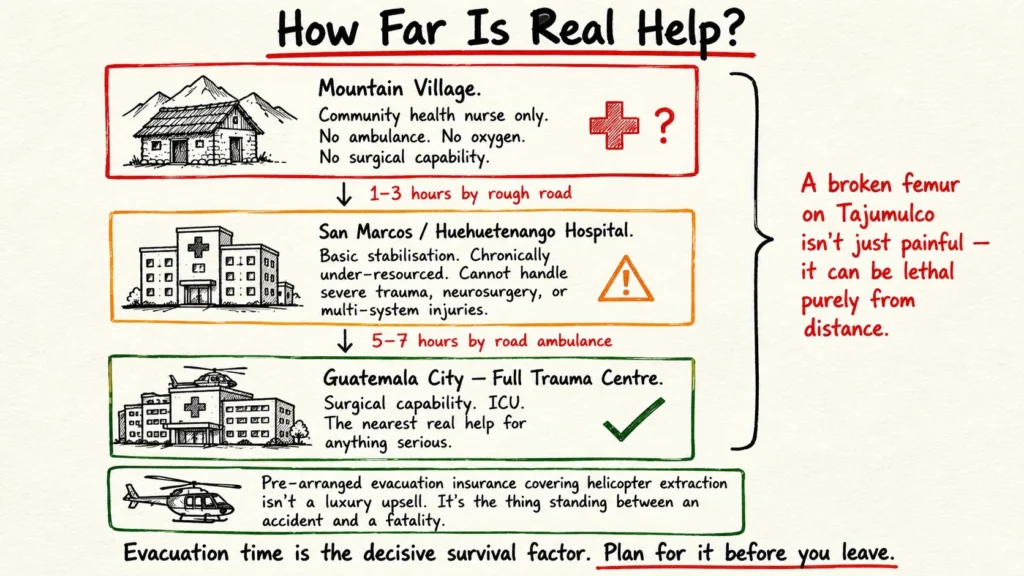
- A serious injury here can be lethal purely from distance — real hospitals mean a 5–7 hour drive to Guatemala City, so evac insurance isn’t optional for adventure travel.
- In remote traditional villages, always ask before photographing people — outsider mistrust is real and rumors can escalate fast.
Risk Reality Check: At a Glance
- Highway travel after dark: 🔴 EXTREME — do not do it, full stop.
- Volcano hike without a vetted guide: 🔴 VERY HIGH — environment and banditry stacked together.
- The border strip (0–20km from Mexico): 🔴 CRITICAL — no-go zone for tourists without a vetted security arrangement.
- City markets & centers in daylight: 🟡 MODERATE — normal urban street-smarts apply.
The Real Danger Isn’t What You Think
Here’s the thing most people get wrong before they arrive — they picture chaos, random gunfire, being unlucky in the wrong place at the wrong second. That’s not it. The actual pattern in San Marcos and Huehuetenango is targeted and that distinction changes everything about how you protect yourself. These two departments sit on a major corridor for cocaine and heroin moving north toward Mexico, which means heavily armed transnational groups and street gangs operate here — but their turf wars mostly stay in the lowland capitals, not the highland tourist towns. What reaches you is the opportunism that grows around all that money: extortion, roadside robbery, the deliberate singling-out of anyone who looks like they’re carrying something worth taking.
So petty pickpocketing isn’t really the headline. The headline is being picked out — a foreign-plated vehicle on an empty stretch, a hiker on a secluded trail, a tourist who looks unguarded. In 2024 and 2025 there were isolated armed robberies on hiking trails near Tajumulco and in the Tacaná area, attackers after cash, phones and equipment and there have been reports of sexual assault on solo female hikers serious enough that police stepped up patrols on the popular San Marcos routes. Before you go, read the current U.S. State Department advisory for Guatemala and the UK FCDO’s Guatemala travel advice side by side — they update on real incidents and reading both gives you a fuller picture than either alone.
Mountain Roads and the 4 PM Rule
If you take one concrete rule from this whole article, make it this — do not drive between cities after 4:00 PM. Everything about these roads gets worse in the dark and the threats stack. The Pan-American Highway, the CA-1, climbs through steep mountain passes with sheer drop-offs, especially west of Huehuetenango toward La Mesilla and thick fog rolls in without warning and drops your visibility to almost nothing. That’s the terrain — before anyone’s even trying to rob you.
Then there’s the human layer and it’s documented, not hypothetical — armed assaults on the CA-1 in the early morning and after dark, criminals throwing rocks or setting up makeshift roadblocks to force vehicles to stop. The stretch between Malacatán and the Mexican border is a known hotspot, as is the road from Huehuetenango up to Todos Santos Cuchumatán. Carjackings are the high-impact version of this and the profile they want is exactly the comfortable rental a lot of travelers pick — late-model SUV, tinted glass, lonely road. Add the rainy season from May to November, when landslides — derrumbes — bury sections of road or cut off villages for days and the calculus is simple: move long distances in daylight, check for recent derrumbes before you set out and once you’re off the CA-1, assume you need a high-clearance 4×4. Local outlets like Prensa Libre carry the incident reports and road-closure news in real time and it’s worth a scan the morning you travel.
The Mexico Border Is Not a Day Trip Zone
Let me be blunt about this one, because the romance of “I’ll just pop over to see the border” gets people into real trouble — the strip where San Marcos and Huehuetenango meet Chiapas isn’t a bureaucratic line you photograph and leave, it’s a working frontline. Mexican cartels and their Guatemalan allies fight over the smuggling routes that run through here and the area around the official La Mesilla crossing — plus the informal ones near Tacaná and El Carmen — sees periodic gunfights that sometimes spill onto Guatemalan soil. This is not background noise you can tune out; it’s the defining feature of the zone.
The specific thing that catches travelers off guard is the unofficial checkpoint — armed men in plain clothes, not police, stopping vehicles and demanding payment for “safe passage.” If you find yourself at one, compliance is the only safe option and the better play is never being in that position at all. The region’s also a choke point for migrants heading north, which draws coyotes and the predatory gangs that prey on them — and while you’re not the primary target, a lawless environment doesn’t check ID before things go wrong. The practical line: stay away from all unofficial crossings, treat the immediate border strip outside official ports of entry as a no-go and if you’re set on hiking Tacaná — which literally straddles the border — do it only with a qualified guide from the Sibinal community, never solo, because the upper slopes are exactly where you risk walking into armed smugglers. Canada’s travel advisory for Guatemala is blunt about the border departments and it’s a useful gut-check before you commit to anything near the line.
When the Mountain or the Ground Turns on You
The environment here can kill you without a single criminal involved and that’s the part adrenaline tends to drown out. Take Volcán Tajumulco — at 4,220 meters it’s the highest point in Central America and that altitude causes acute mountain sickness in plenty of people who go up too fast. There are no medical facilities near the trailhead, so severe AMS — the HAPE/HACE kind — becomes a death sentence without immediate evacuation and there’s no quick evacuation to be had. Stack on summit temperatures that drop to -10°C with wind chill, year-round electrical storms above the treeline and badly-equipped hikers genuinely die of exposure up there. Tacaná carries all of that plus the border violence, plus thermal vents that make stretches of trail dangerously hot and gas-emitting.
And the ground itself is restless — San Marcos was the epicenter of the devastating 2014 quake and again in 2017, sitting right on the Cocos-Caribbean plate boundar and a major quake here triggers landslides on deforested slopes and collapses the adobe buildings common in Huehuetenango’s rural villages. The 2020 hurricanes, Eta and Iota, washed away bridges and buried whole communitie and infrastructure was slow to come back. Check INSIVUMEH, the Guatemalan met service, for volcano and weather bulletins before any mountain day.
Here’s the piece that ties the danger together though — distance. A broken femur on Tajumulco isn’t just painful, it can be lethal, because the nearest real hospital care means a 5-to-7-hour ground ambulance to Guatemala City. San Marcos’s public hospital is chronically under-resourced, Huehuetenango’s is a bit better but still can’t handle severe multi-system trauma or neurosurgery and in the mountain villages “medical help” means a community health nurse, no ambulance. So if you’re doing anything high-altitude or adventurous, a pre-arranged medical evacuation plan with insurance covering helicopter extraction isn’t a luxury upsell, it’s the thing standing between an accident and a fatality.
A Grounded Last Word
Two things I’d genuinely want a friend to carry in, beyond all the specifics — first, the bloqueos. Community and indigenous groups blockade the Pan-American Highway in these departments to protest land rights, electricity prices, whatever’s live that week and a blockade can be total, lasting days, stranding you with no food, water or route to an airport. Don’t try to cross one — ever — they can turn violent fast; build slack into your itinerary instead so a lost day isn’t a crisis. Second, respect the village distrust for what it is — in remote traditional communities, an outsider photographing people can get tangled in rumor in ways that escalate badly, so always ask first and read the room.
None of this is meant to scare you off — San Marcos and Huehuetenango are genuinely extraordinary and plenty of travelers move through them and leave with nothing but good stories. The ones who do share a habit: they treat isolation, darkness and the border as the three things to never take lightly and they spend a little money and planning on the boring stuff — daytime travel, a vetted guide, real insurance. Do that and you’ve removed most of the risk that actually hurts people here. Skip it and you’re gambling with the parts that don’t forgive mistakes.