
Solo travel isn’t having a moment — it’s the moment. In 2026, 72% of travelers plan to take at least one trip alone, driven less by rebellion and more by a genuine hunger for self-directed experience, the kind where you wake up in Lisbon with no itinerary and somehow end up sharing pasteis de nata with a Brazilian photographer at sunset. But here’s the thing I’ve learned after a decade of solo trips: the destination matters far less than the infrastructure around being alone — safety nets, social on-ramp and the quiet confidence that you can navigate a foreign city at midnight without your heart racing
- Key Takeaways
- Japan and Portugal dominate the 2026 safety-and-accessibility indices, making them ideal first solo flights.
- Iceland and New Zealand trade nightlife for pure, almost meditative security — perfect if your idea of company is a glacier, not a hostel bar.
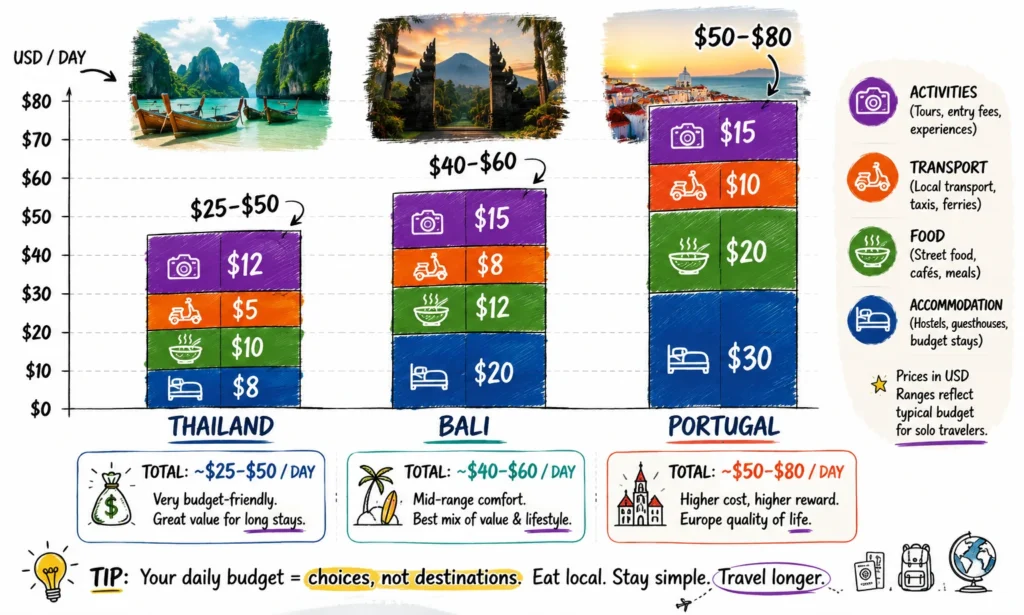
- Thailand remains the budget king at $25–$50 daily, but it’s real superpower is social infrastructure that forces connection.
- The “single supplement” is finally dying — more hostels, cruises and boutique hotels now price for one without the penalty.
Quick List by Traveler Type
- First-Timer Nervous Nellie: Japan — because nothing calms anxiety like a train that arrives to the second.
- Adventure Introvert: Iceland — solo road trips where the only voice is the wind.
- Broke but Bold: Thailand — street pad thai for $2 and instant hostel families.
- Spiritual Reset: Bali (Ubud) — yoga, rice terraces and enough expats that loneliness evaporates.
Why I Stopped Trusting “Top 10” Lists (And Built My Own Criteria)
I’ve been burned by gorgeous Instagram locations that felt hostile to anyone dining alone, so my framework is stricter than most travel blogs will admit, I look at five non-negotiables: the Global Peace Index ranking (anything outside the top 40 gets side-eyed), English proficiency scores from the EF Index, actual solo female traveler safety reports (not government PR), whether the hostel culture includes privacy pods or just party dorms and — this one’s personal — can I eat alone without feeling like a specimen in a jar?
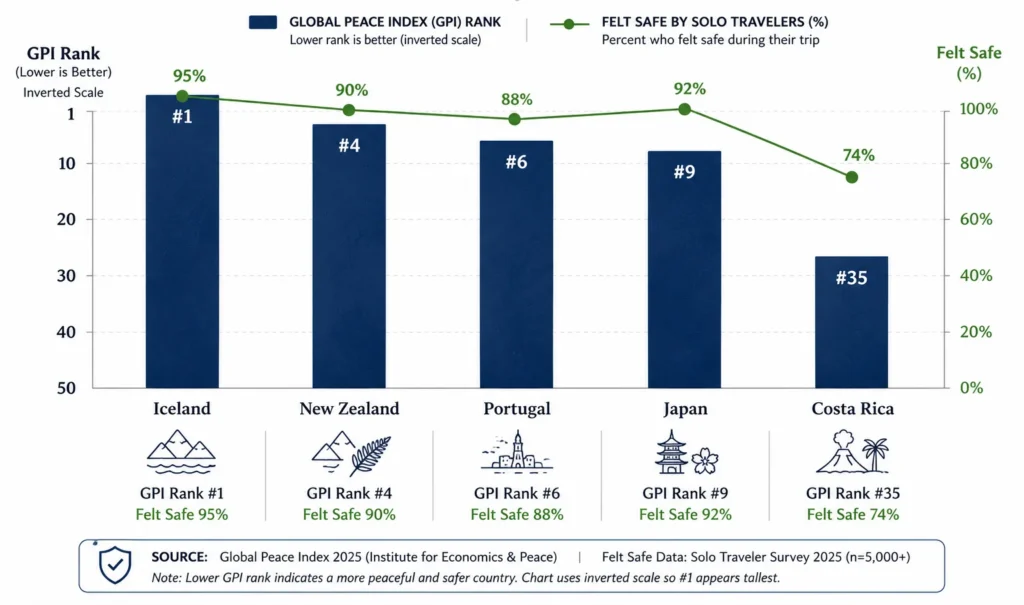
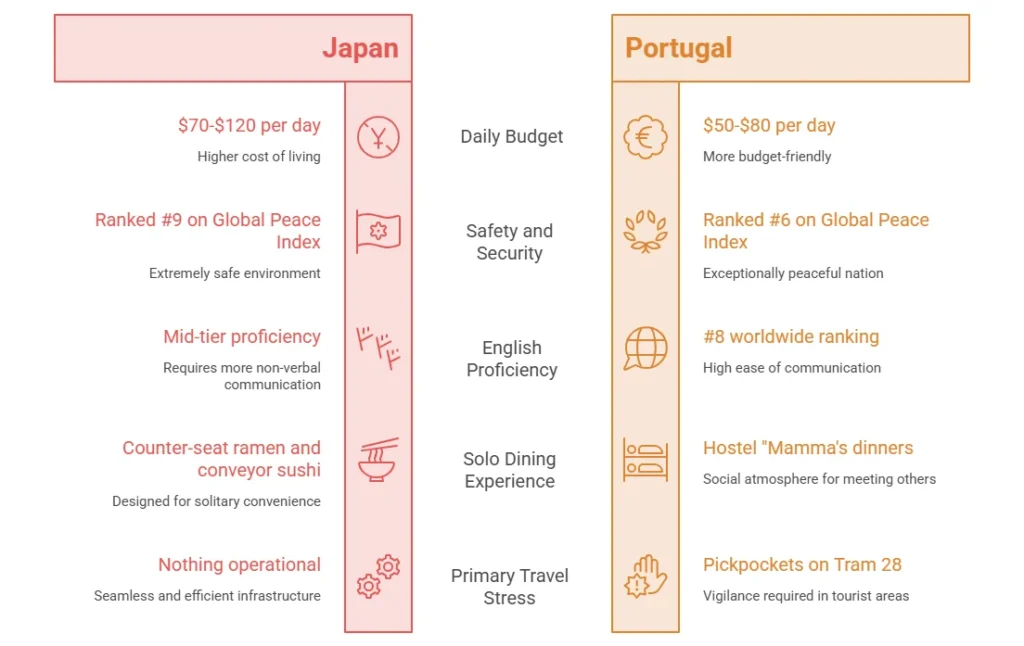
Japan nails this so hard it almost feels unfair. The concept of ichi-meshi — solo dining — isn’t tolerated, it’s designed for. Conveyor-belt sushi, counter-seat ramen shops, capsule hotels where your pod is a sanctuary, not a compromise. The Global Peace Index ranks Japan #9 globally and in my experience, that stat understates the reality — I’ve left my phone on a Tokyo park bench for an hour, returned panicked and found it exactly where I left it, nobody even glanced at it
Portugal is the European equivalent and honestly, it’s where I send friends who want “Europe” without the edge. Lisbon’s Home Hostel runs “Mamma’s dinners” that turn 20 strangers into a temporary family within one meal, the GPI ranks it #6 and the English proficiency is #8 worldwide — you can get lost in Alfama’s cobblestones and still find your way home through conversation. My rule of thumb: if a country’s EF English score is above 600, my stress level drops by half
For the First-Timer: Japan and Portugal
Look, I get it — your first solo trip is terrifying. I cried in a Munich train station bathroom in 2014 because I couldn’t figure out which platform and nobody made eye contact. Japan fixes this through sheer operational perfection: the Suica/Pasmo card works on every train, every convenience store, every vending machine, you never fumble for cash or explain yourself. Google Maps is flawless, WiFi is everywhere and the cultural script is so predictable that you can relax into it. My first morning in Kyoto, I hiked Fushimi Inari at 5:30 AM alone, the torii gates glowing in mist and I felt something I hadn’t expected — not bravery, but ease. That’s the metric that matters
Portugal offers a different flavor of safety — warmer, messier, more human. The pickpocket risk on Tram 28 is real (I clutch my phone like it’s oxygen), but the social recovery is instant. Knock over your wine at a Fado show and three locals will help you laugh it off. The budget is gentler too — $50–$80 daily versus Japan’s $70–$120 — and for a first-timer testing whether they actually like being alone, that lower financial stakes matters. I always tell nervous friends: start with Portugal, fall in love with solo travel, then graduate to Japan when you’re ready for precision
For the Adventurer: Iceland and New Zealand
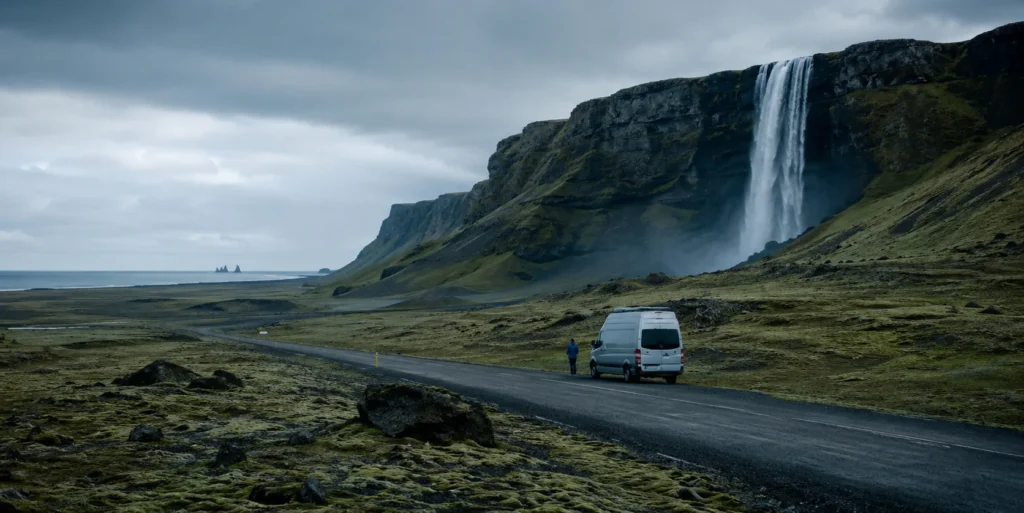
Some of us don’t travel to meet people — we travel to meet ourselves in extremis. Iceland is my cathedral for this. Topping the Global Peace Index for over a decade, it’s the only place I’ve wild-camped without checking over my shoulder once. The Ring Road is built for solo contemplation: waterfalls that make you feel appropriately small, hot springs where you soak in silence and a culture that deeply respects personal space. I drove it in a beat-up campervan last September, cooked pasta from Bónus supermarkets and spent $100–$200 daily — painful, yes, but the introspection was free
New Zealand is Iceland’s extroverted cousin. The “hop-on, hop-off” bus networks — Kiwi Experience, Stray — have been moving solo backpackers around since before I was born, turning the South Island into a rolling social experiment. I bungee-jumped at Kawarau Bridge — the original site — surrounded by strangers who became instant friends through shared terror. The GPI ranks it #4, but the real safety net is infrastructure: Great Walks huts where you share stories by gaslight, adventure lodges where everyone congregates because there’s literally nowhere else to go. My only warning: book those huts months ahead and never underestimate sandflies on the West Coast — they’re the one thing in New Zealand that will genuinely try to kill you.
For the Budget Warrior and the Soul-Searcher: Thailand and Bali
Thailand is where I learned that “cheap” and “rich” aren’t opposites — they’re the same trip viewed from different angles. At $25–$50 daily, I stayed in hostel dorms for $8, ate street pad thai that changed my understanding of what food could be for $2 and got an hour-long massage that fixed a year of laptop posture for $10. But the real budget hack isn’t the money — it’s the social infrastructure. Mad Monkey hostels run daily events that feel organic, not forced; cooking classes in Chiang Mai pair you with strangers over mortar and pestle; even the ethical elephant sanctuaries (do your research — real sanctuaries don’t offer rides) become accidental meeting grounds. The Global Peace Index puts Thailand in the moderate range, which sounds worse than it feels — tourist zones are tightly policed and Thai hospitality is genuinely protective. My only real scare? A tuk-tuk driver in Bangkok tried to take me to a gem shop instead of the Grand Palace. I laughed, got out, walked. That’s the learning curve
Burning season in the north (February–April) is non-negotiable — the air quality turns Chiang Mai into a lung hazard and no amount of cheap mango sticky rice is worth coughing through a temple visit. I learned this the hard way in 2019, spent three days in my hostel room with a wet towel under the door and now I plan around it like a religious observance
Bali, specifically Ubud, is Thailand’s spiritual cousin with better WiFi. I went there burned out from a consulting contract, stayed in a $20/night guesthouse with a pool I shared with a Danish yoga instructor and a Canadian novelist and spent mornings writing in raw-food cafés that charged $4 for smoothie bowls the size of my face. The expat community is so dense that loneliness evaporates without effort — but the traffic is chaos, scooter accidents are common and “Pura Vida” can feel like a marketing slogan if you stay too long in the tourist corridor. My rule: one week in Ubud, then escape to the north coast or Lombok before the Instagram energy curdles
The Honest Truth About Solo Travel in 2026
Here’s what the 72% statistic doesn’t tell you: solo travel is easier than ever, but the reason it’s easier matters. It’s not just about better hostels or cheaper flights — it’s that the world has finally stopped treating alone travelers like anomalies. Booking.com’s 2026 data shows “wellness and journey-to-self” motivations now dominate, which is corporate speak for “we’re exhausted and want to be alone without being lonely.” The technology helps — eSIMs, translation apps, Hostelworld’s Hangouts feature — but the real shift is cultural. Single supplements are vanishing. Solo cabins on cruises exist. Even luxury hotels, those last bastions of couple-dom, now price for one without the pity surcharge
I’ve watched this evolution personally. In 2016, I paid a 40% single supplement in Santorini and ate breakfast facing a wall so I wouldn’t occupy a “romantic” table. In 2024, I stayed at a boutique hotel in Porto that gave me the corner room with the best view because I was alone and they wanted to fill it. The difference isn’t subtle — it’s structural and it’s why I believe this solo travel boom isn’t a trend. It’s a permanent renegotiation of how we move through the world
My final piece of advice? Start with the place that scares you least, not the one that excites you most. Japan if you need predictability, Portugal if you need warmth, Iceland if you need silence. The adventure isn’t in the destination — it’s in discovering that you’re enough company for yourself. I didn’t believe that until I sat alone in a Reykjavik hot pool at midnight in January, snow falling on my face and realized I hadn’t spoken to another human in fourteen hours and felt completely, irrationally, at peace.