
Thailand rewards travelers who slow down and pick their season carefully — the country runs on a split monsoon, so the “wrong” month on one coast is the perfect month on the other. Skip the assumption that it’s all beaches and full-moon parties; the North, the old capitals and the food are where the real country lives.
I usually grimace a little when I hear someone say they are “doing Thailand” in five days, beach only, as I’ve heard this comment so many times. Not because the beaches aren’t beautiful – they are. But Thailand is one of those locations that praises a patient itinerary and silently punishes a hasty one. It’s the most visited country in Southeast Asia, for a reason, and the most misunderstood by the people passing through it. So here is what I actually tell friends before they book anything.
When You Go Matters More Than Where
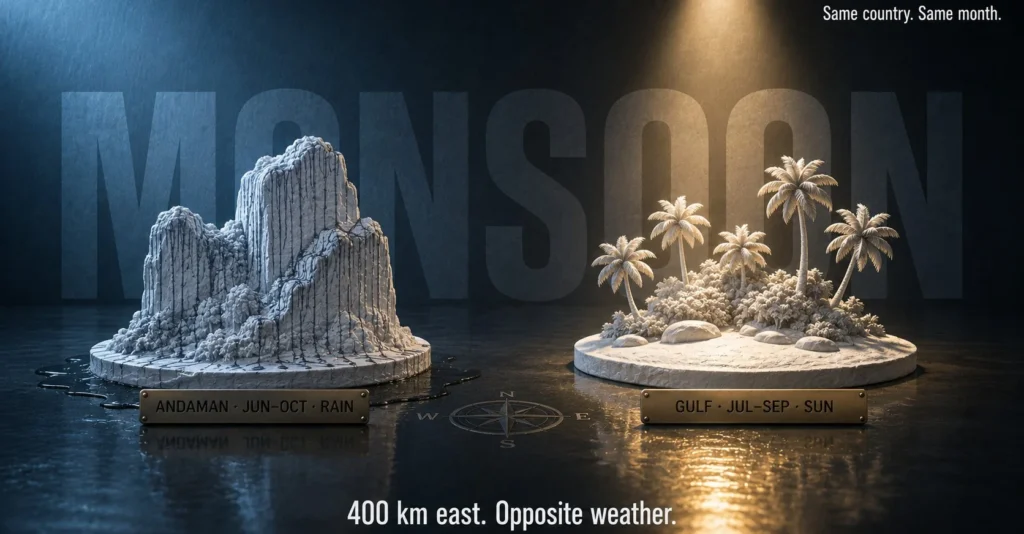
That is the error that most people make. They pick a place first, then dates, and then wonder why their September trip to Phuket was a flop of strong seas and closed island tours.
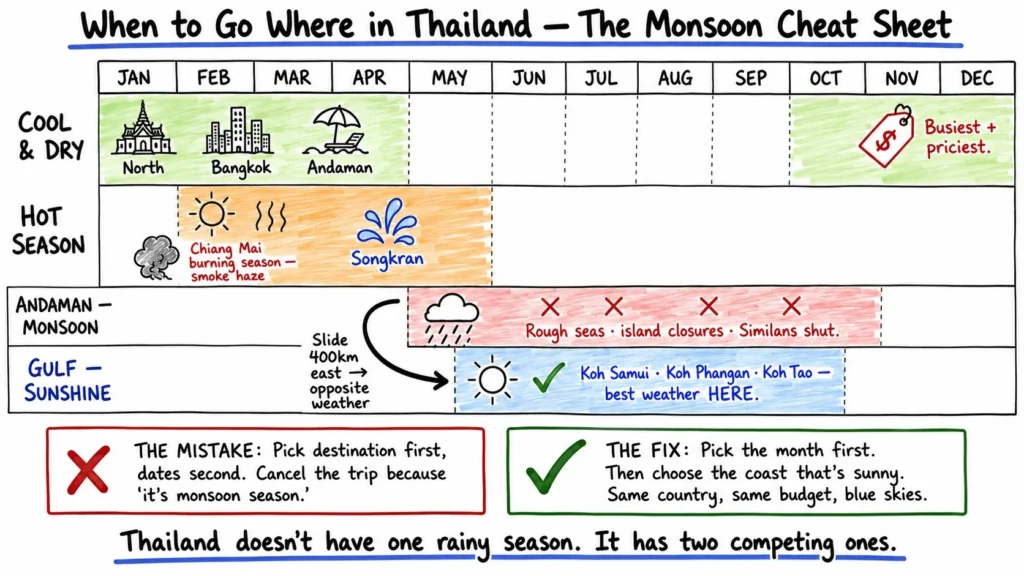
This is the thing the brochures don’t tell you. There isn’t one rainy season in Thailand. There are two conflicting rainy seasons. On the Andaman side, Phuket, Krabi, the Phi Phi Islands get hit by the southwest monsoon from about June to October, with island closures like the Similans. But the Gulf islands? Koh Samui, Koh Phangan and Koh Tao are in a distinct microclimate and have their best and sunniest stretch from July through September. Same country, same month, opposite weather. I have seen people completely cancel a trip because “it is monsoon season”, when they could have just moved 400 km east and had blue skies all the time.
For the remainder of the country the nice, dry, cool window is November to February – and sure, it’s also the priciest and busiest, especially around New Year. The hot season (March to May) is hellish inland but bearable on the shore, and it is when Songkran, the Thai New Year water fight, takes over in April. If chaos isn’t your thing, then plan for it. If it is, plan on it.
Start in the North, Not the Beaches
If I could rearrange one thing about how most people plan Thailand, it’d be this: arrive, get over the jet lag in Bangkok for a day or two, then go straight up to Chiang Mai before you even think about sand.
The North is a different country, almost. It was the seat of the old Lanna kingdom, founded back in 1296, and the food alone justifies the flight — this is Khao Soi country, that coconut-curry egg noodle bowl with the tangle of crispy noodles on top, which traces its roots to Chinese-Muslim traders coming over the Burmese border. You will not find it done properly down south. The Old City still holds more than thirty temples inside its broken moat walls, and Wat Phra That Doi Suthep watches over all of it from the mountain.
One thing I feel strongly about, though, and I’ll say it plainly: do your homework on elephants. The North is the hub, and the industry has shifted hard from riding camps toward observation-based sanctuaries — but “sanctuary” is an unregulated word here, and plenty of places use it while still offering rides and tricks. The honest rule of thumb is simple. The more an elephant is doing for your entertainment, the worse the place usually is.
And if you want the version of the North that almost no one writes about, look at Nan — quiet temple-town life, the famous whispering-couple murals at Wat Phumin, and barely a tour bus in sight.
The Old Capitals Are Worth a Detour (Skip Bangkok’s Crowds for a Day)
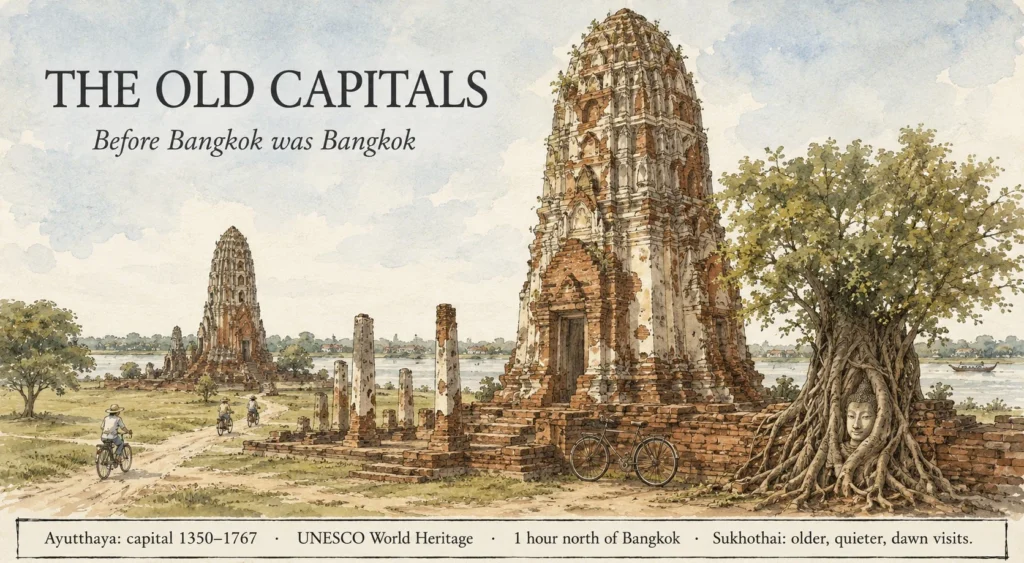
Before Bangkok was Bangkok, there was Ayutthaya, and before that, Sukhothai. Most people blow past both, which I think is a genuine miss.
Ayutthaya sits about an hour north of Bangkok — an easy day trip — and it was the Siamese capital from 1350 until the Burmese sacked it in 1767. What’s left is a scatter of ruins on an island where three rivers meet: collapsed prang towers, a Buddha head swallowed by tree roots at Wat Mahathat, the long colonnades of Wat Chaiwatthanaram. Rent a bike and ride between them. It’s a UNESCO World Heritage site, and it earns it.
If you’ve got more time, Sukhothai — the first kingdom’s capital, a couple centuries older — is the quieter, dreamier one. Fewer crowds, lotus-bud chedis, huge serene Buddhas in landscaped parks. Go at dawn. And for something heavier, Kanchanaburi holds the WWII Death Railway and the Bridge on the River Kwai, built by forced labor; the Hellfire Pass walking trail is sobering in a way that stays with you.
Bangkok: Don’t Just Pass Through It
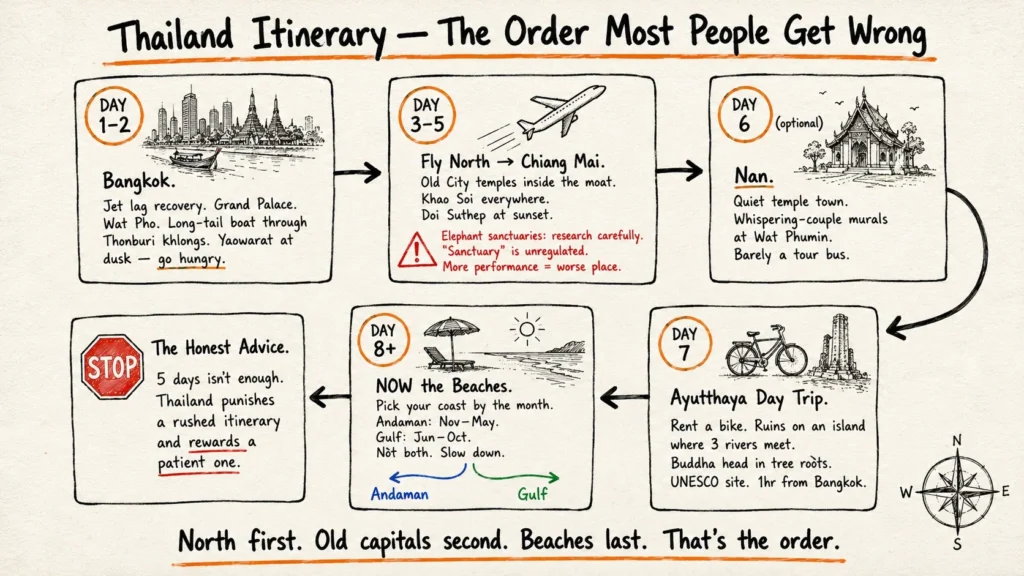
Here’s my mild rant. People treat Bangkok as a layover — land, see the Grand Palace, flee to an island. And sure, the Grand Palace and Wat Pho’s 46-meter Reclining Buddha are non-negotiable. But the city’s real texture is in the khlongs, the old Thonburi canals, where a long-tail boat takes you past stilt houses and monitor lizards sliding through the water.
And Yaowarat — the Chinatown — at dusk? One of the great street-food crawls on earth. Go hungry.