
December through April is the classic sweet spot for the Pacific coast — dry, sunny, reliable. But “best” really depends on what you’re after. Chasing humpback whales? August–September. Green turtles at Tortuguero? July–October. Cheap hotels and empty trails? September. The Caribbean coast runs on an entirely opposite weather calendar from the Pacific, which changes everything. Keep reading if you want the real breakdown — the one that actually helps you choose.
Costa Rica Doesn’t Have Four Seasons. It Has Two — And One of Them Is Misunderstood.
Most people land in San José having heard “go in the dry season” without understanding what that actually means on the ground. So here’s the real framework.
Costa Rica sits in the tropics, so the temperature across the year barely moves — what changes is the rain. The country runs on two seasons: verano (dry season, roughly December to April) and invierno (rainy or green season, May through November). Simple enough.
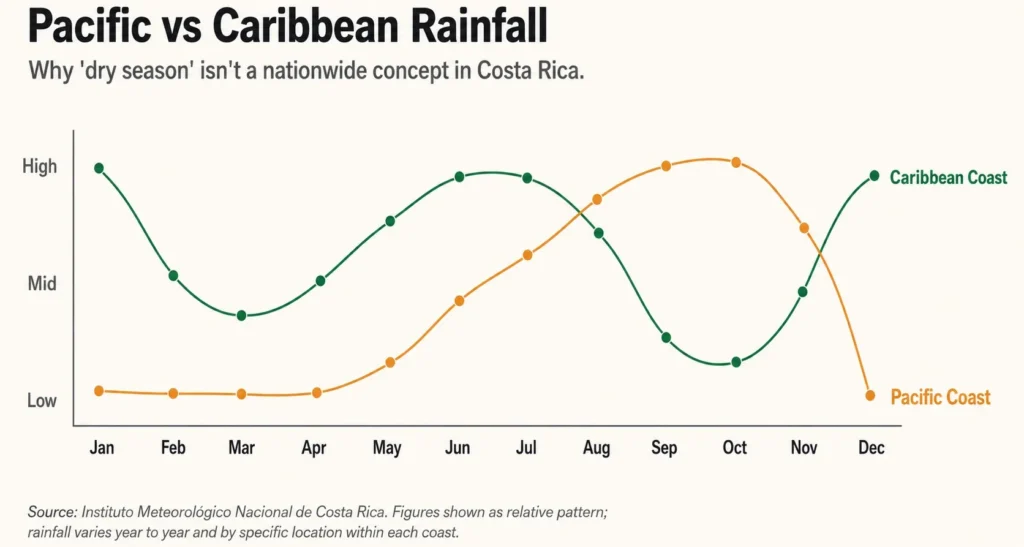
Except — and this is the part people miss — the Pacific coast and the Caribbean coast follow almost opposite patterns. When the Pacific is at its driest and most crowded, the Caribbean is often dealing with rain. When the Pacific is soaked in September, the Caribbean side can be sunny and gorgeous. So “best time” has no universal answer until you know which part of Costa Rica you’re actually going to.
I’ve made the mistake of planning a Caribbean-heavy trip in January assuming dry season = dry everywhere. It doesn’t.
The Pacific Slope
(Guanacaste, Manuel Antonio, the Osa Peninsula) is the classic version of the dry/wet pattern. December through April: sunshine, heat, low humidity, beach weather. May through November: afternoon downpours, lush green everything, rivers full. There’s one pleasant exception — a mid-year spell locally called veranillo, usually in July, where the rains ease up for a week or two and the Pacific gets some of its best weather of the green season.
The Caribbean Coast
(Tortuguero, Puerto Viejo, Cahuita) gets rain year-round. It’s not always heavy, but there’s no real dry season to speak of. Its two quieter weather windows — February–March and September–October — are when you want to plan a visit there. November through January is often the wettest stretch.
The Central Valley
(San José, Heredia) sits at elevation and stays comfortable almost any time — around 22°C / 72°F year-round. Rain picks up from May onward but rarely disrupts a day completely.
[Here, a simple side-by-side chart comparing average monthly rainfall (mm) on the Pacific coast vs the Caribbean coast would be valuable — showing 12 months on the x-axis with two lines: one for Guanacaste/Liberia and one for Puerto Limón. The visual inversion of the two curves is the clearest way to show travellers that “dry season” is not a nationwide concept.]
Month by Month: What’s Actually Happening Out There
Rather than give you a vague “good / bad / okay” list, let me walk through the year by the kind of trip you’re actually planning.
If you want sun, beaches, and zero logistical stress — January to March
This is when Costa Rica fills up. Peak season, peak prices, book your accommodation months ahead. Pacific beaches are stunning — dry, hot, clear water. Papagayo winds hit Guanacaste hard in January and February, which is either a feature or a nuisance depending on whether you’re kitesurfing or trying to snorkel. Northern humpback whales are showing up off the Pacific. Diving visibility is excellent. If you want postcard Costa Rica, this is it — just expect to share it with everyone.
March deserves a specific mention: it’s often the hottest month, not December. Dusty, dry, temperatures climbing toward 38°C in the lowlands. Beautiful for beaches but genuinely exhausting for jungle hiking if you’re not an early riser. Olive ridley turtle arribadas can happen at Ostional during this period — a mass nesting event where thousands of turtles come ashore at once. If you’ve never seen it, it’s worth building a trip around.
If you want value, fewer crowds and lush landscapes — May to June
Green season begins. Mornings are often clear and beautiful. Afternoons bring rain. Prices drop significantly — sometimes 30–40% off high-season rates at midrange lodges. Wildlife doesn’t care about the rain; it’s actually more active. Leatherback turtles start nesting on the Caribbean coast. The landscape looks like someone turned the saturation up.
April is worth a note here too — a transition month, dry season ending, rainy season revving up. Easter week (Semana Santa) is Costa Rica’s biggest domestic holiday. Highways jam, beaches pack with local families, prices spike. The week after Easter, though? Crowds vanish almost overnight, prices drop, and the first rains start greening everything up. That post-Easter window is genuinely one of the most underrated entries into green season.
If you’re going for wildlife — July to October is where it happens
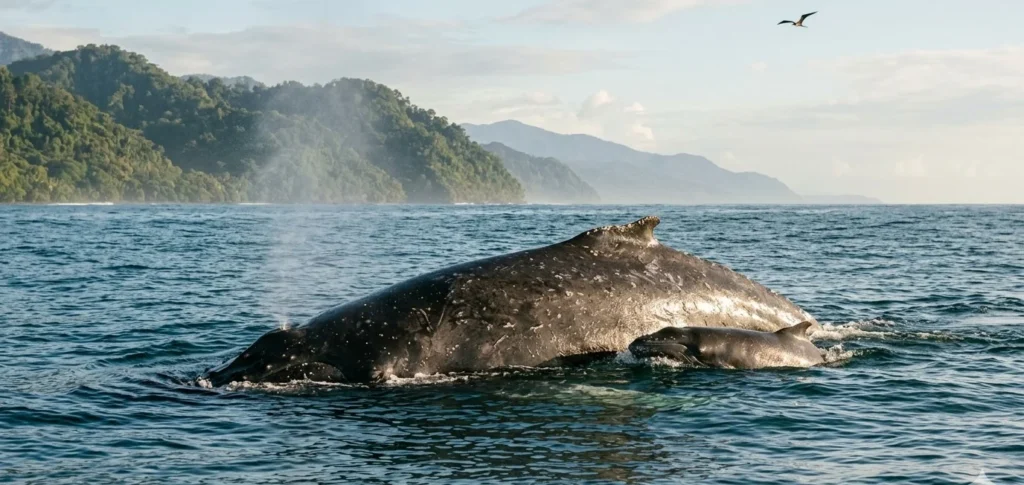
July is interesting on its own. The veranillo usually brings a genuine dry stretch to the Pacific — sometimes ten days, sometimes three weeks of almost-dry-season weather. Costa Rican school holidays fall in the first two weeks, so domestic tourism surges. But for wildlife? July is when things get serious. Southern Hemisphere humpbacks start arriving. Green turtle nesting at Tortuguero builds toward its peak.
August and September are prime whale watching on the central and south Pacific. Southern Hemisphere humpbacks arrive with calves. Uvita, Drake Bay, around the Osa — whale sightings are frequent and close. If you’re going for whales, August–September beats January–March easily for sheer density of encounters.
September is also the cheapest month of the year — discounts of 30–50% off high-season rates. Yes, the Pacific side is wet. Roads in remote areas can wash out. But the Caribbean coast goes through one of its sunniest stretches, Resplendent quetzals get active in the cloud forests, and the parks are nearly empty.
October keeps the wildlife momentum going — Pacific still wet, Caribbean still dry, prices still low. Limón Carnival happens on the Caribbean coast, usually mid-October: music, dancing, parades through the streets of Puerto Limón. Worth the trip on its own.
If you’re timing around shoulder season — November and December (first half)
November is transitional. Early in the month it can still be quite wet on the Pacific. By late November the dry pattern starts asserting itself. US Thanksgiving brings a noticeable wave of North American visitors and hotel prices tick up. But outside that week, November offers something rare — decent weather, reasonable prices, and almost no competition for accommodation.
December splits cleanly in two. First half: low season lingers, prices reasonable, Pacific beaches getting drier and nicer by the day. Mid-December onward: prices spike hard for Christmas and New Year — highest rates of the entire year. Book those dates early or adjust expectations.
The Activity Breakdown Nobody Puts in One Place
Generic travel advice says “go in the dry season.” That’s fine if you want a beach holiday. It’s actively wrong for several other reasons to visit Costa Rica. Here’s what I’d actually tell a friend planning a specific kind of trip.
For Surfing
It depends entirely on which coast and what kind of waves you want. Guanacaste and the northwest Pacific (Tamarindo, Nosara) have clean, offshore-wind conditions from December through March. South swells are weak, but the water surface is glassy in the mornings. The central and south Pacific (Jacó, Pavones) flip this: the best swells arrive during green season, May through November, when south swells push up from the Southern Ocean. Mornings are still workable before the onshore wind picks up. Caribbean side — Puerto Viejo’s Salsa Brava breaks best December through March, with another decent window in June–July.
For Diving and Snorkeling
Pacific visibility peaks during dry season, December through April, when there’s less runoff and the water clears up. Bat Islands in Guanacaste is one of the few places in the world where you can reliably dive with bull sharks — best conditions December to May. Isla del Caño near the Osa Peninsula is exceptional for pelagics; whale sharks pass through. Caribbean diving is best September–October when seas calm down and visibility opens up.
For Hiking and National Parks
Dry season is easier, full stop. Trails dry out, river crossings are manageable, logistics are simpler. But green season hiking has its own logic. Waterfalls are thundering. The forest is so green it looks unreal. Parks like Corcovado are nearly empty. The trade-off is mud — real, deep, boot-sucking mud on some trails — and the possibility of a trail closure after heavy rain. If you go in green season, hike early. By 7am the forest is usually clear and cool. By 2pm you’re in a downpour.
For Wildlife, the Calendar Gets Specific
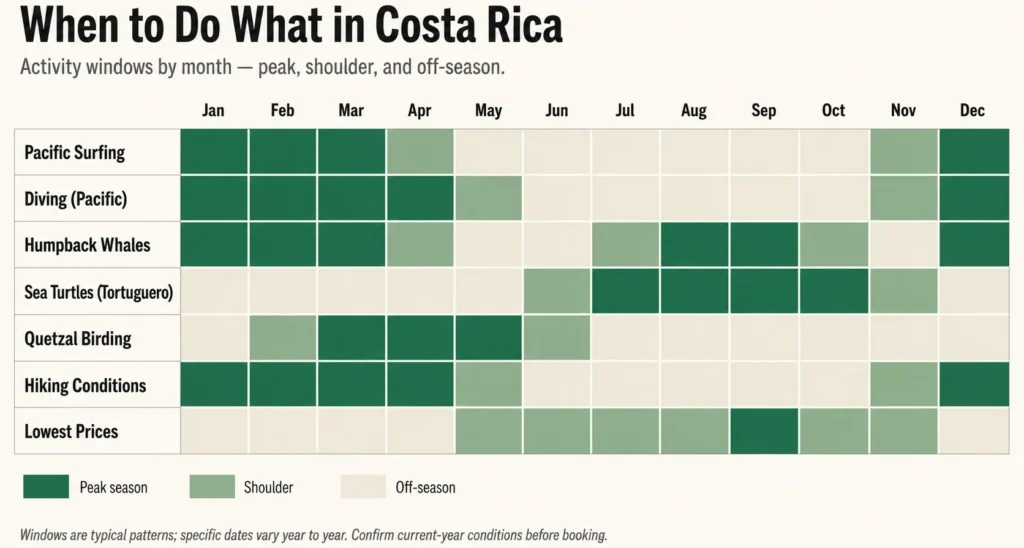
Humpback whales are actually present for a remarkable stretch of the year because Costa Rica gets two different populations. Northern Hemisphere whales come down December through March, mostly around Guanacaste and the Nicoya Peninsula. Southern Hemisphere whales arrive July through October, concentrating around Uvita, Drake Bay, and the Osa. The overlap window in late July means you can technically encounter both populations at once — something almost no other place on earth offers.
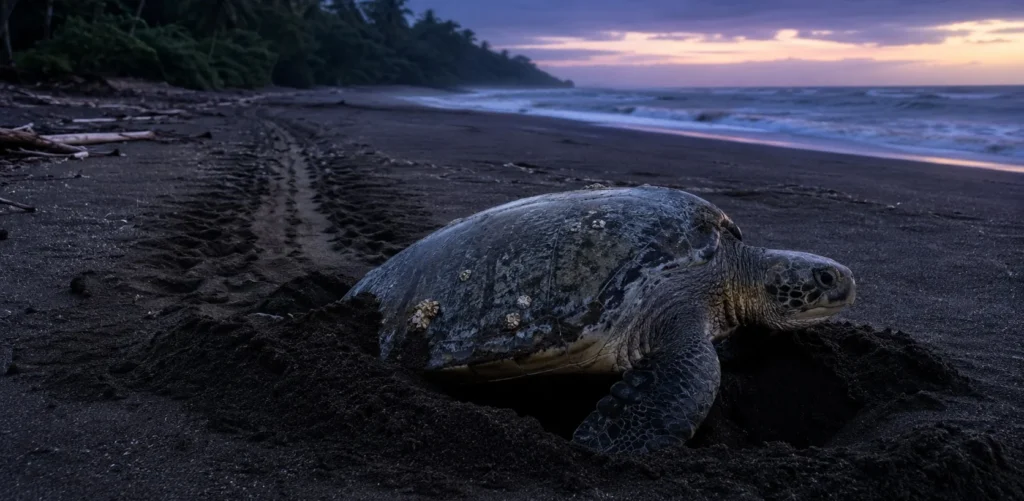
Sea turtles have four different species nesting on different coasts at different times. Olive ridley arribadas at Ostional happen year-round but the biggest events run July through December, peaking September–October. Leatherbacks nest on the Pacific from October through March and on the Caribbean from February through July. Green turtles at Tortuguero peak August–September. Hawksbills on the Caribbean, February through October. If turtles are the whole reason you’re going, narrow down which species and then choose your dates.
Quetzals are cloud forest birds and notoriously hard to find outside breeding season. March through May is when they’re most visible — males displaying their extraordinary tail feathers, pairs flying between nesting trees. Monteverde and the Los Quetzales National Park near San Gerardo de Dota are the two go-to spots. Come in June and you’ll still see them but it gets harder fast.
A Few Things I’d Tell You That Most Articles Skip
- Combining both coasts is underrated — if you time it right. A trip in late March or mid-October can get you decent weather on both sides. The inverse rainfall pattern means that when one coast is at its worst, the other is often at its best. Most first-time visitors stick to the Pacific. That’s fine, but Tortuguero and Puerto Viejo are worth building a trip around.
- September is not a mistake. The reputation is all about Pacific rain, and yes — it rains. But the prices are real (30–50% off isn’t marketing language, it’s what the hotels actually charge), the crowds disappear, and if your itinerary leans Caribbean or wildlife-focused, September might genuinely be the best month you could pick.
- Climate variability is real. Costa Rica’s rainfall patterns have shifted noticeably over the past decade according to the country’s national meteorological institute. The dry season still shows up broadly on schedule but the edges are fuzzier — expect occasional early rains in April, occasional dry spells pushing into May. The broad seasonal logic still holds; the precise timing is less reliable than it used to be. Build flexibility into your itinerary.
- Semana Santa is a different country. If Easter falls in your travel window, decide deliberately whether to be there during it or avoid it. It’s an incredible cultural spectacle — processions, packed beaches, the whole country moving at once. It’s also the most logistically demanding week of the year. Book everything months ahead or shift your dates by a week in either direction.
The right month for you exists. It just depends on which Costa Rica you’re going to visit.