
Reynosa, the Tamaulipas border city across from McAllen, Texas, sits under the U.S. State Department’s Level 4 “Do Not Travel” advisory — the same category as active war zones. The UK, Canada, Australia and New Zealand all warn against travel there too. The reasons: cartel gun battles in public, systemic kidnapping and roads so dangerous that American diplomats aren’t allowed to drive them. This isn’t a “be careful” situation. It’s a “don’t go” situation.
I’ve spent years reading government travel advisories and most of them are background noise. Pickpockets in Barcelona. Scams in Bangkok. Exercise increased caution, watch your bag, the usual.
Reynosa is not that.
When I sat down with the actual advisory language for this piece, what struck me wasn’t the warning itself — it was what the U.S. government tells it’s own employees they’re allowed to do there. Because that’s the part most travelers never read and it’s the part that tells you everything.
What Level 4 Actually Means?

The U.S. State Department’s Mexico Travel Advisory puts the entire state of Tamaulipas at Level 4: Do Not Travel. Four is the ceiling. There is no Level 5. Syria gets a Level 4. So does Tamaulipas and it has held that designation continuously since 2018.
The stated reasons are crime and kidnapping — but the advisory gets specific in a way that’s rare. Gun battles between rival criminal groups or between cartels and Mexican authorities, happen in public places in broad daylight. Criminals target people walking or driving, including on highways. U.S. citizens and lawful permanent residents have been among the kidnapped.
Then there’s the paragraph that stops people cold. The State Department advises anyone who travels to Tamaulipas anyway to draft a will first. Designate a beneficiary. Leave DNA samples with a medical provider. Share your GPS location with someone you trust. And if confronted by criminals — don’t resist.
A government agency telling you to prepare DNA samples before a trip is not boilerplate. I’ve never seen that language attached to a normal destination.
The diplomat test
Here’s my honest shortcut for reading any advisory: ignore what they tell tourists and look at what they tell their own staff.
In Reynosa, U.S. government employees can only move during daylight hours, only for official business with prior authorization and only in armored vehicles with dedicated security. They can’t hail street taxis. They can’t travel between cities after dark. They’re banned outright from Highway 2 between Reynosa and Nuevo Laredo and from Highway 40D — the main toll road to Monterrey.
Think about what that means. These are trained personnel with diplomatic protection, security briefings and institutional backup. And their employer still won’t let them drive certain roads. What’s the realistic picture for a civilian in a rental car with out-of-state plates?
It’s Not Just Washington Saying This
One government’s advisory can reflect politics or caution. Five governments saying roughly the same thing is a pattern.
The UK’s FCDO travel advice for Mexico advises against all but essential travel to Tamaulipas and flags something specific: express kidnapping, where victims are forced to withdraw cash from ATMs. British nationals have been among the victims.
Canada’s advisory is the most geographically precise of the bunch and I find it the most telling. Ottawa says avoid non-essential travel to Tamaulipas generally — but for the zone within 20 km of the U.S. border, which covers all of urban Reynosa, the language hardens to avoid all travel. Interestingly, Canada carves out a softer rating for Nuevo Laredo. Reynosa gets no such exception.
Australia’s Smartraveller lists Tamaulipas as “Do not travel” and names Reynosa specifically. New Zealand says the same. Germany and France mirror the lot.
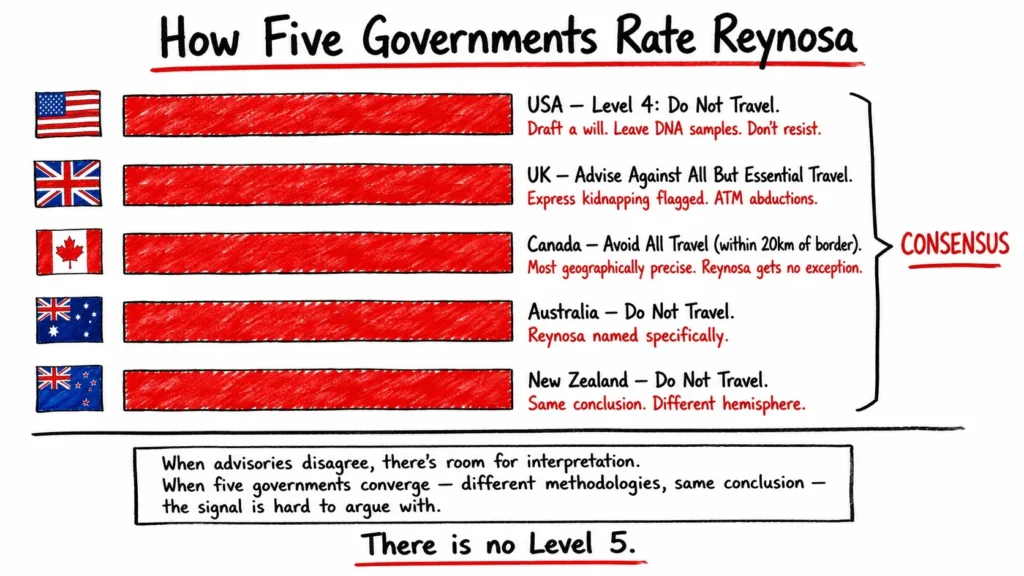
When advisories disagree, there’s room for interpretation. When they converge like this — different governments, different methodologies, same conclusion — the signal is hard to argue with.
What the Danger Looks Like on the Ground
The advisories read abstract until you get into the incidents behind them.
March 2023: four Americans crossed into Matamoros — next city over, same cartel ecosystem — in broad daylight. They were fired on and abducted within hours. Two died. That case made global headlines and it reshaped how the State Department talks about Tamaulipas, partly because the victims weren’t doing anything exotic. One was there for a medical procedure.
March 27, 2024: the U.S. Consulate in Matamoros issued an emergency alert telling citizens in Reynosa to shelter in place. Active gun battles, multiple sectors of the city, lasting hours. In August 2024, a firefight outside a Reynosa shopping mall killed several people, including a security guard.
The highway problem
The roads might actually be the most dangerous part. Criminal groups on Highway 40D — the Reynosa–Monterrey toll road — use ponchallantas, tire spikes scattered across lanes to disable vehicles. Your tires blow, you pull over and the ambush is waiting. Mexico’s National Guard issued repeated alerts about this through 2024, with outlets like Border Report covering the pattern, particularly the targeting of cars with out-of-state plates.
And the fake checkpoints. Criminals run vehicles dressed up as police or military units — uniforms, lights, the works. So the standard advice of “comply at official checkpoints” gets complicated when you can’t tell which checkpoints are official.
Who actually gets hurt
Here’s the part I think matters most: the victims in Reynosa are rarely adventure tourists. Mostly they’re dual nationals visiting family, people crossing for cheaper dental work or medication ordinary travelers who’ve made the trip a dozen times before. Familiarity reads as safety. It isn’t. Cartels monitor the Pharr-Reynosa bridge area specifically to identify targets and shootouts have erupted within sight of the port of entry.
If You’re Still Weighing It

I won’t pretend nobody has reasons to cross. Family is family. But know three things going in.
Your travel insurance is almost certainly void — most policies exclude destinations under a “Do Not Travel” advisory, so a medical evacuation comes out of pocket. Consular help is thin, because U.S. staff can’t move freely in Reynosa themselves. And the McAllen side of the bridge tells you nothing about the Reynosa side; the risk profile flips the moment you cross.
There’s no clever workaround here, no local-knowledge hack. Five governments did the math and landed on the same answer. For once, the boring official advice is also the right call: don’t go.