
Sedona is a small Arizona town at 4,350 feet where the Colorado Plateau collapses into red sandstone spires and almost everything worth doing there is outdoors, regulated and busier than you expect. This guide covers when to actually go, how the trailhead system really works (including the free shuttle that’s mandatory for some trails), what the vortex thing is without the fluff and the mistakes I made so you don’t have to. Short version: go in late fall, park your ego with your car and buy the $5 pass.
The Place Itself, Minus the Brochure
The red comes from rust. Oxidized hematite in the Schnebly Hill Formation — iron, basically, staining the sandstone and once you know that, the whole landscape reads differently. You’re not looking at scenery. You’re looking at a slow chemical event, 116 miles north of Phoenix, where high desert meets the Colorado Plateau.
My first trip, I treated Sedona as a photo stop between Phoenix and the Grand Canyon. Wrong. The town sits at elevation, the light changes hourly and the temperature dropped nearly thirty degrees the night I arrived in what I’d assumed was eternal desert summer. I’d packed one jacket. Sort of.
When to Go (And When I Got It Wrong)
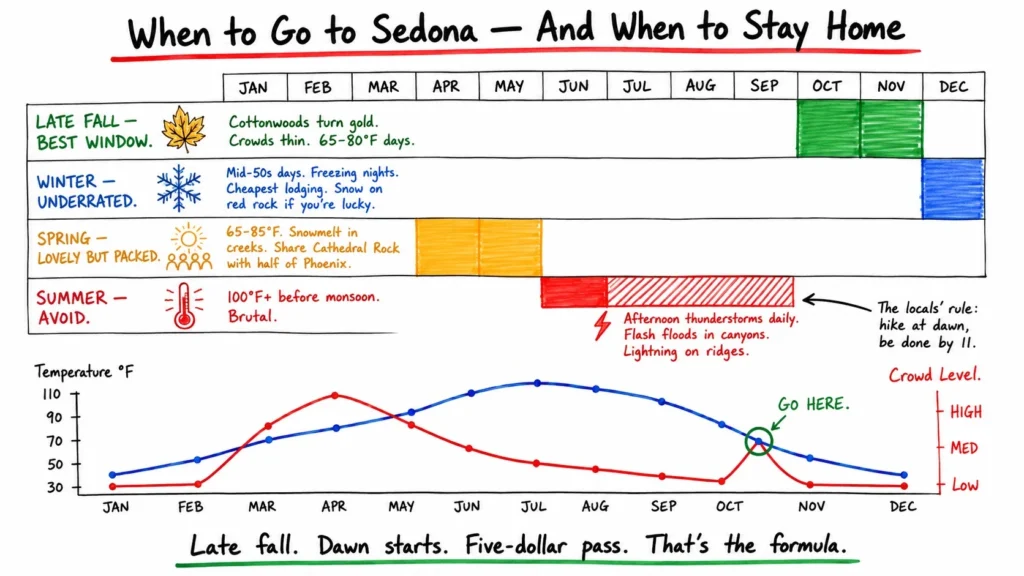
Everyone says spring. Spring is genuinely lovely — 65 to 85 degrees, snowmelt in the creeks — and that’s exactly why you’ll share Cathedral Rock with half of Phoenix.
I’ll argue for two windows instead. Late fall, when the cottonwoods along Oak Creek turn gold against the red rock and the crowds thin after October. Or winter, honestly. Mid-50s by day, freezing nights, lodging at it’s cheapest and if you’re lucky, snow dusting the formations for a few hours before it melts. Photographers wait years for that.
June? Avoid it. Over 100°F before the monsoon breaks. And from early July through mid-September, afternoon thunderstorms arrive almost on schedule — flash floods in the narrow canyons, lightning on exposed ridges. The locals’ rule I learned the slow way: hike at dawn, be done by 11.
The Trailhead Game Nobody Explains
Here’s what no brochure tells you: parking is the crux of Sedona. Not the hiking.
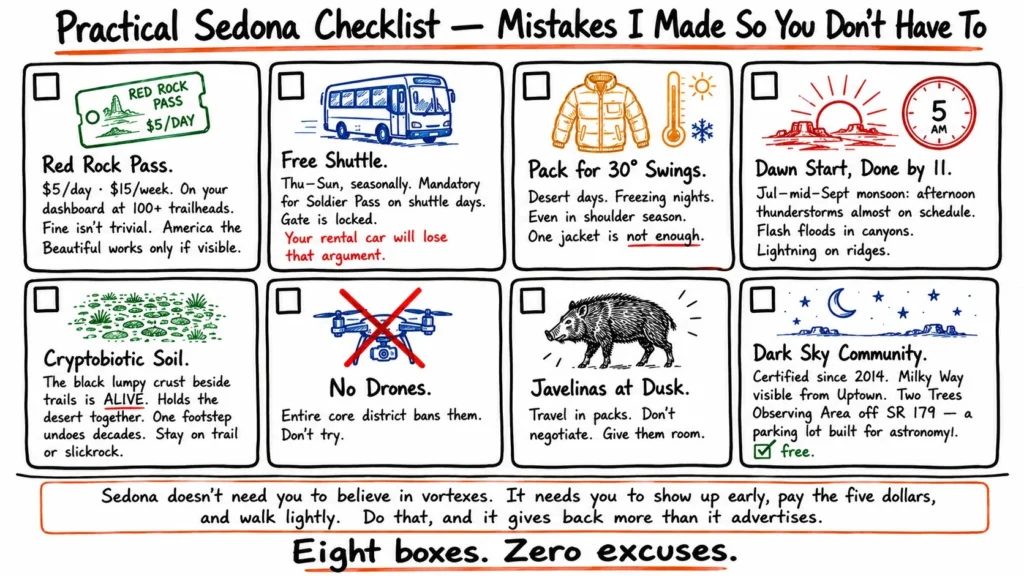
You need a Red Rock Pass — $5 a day, $15 a week — displayed on your dashboard at over a hundred trailheads in Coconino National Forest. It’s enforced, the fine isn’t trivial and an America the Beautiful pass works only if it’s actually visible.
Then there’s the shuttle. Thursday through Sunday, seasonally, a free Sedona Shuttle serves the most slammed trailheads and on those days it’s the only way into Soldier Pass parking. I watched a rental car argue with a locked gate about this. The gate won.
The Vortex Question, Answered Honestly
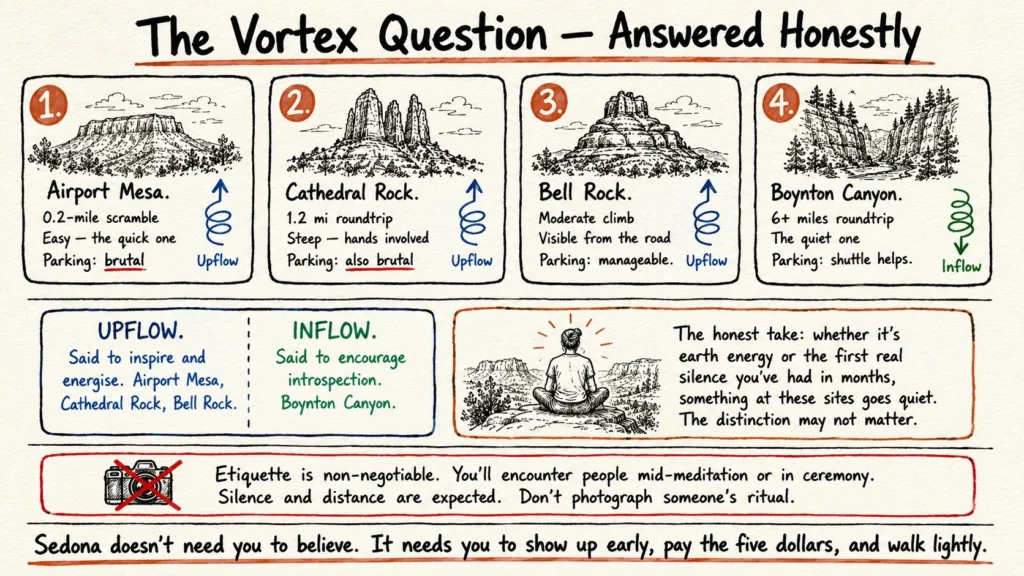
You can’t write about Sedona and dodge the vortexes. So here’s my honest take.
The framework says certain sites emit swirling earth energy — “upflow” sites like Airport Mesa, Cathedral Rock and Bell Rock for inspiration, “inflow” sites like Boynton Canyon for introspection. Do I believe the metaphysics? I stay agnostic. What I can report: sitting alone at the Boynton Canyon site near the end of that box canyon, six-plus miles round trip from the car, something in me went quiet. Whether that was energy or just the first real silence I’d had in months, I can’t tell you. Maybe the distinction doesn’t matter.
Practical ranking: Airport Mesa is the easy one — a 0.2-mile scramble, brutal parking. Cathedral Rock makes you earn it with a steep 1.2-mile round trip on slickrock, hands involved. And one thing that does matter: you’ll encounter people mid-meditation or in ceremony at these sites. Silence and distance are the expected etiquette. Don’t photograph someone’s ritual. I shouldn’t have to say that, but I’ve watched it happen.
The Hikes Worth Your Knees
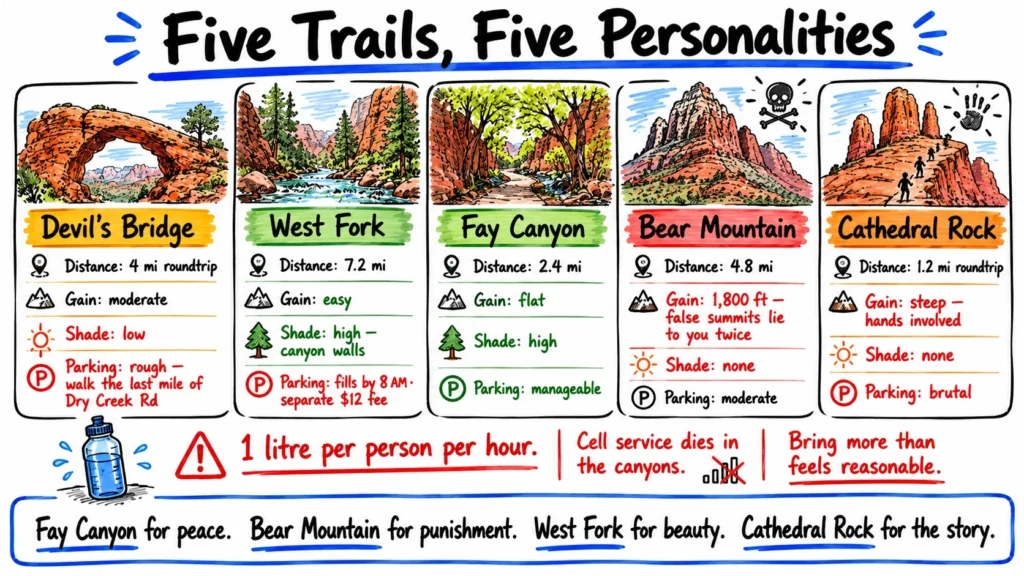
Five trails, five personalities. Devil’s Bridge (4 miles, moderate) for the largest natural arch around — walk the rough final mile of Dry Creek Road rather than risking a rental on it. West Fork (7.2 miles, easy) is the canyon-and-creek classic; your shoes get wet, the lot fills by 8 AM, separate $12 fee. Fay Canyon if you want shade and a flat 2.4 miles. Bear Mountain if you want punishment — 1,800 feet of gain and false summits that lie to you twice.
Cathedral Rock I’ve already confessed to. Bring more water than feels reasonable: the official guidance is a liter per person per hour and cell service dies in the canyons.
After Dark, the Second Sedona Shows Up
This is the part most visitors sleep through. Sedona has been a certified International Dark Sky Community since 2014 — strict lighting ordinances, enforced — and the Milky Way is visible to the naked eye even from Uptown. From Two Trees Observing Area off SR 179, a parking lot literally designated for astronomy, it’s something else entirely.
My best night there cost nothing. A tailgate, a thermos and an hour of letting my eyes adjust. If you want the guided version, local outfits run telescope tours with professional astronomers. Either way: the same ordinances that keep the sky dark mean the town goes genuinely dim at night. That’s a feature.
Eat, Detour and Leave It Better
Two food notes that earn their space. Elote Cafe takes no reservations and lines form ninety minutes before opening — decide whether the smoked chicken enchiladas are worth that to you (they were, once, to me). Indian Gardens Cafe in Oak Creek Canyon, a market standing since 1947, is the correct breakfast stop on the drive up 89A.
If you’ve got a spare half-day, Jerome — a copper ghost town bolted to a hillside thirty miles southwest — is the detour I’d defend. And Montezuma Castle, twenty-five minutes south, holds a 20-room Sinagua cliff dwelling that predates everything else you came here for.
Last thing and I mean it: that black, lumpy crust beside the trails is cryptobiotic soil. It’s alive, it holds the desert together and one footstep undoes decades. Stay on trail or slickrock. Skip the drone — the whole core district bans them anyway. Give the javelinas room at dusk; they travel in packs and don’t negotiate.
Sedona doesn’t need you to believe in vortexes. It needs you to show up early, pay the five dollars and walk lightly. Do that and the place gives back more than it advertises.