
It’s not all about the well-known dishes when exploring Asian food. It is more of an understanding of how a meal in Seoul, is different to a meal in Lahore, than it is about following the spice routes and sampling the fermentation that binds the taste of a region together. Explore it’s cuisine, midlife entertainment that can be indulged at night markets and mountain tea plantations.
The first mistake people often make before traveling to Asia for their first major dining adventure is referring to “Asian food.” It isn’t. Not even close. From the seasonal kaiseki counters in Tokyo to date and camel’s milk in the Arabian Peninsula, the continent’s culinary history is a patchwork quilt of different worlds that have been joined together over thousands of years through trade, migration and borrowing. If you’re going to eat your way through any portion of it, the first question you have to ask yourself is: What made up the plate in front of you?
Where It All Began: Spice Routes and Ancient Grains
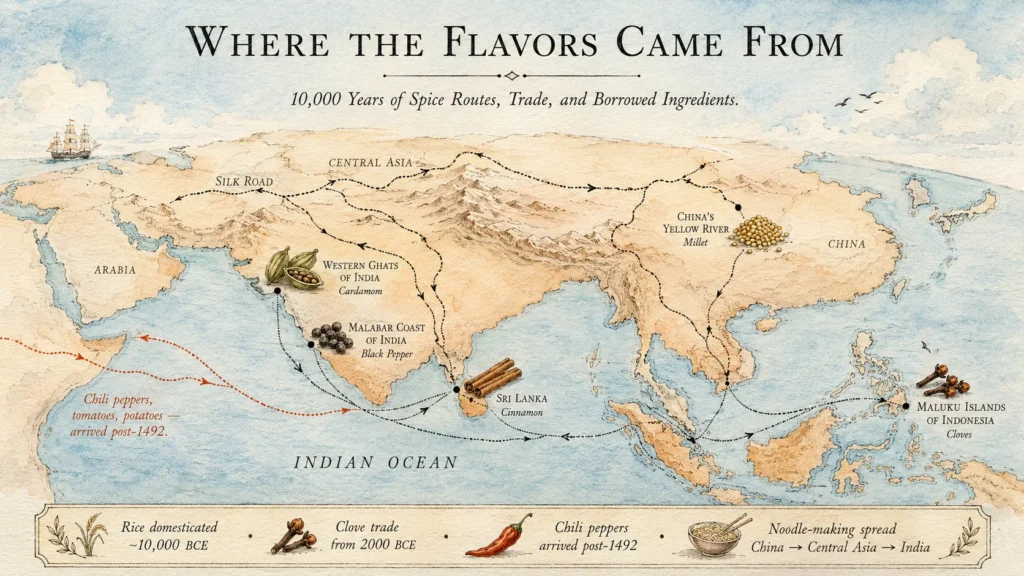
All of these cuisines were well under way before any of them took the form they have today in the river valleys. About 10,000 years ago the Yangtze River valley in China was the place where rice was domesticated. Along the Yellow River millet became established. Across the oceans in South Asia, the Indus Valley Civilization already had advanced granaries and they were trading spices, consuming wheat, barley, dates and beef.
Then came the part that illuminates the eyes of a food traveller, the trade. For thousands of years, China, India, Persia, Arabia and the countries of Southeast Asia were linked by the maritime and overland Silk Roads. Cinnamon moved out of Sri Lanka. Pepper had originated from the Malabar Coast. Some of this trade extended back to 2000 BCE: cloves and nutmeg left the Maluku Islands, cardamom the Western Ghats. But it wasn’t the ingredients who were moving. Making noodles probably spread from China to Central Asia, which in turn introduced biryani to India and plov to Central Asia.
This is the part that people don’t know. Many of the ingredients, which we consider to be characteristic of Asian dishes, are not actually from Asia. Chili peppers, tomatoes, potatoes — all brought to North America after 1492 by the Columbian Exchange and were so thoroughly integrated that it’s hard to imagine anything without them, whether it’s Sichuan, Korean, Thai or Indian cooking.
Faith on the Plate
You can’t really understand Asian foodways without understanding what people believe, because religion drew the lines around what gets cooked and how.
- Hinduism’s concept of ahimsa — The principle of non-harming (ahimsa) of the Hinduism led to the development of general vegetarianism in India.
- Buddhism spread the Indian tradition of temple meals to East and Southeast Asia, resulting in practices such as shojin ryori (Japanese cuisine) and vegetarian Chinese Buddhist cuisine.
- Islam’s halal laws brought together the way food was prepared across a vast region, from West, Central, South and maritime Southeast Asia, from how to go about slaughtering animals to how people celebrate Eid.
- Judaism’s kosher tradition spread to other smaller communities in West Asia and India, but with longer roots.
For a traveler, this is gold. It means a temple meal in Korea — vegan, garlic-free, built on a specific philosophy — is it’s own destination, not just a lighter version of regular Korean food.
The Five Culinary Mega-Regions
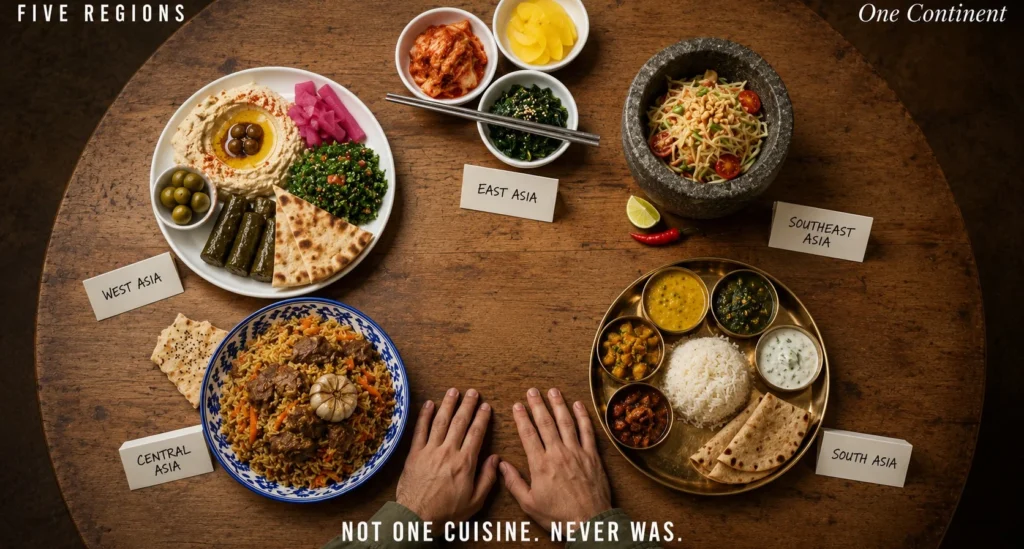
It helps to carry a rough map in your head. Asia’s food splits into five big zones, each one a whole world internally.
| Region | Defining Flavors & Techniques | A Signature to Seek Out |
| East Asia | Fermentation (soy sauce, miso, gochujang), the rice–wheat divide, umami from dashi | Korea’s banchan spread; Japan’s seasonal washoku |
| Southeast Asia | The balance of hot, sour, salty, sweet; fish sauce, lemongrass, galangal | Thai street food; Vietnamese pho and herbs |
| South Asia | Sophisticated spice blending (masalas); tandoor cooking; lentils | A regional Indian thali; Sri Lankan hoppers |
| Central Asia | Nomadic roots — meat, dairy, wheat; moderate spicing | Uzbek plov; manti dumplings |
| West Asia | Mezze culture, olive oil, saffron, dried lime | Persian tahdig; Levantine hummus and falafel |
But notice, washoku is recognized as a UNESCO treasure because of it’s focus on seasonality and presentation – these traditions are not just dinner, but part of the culture.
What’s Actually in the Pantry
After a while, it becomes clear that the same structure recurs in virtually every place you travel and is applied in quite diverse manners. The obvious one is rice — but it’s not just rice. Short-grain in Japan and Korea, long-grain in India and Pakistan, jasmine in Southeast Asia, sticky, glutinous in Laos and northeastern Thailand. But the end doesn’t end there. Rice turns into noodles, rice wrappers, dessert, fermentation base for alcoholic drinks and more.
Here are a couple more anchors to know prior to departing:
- Noodles — wheat (ramen, udon, lamian), rice (pho, pad thai), mung bean, buckwheat soba, egg. Each one gives you some information about local agriculture.
- Soybeans — used in fermentation for soy sauce, miso, doenjang, tempeh and natto; used for tofu and soymilk.
- Fermented fish and shrimp pastes — nam pla, nuoc mam, belacan, bagoong, ngapi. These are the umami anchors. Pungent up close, irreplaceable on the plate.
- Coconut — milk/curries, cream (southern India and Sri Lanka), water to drink.
- Aromatics — fresh rhizomes (ginger, galangal, turmeric); the whole allium family; dried spices (star anise to fenugreek).
Then, there’s technique, which is the real heart and soul of a cuisine. The intense, rapid heat that a wok is noted for and what makes it’s “wok hei. Steaming – dim sum to south indian idli. Slow cook foods, such as rendang and nihari. A clay oven with flames blasting from it. And fermentation of all kinds — lactic (kimchi), alcoholic (rice wines), fungal (tempeh, koji), bacterial (yogurt, natto). How to get to know a place – watch how it ferments.
Eating by Philosophy
Here’s something that turns a meal into an education. A lot of Asian cooking runs on ideas about balance, not just taste.
The yin yang system in China and Korea classifies foods as “cooling” or “heating” and a healthy meal will balance them. In Ayurveda Indian medicine, foods are medicine and are classified into six tastes and six body types. In court cuisine in East Asian countries, five colors and five tastes were assigned to five elements and organs. All this is concrete at the table and that’s why a dish is paired the way it is.
In almost all places, the feast is shared. The dishes are placed in the centre. Chinese family service, Korean banchan, the Indian thali, West Asian mezze, Central Asian dastarkhan—a similar drive behind a variety of names. It is through food that people connect. When the family sits together at the dinner table you have learned more than you ever will from the words.
The Street Is Where It Lives
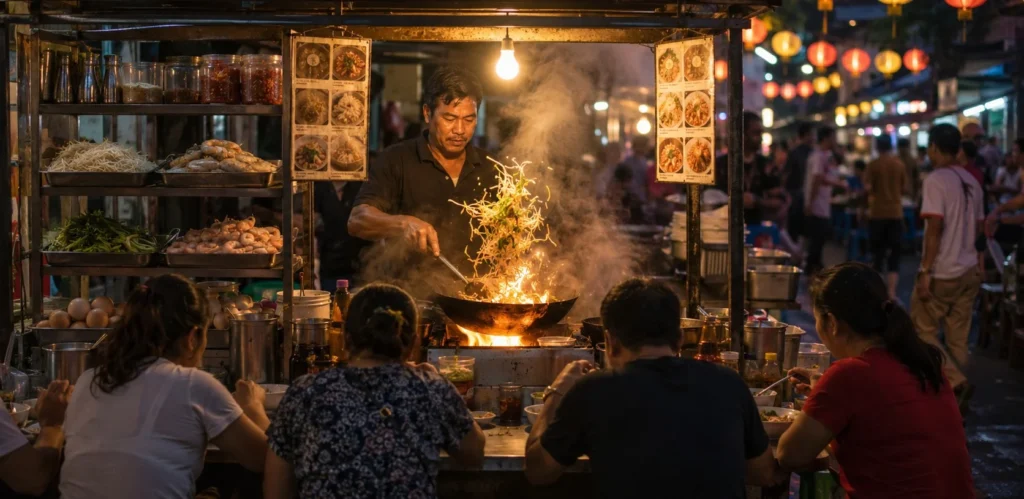
If you are to travel to any food in Asia, it is to be street food. It’s quick, inexpensive and the most accurate snapshot of a culture’s daily fare.
A brief list of suggested regions to study, hit list:
- East Asia — night markets (the stinky tofu in Taipei, the oyster omelette in Tokyo, the pojangmacha tents with tteokbokki in Seoul, the jianbing crepes in Beijing).
- Southeast Asia — the chicken rice and chili crab of the hawker centres and the pho bo of Hanoi, char kway teow and assam laksa of Penang and Bangkok’s pad thai and som tam.
- South Asia — vada pav in Mumbai, chaat in Delhi, kathi rolls and puchka in Kolkata, gol gappay in Lahore.
- West Asia — simit and balık ekmek served in Istanbul, manakish served in Beirut and the stalls of Djemaa el-Fna in Marrakech.
Following the Food: How to Actually Explore
So how do you turn all this into a trip? The research points to a few proven ways in:
- Cooking classes and homestays — learn Thai curry paste or Tibetan momos where they’re actually made.
- Food trails and market tours — Tokyo’s Toyosu market, Istanbul’s Spice Bazaar, Delhi’s Chandni Chowk.
- Farm-to-table visits — tea plantations at Darjeeling, coffee plantations at Yunnan, the rice terraces at Bali.
- Festival gastronomy — it’s time to taste the food at the Vegetarian Festival in Phuket or the Tamil Nadu Pongal festival.
Another thing to follow along on the way: how these cuisines spread and adapted. Bunny chow was developed by the Indians in South Africa and roti wrapping in the Carribeans. Peru’s chifa cuisine and lomo saltado were introduced by the Chinese expatriates. Hawaii’s Japanese immigrants have influenced the development of Nikkei cuisine and the creation of spam musubi and poke bowls in Hawaii. Foods purchased at home may have a pass, too.
Why Bother
Cooking Asian food is not so much about the recipes, after all. It’s a gateway into history, faith, geography and art and even into the spice routes, the philosophy of balance, the deep umami of the fermentation and the constant push and pull between tradition and reinvention. Not the glass pieces from museums! They’re dynamic, changing environments and each meal you enjoy becomes a new entrance. The exploring goes on and on. That’s the thing that it’s all about.