
Each year since 2018, the Cleveland Metroparks Zoo has turned into a 1,000-sculpture walking trail after dark featuring glow-in-the-dark silk-and-steel lantern sculptures, as long as a city bus, constructed by craftsmen flown in from Zigong, China. It is not a preconceived idea of the old boys club.It is not an old boys club mentality. It’s an intentional, contemporary cultural import and one of the most popular summer attractions in northeast Ohio. In brief, if you only have 10 seconds: it lasts for a few weeks, starting around the middle of July and ending around the beginning of September, tickets are between $18 and $22 for adults and everyone takes a picture of the dragon.
Where the Festival Actually Comes From?
This is the section most articles miss when talking about the subject. The Asian Lantern Festival, Cleveland is not, in the strict sense of the word, the lantern festival, that Chinese families have on the fifteenth day of the first lunar month, when they eat tangyuan or hang lanterns that have riddles. It is known as Yuan Xiao Jie, it is in the late winter season and it”s roots trace back to the Han Dynasty, 2000 years ago, when Emperor Ming ordered people to light lanterns in honour of Buddha at their households and temples. It developed into the city-wide celebration that it remains today during the Tang and Song dynasties, when Zigong in Sichuan Province was recognized as the capital of lantern making in China.
What Cleveland offers is something quite different—a summer-rotated, walking-through-art event that takes inspiration from the two-thousand-year-old tradition without it’s time restrictions. The lanterns are manufactured in Zigong by the Zigong hereditary lantern-making families’ descendent company Tianyu Arts & Culture and sent in sections to American venues, where they are re-assembled on-site. By 2012, both Boston’s Franklin Park Zoo and Denver Zoo were doing this format. In the middle of the 2010’s there was essentially a tour of lantern festivals in American zoos and botanical gardens and Cleveland was part of that.
So, as you walk it you are viewing both a true old craft (silk stretched over welded steel armatures and hand-painted) and a most contemporary form of delivery (LED-lit, ticketed and timed around the summer operating hours of the zoo). Both halves are indeed real! Both sides aren’t trying to act as if they’re the other.
How Cleveland’s Version Started and Why the Zoo, of all Places
It’s not a coincidence that this has been accomplished at Cleveland Metroparks Zoo. During the mid-2010s the Metroparks system aggressively encouraged the zoo to open up at night and become a destination throughout the year and by that time, the zoo already had many animals on display that were from Asia — Amur leopards, red pandas, snow leopards, Asian elephants. The idea of an Asian wildlife theme was not out of the realm of possibility; it was almost as if they were made for each other.
The deal with Tianyu was signed in late 2017. The inaugural festival opened on July 19, 2018 and ran into early September. About forty large lantern installations along a one-mile loop. The headline piece was a two-hundred-foot dragon stretched along the Waterfowl Lake area — a traditional symbol of rain and fortune, which lands a little differently when it’s reflected in actual water. There was also a tunnel of lights modelled loosely on imperial palace corridors and lantern versions of giant pandas, red pandas, cranes and tigers, each one sitting near interpretive signage about the real animal’s conservation status.
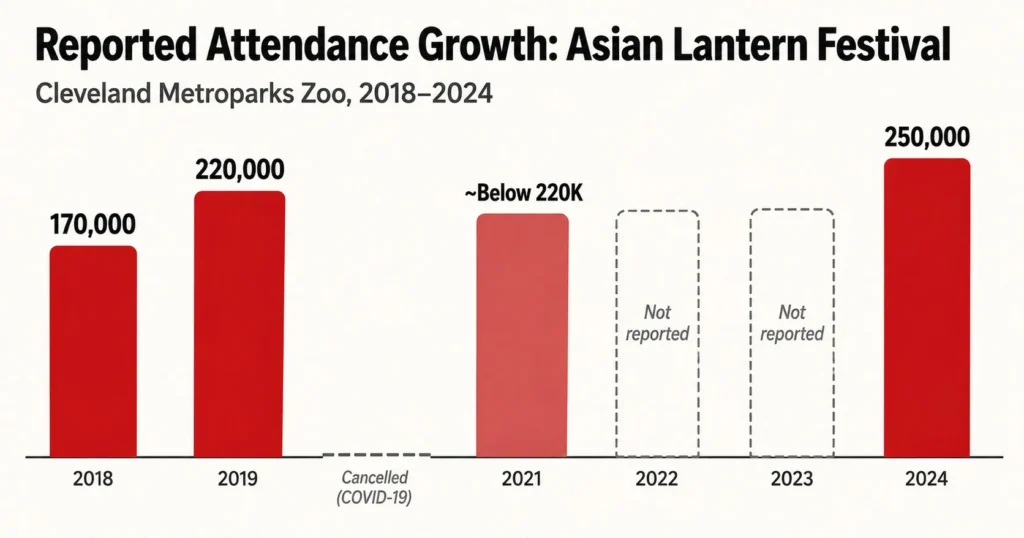
That first season reportedly drew around 170,000 visitors — a number worth taking as approximate, since I’m working from the zoo’s own communications rather than an audited figure. Either way, it was enough to come back the next year bigger.
| Year | Theme | Reported attendance | Notable additions |
| 2018 | Inaugural festival | ~170,000 | 200-ft dragon, palace light tunnel |
| 2019 | Mythology focus (Shan Hai Jing) | ~220,000 | Nine-tailed fox, qilin, interactive wishing tree |
| 2020 | Cancelled (COVID-19) | — | — |
| 2021 | Wild Asia: Mountains and Seas | Below 2019 peak | Timed entry, crane bridge, lotus pond |
| 2022 | Nature’s Wonders | Not publicly reported | Bioluminescent sea creatures, bamboo forest |
| 2023 | Into the Wild | Not publicly reported | Endangered species lanterns + QR conservation links |
| 2024 | Legend of the Dragon | ~250,000 | Dragon centrepiece returned; Dragon’s Lair interactive zone |
What You Actually Walk Through?
The mile is the unit that matters here. You enter after sunset — the zoo opens the festival gates around dusk, which in a Cleveland July means somewhere close to nine o’clock and the path moves you through the existing zoo grounds, except the grounds have been rewired. Some animal habitats are still active; the red pandas in particular tend to be more visible at dusk than during the day, which is a small bonus the marketing doesn’t push.
The lanterns are not, technically, lanterns in the candle sense. Each one is a welded steel skeleton wrapped in stretched silk, hand-painted, lit from inside by LED arrays. Up close you can see the seams. That’s not a flaw — it’s how the craft has always worked; the older versions just used oil lamps and paper instead of LEDs and silk. The bigger pieces, the dragon especially, are built in sections and only fully assembled on site.
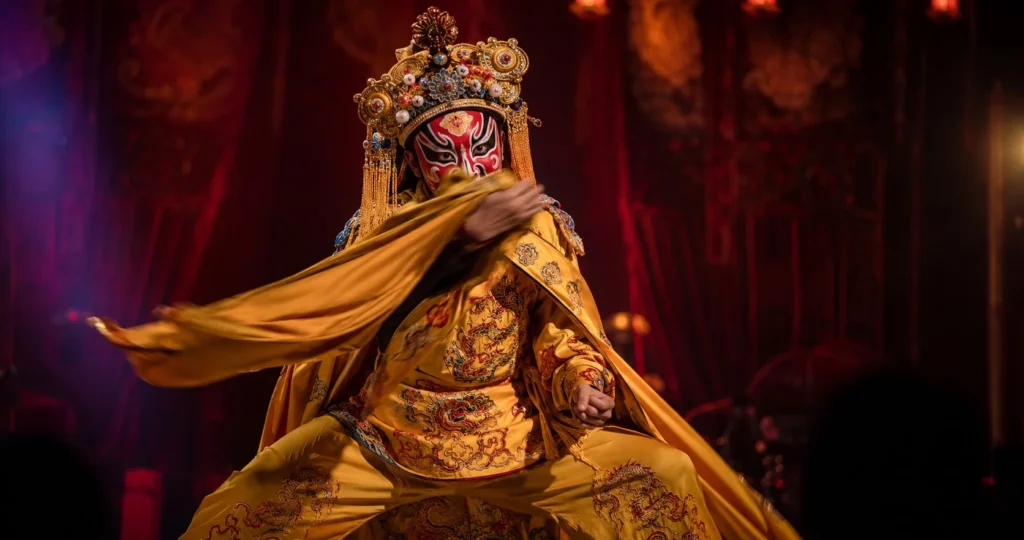
Scattered through the route are performance areas. Sichuan opera face-changing — bian lian, where a performer flips through painted silk masks faster than you can track — is the one that genuinely stops people. Martial arts demonstrations and folk music run on a rotation. None of it is long. You’re not committing to a show; you’re walking through and catching ten minutes of something before drifting on.
The food situation has grown noticeably year to year. Bao, dumplings, bubble tea, more recently some Thai street-food vendors. It’s not cheap and the lines after eight-thirty get long. If you eat before you arrive you’ll be fine. If you don’t, factor in the wait.
The Zigong Connection and Why it Matters More Than the Dragon Does
This is the part of the festival I think most travel coverage underplays.
Every year, a team of roughly twenty to thirty craftsmen flies from Zigong to Cleveland and spends up to two months on site building the displays. They weld the frames, stretch and paint the silk, wire the LEDs and stage the pieces along the route. Zoo staff and some local artists get to watch the process, occasionally help with the simpler work. The Zigong lantern-making tradition is on China’s national intangible cultural heritage register and what’s happening in those weeks before the gates open is essentially a transfer of a living craft, performed in Ohio, by people whose grandparents made lanterns from oiled paper.
You can’t really see this part as a visitor — the build happens before the festival opens. But it’s worth knowing it’s there, because it’s the reason the work doesn’t feel like prop-shop output. The same hands that made the dragon also made it differently last year and will make a different one next year and the design conversations between Tianyu’s artisans and the zoo’s conservation staff now happen years in advance to align lantern subjects with the species the zoo wants to highlight.
If you’ve been to one of the other American lantern festivals — Boston, Denver, the Missouri Botanical Garden — you’ve likely seen Tianyu’s work without knowing it. Cleveland’s version is distinguished mainly by how tightly the zoo has braided the lanterns into it’s conservation programming, which we’ll come back to.
Planning Your Visit
The festival runs annually from mid-July to early September, though exact 2026 dates and ticket pricing aren’t published yet. Check the Cleveland Zoological Society site directly before you book travel — historically they announce dates in spring and tickets sell faster on Friday and Saturday nights.
A few practical notes from how the event has run in recent years:
- Adult tickets have typically sat in the $18–$22 range, with discounts for zoo members and lower pricing for children. Member pre-sales open before the general public.
- The festival is timed entry. You pick a window when you book. Late slots (around 8:30–9:00 PM) give you the best lantern-to-daylight ratio, but the food lines are also at their worst then. Earlier slots let you see the zoo animals first and the lanterns light up as you walk.
- It’s a walking event — the full loop is about a mile, paved but with some grade. Strollers and wheelchairs work; heels do not.
- Mosquitos are real in Cleveland summer evenings. The zoo sits next to wooded park land.
- The grounds are exposed; if there’s a thunderstorm warning, check before you drive in. The festival runs rain or shine but the lanterns are not as photogenic in heavy rain.
What to bring:
- A light jacket or layer — even July nights cool down once the sun is fully gone.
- Bug spray.
- A camera that handles low light reasonably; phone cameras work but the dragon at full size will defeat anything shooting on auto.
- Cash or card for food and merchandise.
- Comfortable walking shoes, not sandals.
- If you’re bringing kids, snacks for the inevitable wait between dinner-line and dragon.
If you’re travelling in from outside Cleveland, the festival pairs reasonably well with a daytime visit to the Cleveland Museum of Art (which is free and has a serious Asian art collection that gives the lanterns useful context) or a meal in the Asia Town neighbourhood east of downtown. Don’t try to do the zoo by day and the festival the same night — by the time the lanterns light up you’ll be too tired to enjoy them.
The Conservation Thread — Which is the Part That’s Quietly Working
Most American zoo lantern festivals treat animals as decorative motifs. Pretty tiger lantern, pretty panda lantern, end of conversation. Cleveland’s version has built a different layer underneath that, which is worth knowing about before you go because it changes what you’re looking at.
The designs of the lanterns are synchronized with the conservation programs of the zoo. Clearly, 2023 is the purest form of this, with lanterns featuring QR codes for each of Amur leopard, Malayan tapir and pangolin, the actual field projects that the zoo funds. The one involving the pangolin is the most radical of those options, in conservation terms; pangolins are the most trafficked mammal on earth and most of the people couldn’t even tell you what the big, scaly mammal is. A small act of “visibility” for a species that desperately needs it, is to make a glowing eight foot pangolin sit beside the path.
The zoo runs the Asian Turtle Program and contributes to snow leopard anti-poaching work in central Asia. None of this is what brings 250,000 people through the gates. But the festival is paying for part of it and the lanterns are how a lot of those visitors first hear that the zoo does field conservation at all.
That’s the version of the festival worth holding in mind on the walk. The dragon is the photograph. The pangolin is the point.