
Majority overpack and under-protect. It is not a judgment, it is merely what occurs when you are in your bedroom the evening before an international flight, and you are attempting to put just in case items into a bag which is already on the verge of bursting at the seams. The New York Times product review division, Wirecutter, has years of field-testing gear, tailored to overseas travel, and their selections cut through the clatter quite well. Here, the authors take you on a tour of their best suggestions — security equipment, luggage, technology, travel accessories, and attempts to provide you with a sincere idea of what they really should purchase and what simply sounds good on paper during a review but gathers dust during their real travel.
Security Without the Paranoia: Anti-Theft Gear That Actually Works
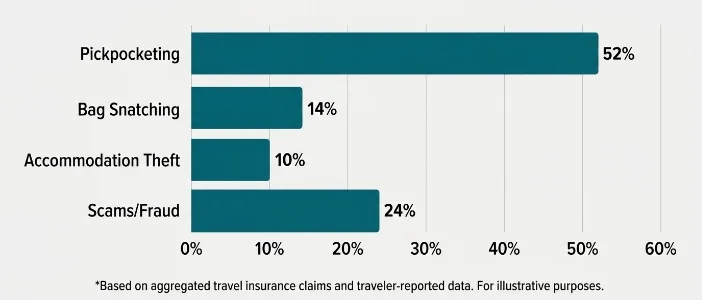
This is the thing with travel theft, it is hardly dramatic. No one is getting mugged in the dark alley in most of the places the tourists visit. What really occurs is less noisy. Somebody slips a hand into a pocket in the rear of the metro. You are having a cup of coffee at a cafe and a bag is unzipped. Hotspots of pickpocketing incidents reported by users of the Reddit community are always related to the same scenarios: overcrowded transit, tourist-infested squares, the time when you are lost with your map.
Which is why the Wirecutter recommendations here are less about paranoia and more about friction. Make yourself a slightly harder target than the person next to you, and most opportunistic theft just… doesn’t happen.
Pick-pocket proof pants are exactly what they sound like — wrinkle-resistant nylon with seven pockets secured by zippers and buttons. Ugly? A little, depending on the cut. Functional? Genuinely yes. Your phone goes in a zippered thigh pocket, cards in a buttoned interior pocket, and suddenly the whole “should I bring a money belt” debate gets simpler.
Speaking of money belts — the hidden money pouch that clips onto a belt loop and sits flat against your body under clothing is the move for passports and backup cash. Not the neck pouch that bunches under your shirt and becomes visible every time you reach for something. The under-waistband version stays put.
The decoy wallet idea gets dismissed by some travelers as overcautious, but it’s worth thinking through. An old wallet with a small amount of local currency and a few expired cards — if someone does demand your wallet, you hand that over. The real stuff is elsewhere. Travel safety researchers note this is a widely practiced approach among frequent international travelers, particularly in regions with higher street crime rates.
| Security Item | What It Does | Best For |
| Pick-pocket proof pants | 7 secured pockets, wrinkle-resistant | Daily city use |
| Hidden money pouch | Worn under clothing on belt loop | Passport + emergency cash |
| Decoy wallet | Decoy with small cash + expired cards | High-risk areas, peace of mind |
Carry-On Only: The Philosophy and the Bags That Make It Work
There’s a specific kind of misery that comes from waiting at baggage claim after a long-haul flight, watching the carousel go around, wondering if your bag made the connection. Airlines lost or delayed roughly 6 out of every 1,000 checked bags in recent years according to US Department of Transportation reports — a small percentage, sure, but you only need it to happen once on a tight itinerary to become a carry-on convert.
The one-bag philosophy isn’t just about avoiding lost luggage though. It’s about what Wirecutter describes as not becoming a “hostage” to your bags. Plans change. Flights get canceled. You want to switch to a train or grab a last-minute rental car — and if you can sling your bag on your back and walk out, you can. Checked luggage makes that complicated. A carry-on doesn’t.
Two bags dominate the Wirecutter recommendation for this:
- Cotopaxi Allpa 35L – clamshell, strong, simple. Well, those who pack by feel and desire a no-system easy access.
- Peak Design Travel Backpack 45L – expandable up to 30 45 liters, compatible with customizable internal cubes. Prefer better those who prefer everything to be in its place.
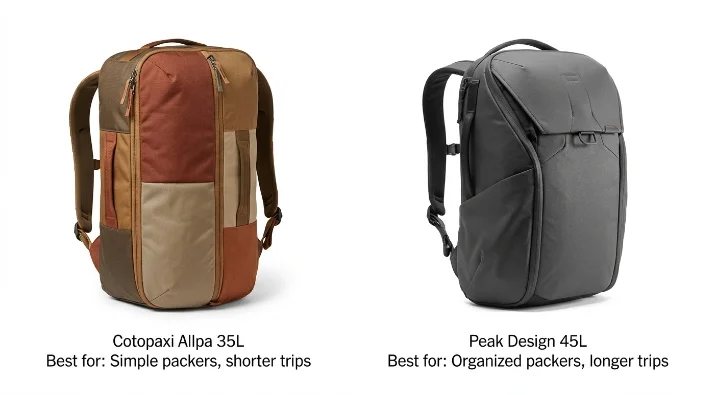
Both fits TSA carry-on size dimensions of most major airlines, but it is always best to confirm with low-cost airlines in particular.
One secret weapon: a cable ski lock to attach your bag to something stationary – a bed frame in a hostel, an overhead rack, a cafe chair – when you cannot keep an eye on it. Will not stop a willful plunderer, but will stop the premeditated seize.
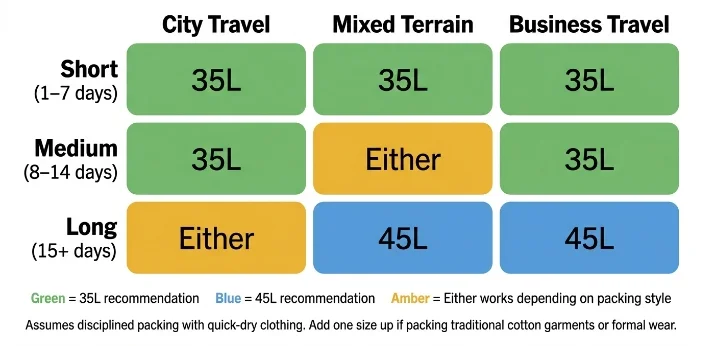
- With a strict packing regime, 35L is good on trips up to 1014 days.
- 45L provides more space to breath during longer journeys or destinations that need differentiated clothing (think business meetings and hiking).
- Quick-dry, wrinkle-resistant fabrics make sink-washing viable, which changes the packing math entirely.
Staying Powered and Plugged In Anywhere
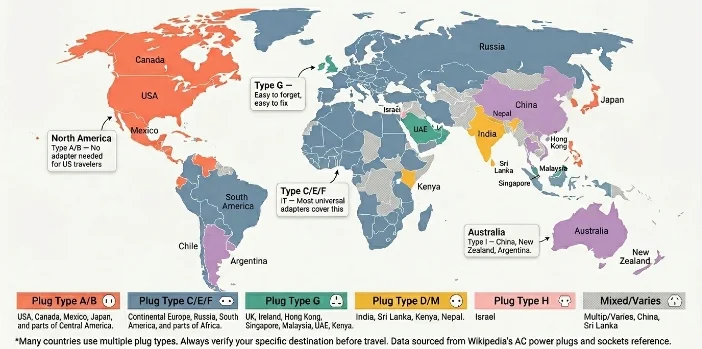
Plugs are one of those things you don’t think about until you’re standing in a hotel room in Tokyo at 11pm with a dead phone and a charger that doesn’t fit the wall. There are 15 different plug types used across the world — Type A through Type O — and no single country uses all of them. Europe alone has enough variation to catch people off guard.
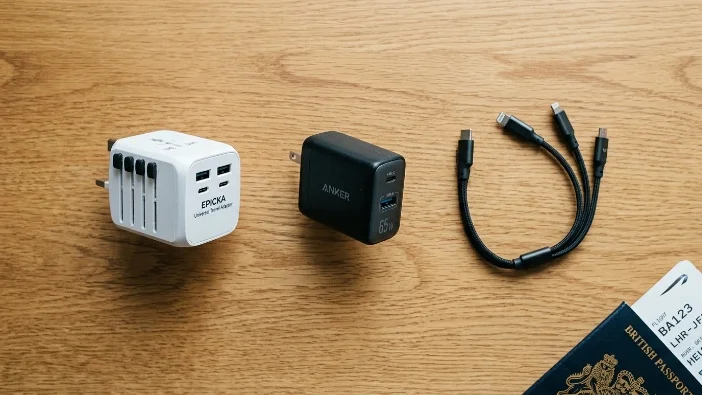
The Epicka Universal Travel Adapter handles this cleanly. It covers most major plug types, has USB ports built in, and doesn’t require you to carry a separate adapter for every region. One thing worth knowing — it’s an adapter, not a converter. It changes the plug shape, not the voltage. Most modern electronics (laptops, phones, cameras) handle dual voltage automatically, but check your device labels before plugging in anything older.
The charging situation gets more interesting with the Anker combination charger — a wall plug that doubles as a portable battery. The idea being you charge it overnight, leave the hotel with a full phone and a backup power source in your bag, and you’ve eliminated one whole device from your kit. Sounds minor. After a few trips it genuinely isn’t.
Then there’s the multi-cable — sometimes called a spider cable — with connectors for USB-C, Lightning, and Micro-USB built into one cord. Because someone in your travel group will always have a different device.
A few practical things worth knowing before you buy:
- Check whether your destination uses 110V or 220V — the US Energy Information Administration has country-level electrical data if you want to dig into specifics.
- The Anker combo charger charges slower than a dedicated wall brick, which matters if you’re working off a laptop.
- Budget airlines in some regions have USB ports but no standard power outlets — the portable battery matters more there than the adapter.
Health, Hygiene and In-Transit Comfort
Flights that take long are literally a nightmare to the body. Not like a drama– just the gradual build-up of dehydration, poor posture, recycles, and insufficient sleep in 10 or 14 hours. The equipment in this group is that of dealing with that.
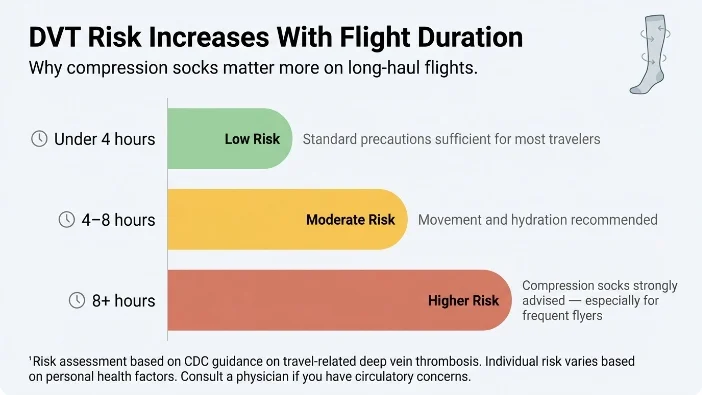
Compression socks are the most clinically grounded item on the whole list. The CDC has recorded that spending hours and hours sitting immobile (4 hours or longer) heightens the danger of deep vein thrombosis, which is a condition that causes blood clots to develop in the legs. Compression socks enhance circulation, as they exert graduated pressure on the ankle upwards. They’re not glamorous. They are used by most frequent long-haul travelers.
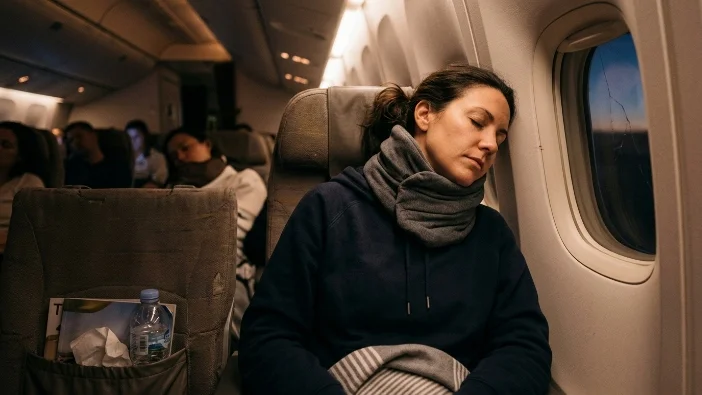
The Trtl Travel Pillow works differently than the standard horseshoe neck pillow. Instead of foam wrapped around your neck, it’s essentially a structured scarf with an internal support rib — holds your head to one side while you sleep upright. Looks a bit odd, works better for most people than the traditional version. The test is whether you can actually sleep on a flight, because if you can’t, everything else about the trip starts rough.
The most doubtful products are the silk sleep sack, where people who have never tried one are the most critical. It is a thin liner – folds up to practically nothing – which you put on when you are not quite sure of the quality of bedding in a hotel. Especially applicable to the budget accommodation, overnights trains, guesthouses in isolated places. It also gives a physical barrier against bedbugs which according to EPA guidelines are becoming more and more frequent even in mid-range hotels worldwide.
Quick reference for this category:
- Compression socks: most important on flights over 4 hours, or if you have any circulatory concerns.
- Trtl pillow: worth it if sleeping upright is something you can do at all — useless if you can’t sleep on planes regardless.
- Silk sleep sack: adds maybe 100 grams to your bag, genuinely useful on longer trips with varied accommodation.
Sound Choices: Audio for the Plane and the Pavement
Two very different use cases here, and Wirecutter splits them correctly.
Bone-conducting headphones — the Aftershokz Aeropex specifically — sit on your cheekbones rather than in or over your ears, transmitting sound through bone vibration. Your ear canals stay completely open. This matters specifically when running in an unfamiliar city, where hearing a car, a motorbike, or someone calling out to you isn’t optional. Road safety researchers consistently flag earphone use while running as a risk factor in pedestrian accidents — bone conduction sidesteps that problem entirely without sacrificing audio quality for podcasts or music.
They’re not the right tool for flights though. Open ears on a noisy aircraft is its own kind of misery.
Noise-canceling earbuds handle that. Compact enough to pocket, good enough for 10-hour flights, and the noise cancellation on current models is solid for engine hum specifically — the frequency they’re best at blocking. Some travelers use them on city transit too, though worth being aware of your surroundings if you do.
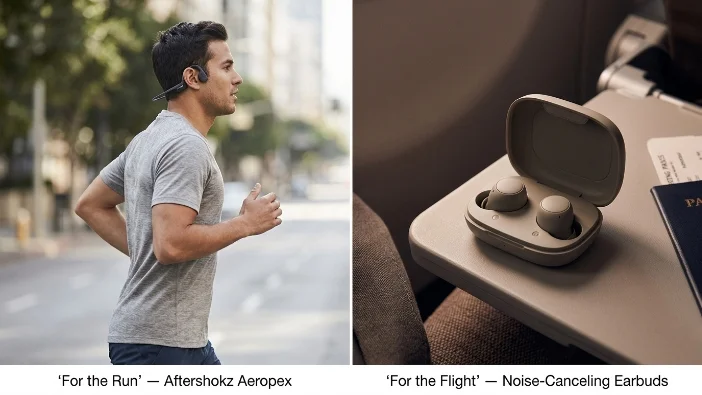
The honest answer is both have a place if you run when you travel. If you don’t, noise-canceling earbuds only is perfectly reasonable. Bone-conducting headphones as your sole option on a long flight is a genuine endurance test.
Small Saviors: The Tiny Things You’ll Be Glad You Packed
There’s a certain type of travel item that doesn’t show up in anyone’s Instagram packing flat lay. No aesthetic appeal, no satisfying unboxing. Just small, ugly, useful things that solve problems you didn’t know you’d have until you’re somewhere remote and the problem is happening right now.
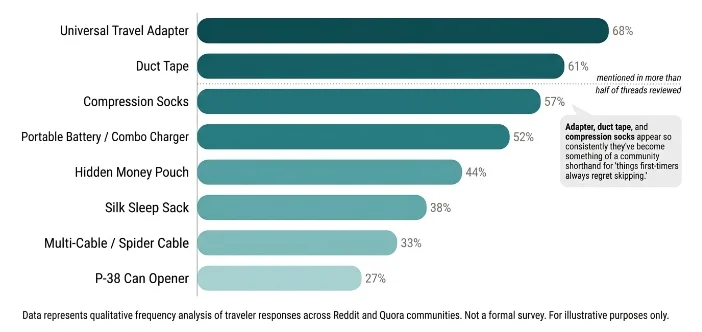
Duct tape is the obvious one. A small roll — not a full hardware store roll, just wrap some around a pen or pick up a travel-sized flat pack — handles a surprising range of situations. A shoe sole separating in a cobblestone street in Lisbon. A luggage zipper pull that snapped off. A adapter that keeps sliding out of a loose European wall socket. That last one is a real scenario multiple travelers have flagged, and duct tape genuinely fixes it temporarily. It’s the kind of thing where you either pack it and never use it, or you don’t pack it and spend an afternoon in a foreign city looking for a hardware store.
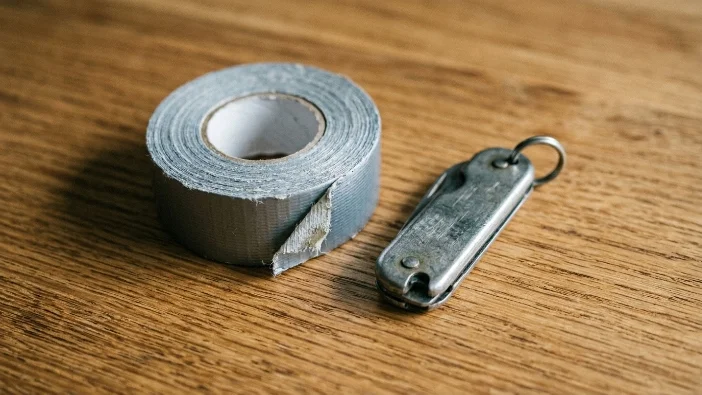
The P-38 can opener is almost comically small — military-issue keychain tool, folds flat, weighs nothing. Useless in cities with functioning restaurants. Invaluable in remote areas, on long train journeys with packaged food, or during the kind of slow travel where you’re stocking a small kitchen for a week. If you’re doing any rural travel at all, it earns its spot.
Camping toilet paper — pocket-sized, flameless — is similarly context-dependent. In developed urban destinations you’ll probably never touch it. In rural Southeast Asia, parts of Central Asia, remote trekking routes, overnight buses — a different story. Takes up almost no space. The downside of having it when you don’t need it is essentially zero.
What connects these three items is the same logic that runs through the whole Wirecutter list, really. None of this gear makes travel more exciting. It just removes a specific category of friction — the kind that turns an inconvenience into an actual problem. A dead phone with no backup power, a neck that won’t straighten out after a 14-hour flight, a bag that got unzipped on the metro — these things don’t ruin trips often, but when they do, they color the whole experience.
There’s a quote that gets passed around in travel writing circles — pack light, but pack a sense of wonder. Gear matters, preparation matters, but the accessories on this list exist to get logistics out of your head so the actual trip can take up more of it. One bag you can carry yourself, a phone that stays charged, a neck that doesn’t hurt — that’s the foundation. Everything else is just the places you go.
Before you finalize your packing list, a few honest questions worth sitting with:
- How long is the trip, and does a 35L bag actually cover it, or are you trying to force a 45L trip into less space?
- Are you going anywhere genuinely remote, or mostly cities? The can opener and camping toilet paper call changes completely based on that answer.
- Do you run when you travel? If yes, bone-conducting headphones move from “nice to have” to fairly essential.
- What’s your accommodation range — mid-range hotels only, or hostels and guesthouses mixed in? The silk sleep sack answer depends on this.
- Have you ever had anything stolen while traveling? If yes, the decoy wallet stops feeling excessive pretty quickly.
No single packing list works for every trip. The Wirecutter approach — and what this article has tried to reflect — is less about buying specific products and more about solving specific problems before they find you somewhere inconvenient. Start there, and the gear mostly selects itself.