
The short answer? If you put a gun to a critic’s head, the most defensible pick is Sainte-Chapelle in Paris — a 13th-century Gothic chapel whose walls all but disappear into stained glass. But the honest answer is that “prettiest” depends entirely on whether you’re asking an architect, a mathematician or someone scrolling Instagram on the metro. This piece walks through all three and lets you decide.
You can’t really settle this. First, you have to acknowledge that. The Greeks built the Parthenon 2500 years ago and we’re still not sure whether anything has topped it. Then you’re shown a picture of the Alhambra at sunset and you’re back to square one.
What I want to do here is something a bit more useful than another “Top 10 Most Beautiful Buildings” listicle. I want to show you how people decide what’s beautiful — the architects, the math people, the tourist boards, the algorithms — and then walk through the buildings that keep coming out on top no matter which lens you use. Some you’ll know. A couple might surprise you.
Fair warning: I have favorites. I’ll try to be evenhanded but I’ll also tell you when I think one building genuinely outclasses the others.
How Do You Even Judge a Building?
There’s no panel of judges holding up scorecards. What there is, instead, is a handful of competing methods — and they rarely agree.
The Architects
Ask people who actually build things and they tend to obsess over proportion, structural honesty and how a space moves you when you walk into it. This is why the Parthenon keeps winning their polls. It’s a ruin. The roof is gone. Half the marble is in the British Museum. And architects still rank it first because the underlying geometry — the slight curvature of those columns, the optical corrections that make straight lines look straight from a distance — is, by their lights, untouchable. Britannica’s entry on the Parthenon gets into the entasis and the stylobate curvature if you want to go down that rabbit hole.
The Math People
Then there’s the camp that thinks beauty can be measured. Specifically, with the golden ratio — that 1.618 number that pops up in seashells, sunflowers and (allegedly) every great façade in history. One widely-circulated analysis a few years back ran the ratio against famous buildings and crowned St. Paul’s Cathedral in London the winner at 72.28% alignment. Worth noting: that study was commissioned by a glazing company as a PR piece, not published in a journal. Take it with the salt it deserves. But it’s the kind of number that travels and it’s why you’ll see St. Paul’s on these lists.
The Public
Polls and Instagram metrics tell a completely different story. Here the Eiffel Tower wins almost every time — most photographed, most geotagged, most likely to make somebody cry on a honeymoon. There’s a delicious irony in this, which we’ll get to, because Parisians at the time absolutely hated it.
The Institutions
Then there’s the curated middle ground — Time Out, Lonely Planet, UNESCO’s World Heritage list. These don’t crown a single winner so much as anoint a tier. UNESCO status in particular is a strong tell: it doesn’t guarantee beauty, but the overlap between the World Heritage list and any “prettiest buildings” ranking is enormous.
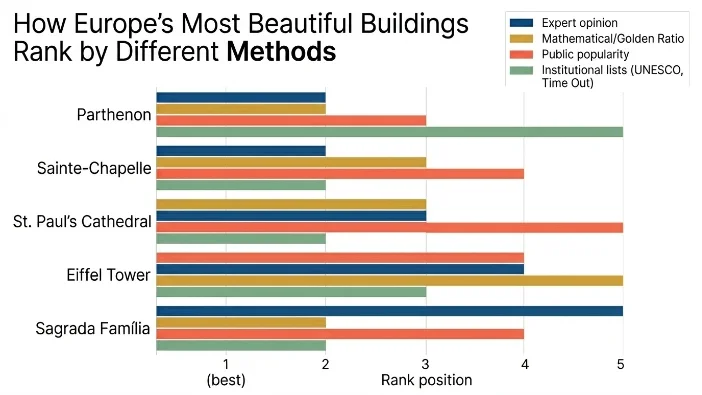
So: four lenses, four different winners. Which is sort of the whole point. Before we get into the buildings themselves, here’s how the heavy hitters stack up:
| Building | Location | Era / Style | Why It Keeps Showing Up |
| Parthenon | Athens, Greece | Classical Greek (5th c. BC) | The architects’ perennial #1 — the textbook on proportion |
| Sainte-Chapelle | Paris, France | Rayonnant Gothic (13th c.) | Critics’ favorite; the stained glass has to be seen to be believed |
| St. Paul’s Cathedral | London, UK | English Baroque (17th c.) | The “mathematically perfect” pick by golden-ratio alignment |
| Alhambra | Granada, Spain | Nasrid / Moorish (13th–14th c.) | Beauty as atmosphere — light, water, geometry, silence |
| Sagrada Família | Barcelona, Spain | Catalan Modernisme (1882–) | Still being built; arguably the boldest sacred space on Earth |
| Eiffel Tower | Paris, France | Industrial / Iron (1889) | The people’s choice; the most photographed monument in Europe |
| St. Mark’s Basilica | Venice, Italy | Italo-Byzantine (11th c.) | 8,000+ square meters of gold mosaic. Yes, really. |
| Neuschwanstein Castle | Bavaria, Germany | Romanesque Revival (19th c.) | The fairy-tale archetype — Disney literally copied it |
| Hallgrímskirkja | Reykjavík, Iceland | Expressionist (20th c.) | Looks like a glacier crossed with a basalt column. Time Out’s highest-ranked European entry. |
| Palace of Versailles | Versailles, France | French Baroque (17th c.) | Power made visible. The Hall of Mirrors alone earns it’s slot. |
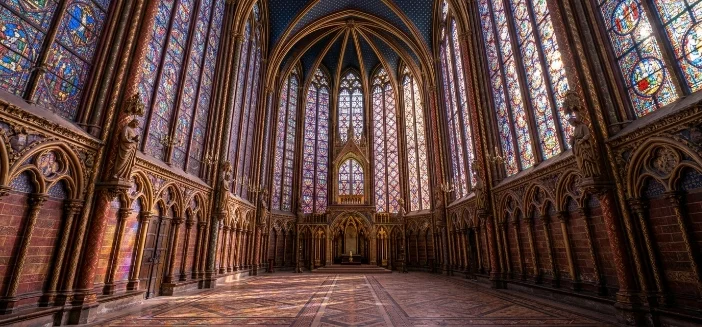
The Architects’ Choice: Why the Parthenon Still Wins
Here’s something that shouldn’t make sense. The Parthenon is broken. It’s been broken for a while, damaged by the Venetians in 1687 (who blew up a Turkish powder room inside the temple with a mortar shell) and quietly pillaged throughout the 19th century (including the famous Parthenon or Elgin marbles, now in London where they’ve been a diplomatic irritant for 220 years). The Acropolis has, structurally, the shell of the Parthenon.
And architects still vote it #1.
Why? Because the bits that are still standing show off a kind of sophistication that didn’t get matched for a very long time afterward. The columns aren’t straight. The platform isn’t flat. Those horizontal lines that look perfectly level from the bottom of the steps are actually subtly curved, because the Greeks understood that perfectly level lines, viewed from below, look like they’re sagging. So they curved them upward to make them appear level. Same with the columns — they bulge slightly in the middle, a trick called entasis, because dead-straight columns look concave to the human eye. Every refinement is calibrated to the way a body actually sees the building.
That’s the part that gets architects misty. Not the marble. The fact that someone in the 5th century BC was thinking about your eyeballs.
Pericles commissioned it. Iktinos and Kallikrates designed it. Phidias did the sculpture. It went up in about nine years on top of an older temple the Persians had burned down and the whole thing was a flex — a city-state declaring, in stone, that it had won. The fact that we’re still arguing about whether anything has surpassed it is itself part of the answer.
What I’d push back on, if I’m being honest: there’s a circular thing happening here. Architects love the Parthenon partly because every architect since has been taught to love the Parthenon. The Doric order, the proportional system, the optical refinements — these are the things you learn in your first year of architectural history, framed as the source. So of course it wins the polls. That doesn’t make the polls wrong, but it’s worth naming.
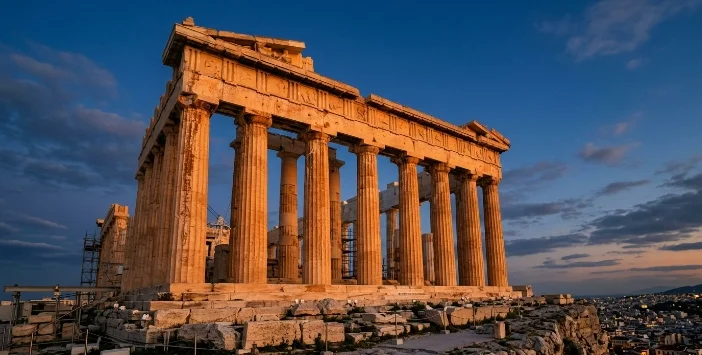
The Critics’ Choice: Sainte-Chapelle and Why I Think It’s the Real Answer
If the Parthenon wins on geometry, Sainte-Chapelle wins on the thing that’s actually harder to pull off — making you forget you’re looking at a building.
It was built in seven years. Seven. Between 1242 and 1248 Louis IX (who became Saint Louis) built it to house the Crown of Thorns he’d bought from the Latin Emperor of Constantinople for an obscene amount, more than he spent on the whole chapel, just so you know where the priorities lay in the Middle Ages. So it’s a double-deck chapel on the Île de la Cité and the first floor is nice, pretty, vaulted, you’d be impressed if you had time to look. But you go upstairs.
And the walls are gone.
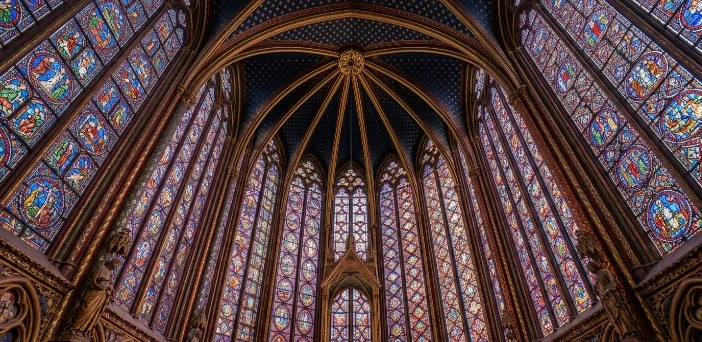
That’s the trick. Rayonnant Gothic was the late phase of the style where the masons figured out how to push the structural load almost entirely into slender bundled piers and external buttressing, which freed the wall to become — well, not a wall. At Sainte-Chapelle the upper chapel has fifteen windows, each over fifteen meters tall, depicting more than 1,100 biblical scenes in glass that is mostly original 13th-century work. About two-thirds of the glass survived the Revolution, the bombings, the various indignities of eight centuries. On a sunny afternoon the floor turns into a moving mosaic of red and blue light.
The architecture critic Tom Dyckhoff has called it “one of the most beautiful buildings on Earth,” praising the way grace, meaning, form and function all show up in the same room at the same time. That’s the part I think tilts it past the Parthenon for me — the Parthenon is a triumph of thinking, but Sainte-Chapelle is a triumph of feeling. You stand in the middle of it and your nervous system reacts before your brain does. Geometry can’t really do that. Light can.
Practical tip in case you ever come: come on a sunny day in the morning. You are seeing colored glass on cloudy days and are inside the light on sunny days. It really differs. Lines may be harsh, book in advance the time of entry at the site Centre des Monuments Nationaux.
A few things I think Sainte-Chapelle does that nothing else on this list does:
- It makes structure vanish. You can’t tell what’s holding the roof up. That’s the whole point of Rayonnant Gothic and nobody else pulled it off this completely.
- The proportions of the upper chapel relative to a human body are perfect. You feel small but not crushed.
- It’s small. That matters. The big cathedrals — Chartres, Notre-Dame, Cologne — are awe at scale. Sainte-Chapelle is awe at room-size, which is somehow more intimate and more shocking.
The People’s Pick: The Eiffel Tower (Which Parisians Hated)
Here’s the funny thing about the Eiffel Tower. The people who write listicles love to point out that artists and writers petitioned against it when it went up — and they did and it’s a good story, but it’s also become it’s own little cliché. Let me give you the actual texture of it instead.
Forty-seven prominent French artists and intellectuals signed a letter of protest in Le Temps in February 1887, while the tower was still being built. Guy de Maupassant signed it. Charles Gounod signed it. The novelist Joris-Karl Huysmans called it a “hollow candlestick.” Another writer called it a “truly tragic street lamp.” Maupassant supposedly later took to eating lunch in the tower’s restaurant on the grounds that it was the only place in Paris where he didn’t have to look at the tower. Whether that’s literally true or one of those quotes that got too good to verify, I’ll leave to you.
What’s interesting is why they hated it. It wasn’t ugliness, exactly. It was that the thing was honest about being made of iron. There was no stone cladding, no historicist costume — just exposed industrial latticework, the bones of the 19th century made into a monument. To people raised on Haussmann’s Paris of cream-colored stone and mansard roofs, this was vulgar. It was the engineering equivalent of someone showing up to the opera in work boots.
It was supposed to come down after twenty years. The contract said so. It’s still there because Eiffel had the foresight to put a radio antenna on top during WWI and the French military decided the tower was too useful to demolish.
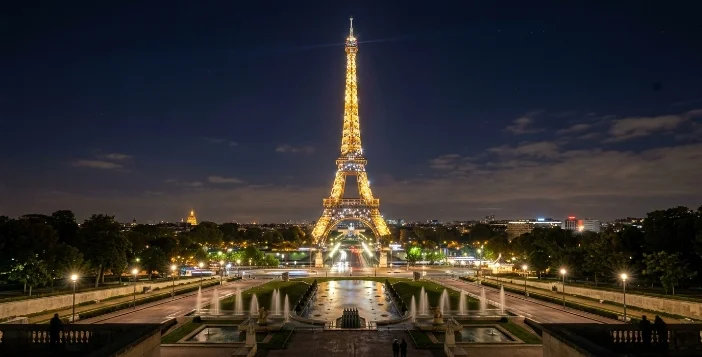
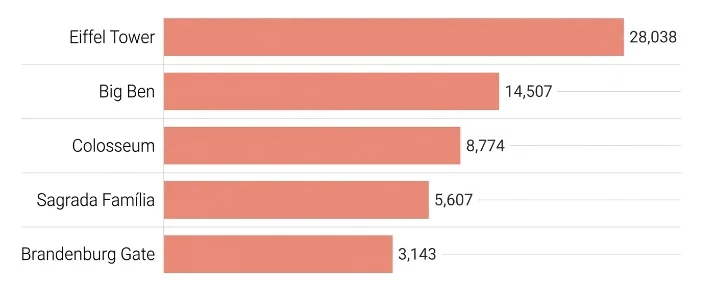
The tower’s modern beauty is, I think, a different category from the Parthenon’s or Sainte-Chapelle’s. It’s not beautiful because of proportion or light. It’s beautiful because it became the symbol of a city so completely that you can’t picture Paris without it. That’s a kind of beauty too — earned, not designed-in. It’s the difference between a face that’s beautiful in photographs and a face you love because it belongs to someone you love. Both real. Different things.
The Atmosphere Pick: The Alhambra, Where Beauty Is a Feeling
I’ve been to the Alhambra twice and I still can’t quite describe what it does. So let me try by way of a small thing.
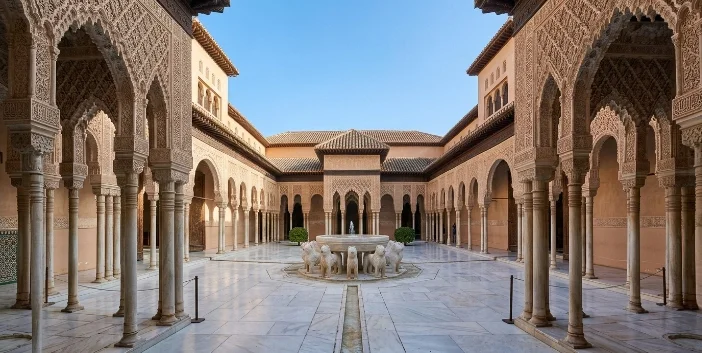
It has a courtyard known as the Court of the Lions which has a fountain supported by twelve marble lions in the center with a channel of water that runs around the courtyard and into four channels leading to the four rooms around the courtyard. The water does not cease to flow. It is very slow, nearly silent–you cannot hear it, you can only feel that the air is different. The entire palace is connected in this manner. The circulatory system is water. The Hall of the Two Sisters has a fountain in the floor and the water comes out through the channel there and passes under the threshold and into the adjoining room. Here architecture and plumbing are synonymous.
The Nasrid trick. The Alhambra was the final great project of Moorish Spain, constructed in the 13th and 14th centuries by the Nasrid dynasty in their court, which was gradually being defeated by the peninsula to the Reconquista. The entire complex is located on a hill above Granada with the Sierra Nevada behind it and was intended to be, in the writings on the walls themselves, in Arabic poetry incised into the stucco, heaven on earth. A garden. An account of paradise in the Quran, translated literally.
Most of what you see is not stone. It’s carved stucco and tilework, painted and gilded, geometric patterns that loop and repeat in ways mathematicians later got very excited about — the Alhambra contains examples of all seventeen possible wallpaper symmetry groups, which is a fact you can either find boring or astonishing depending on your temperament. M.C. Escher visited in 1922 and his entire career changed.
What the Alhambra possesses which it has not in any other of the list is sound. All other buildings here are first a visual experience. The Alhambra is both auditory and sensual and visual simultaneously. The water, how the temperature changes as you pass out of a sunny courtyard into a tiled room, the carvings you can feel your way along with a hand, it’s a structure designed to be felt with, rather than looked at.
If you only see one of the buildings on this list in your lifetime, I would tell you to see this one.
The Still-Being-Built Masterpiece: Sagrada Família
Antoni Gaudi began Sagrada Família in 1882. He was killed in 1926 – he was struck by a tram a couple of blocks off the construction site and like a vagrant due to his shabby clothing, he was brought to a pauper hospital. The basilica was a quarter unfinished. It is not complete yet, in 2026, but they are saying that it was planned to complete the main towers in 2026 and we will see.
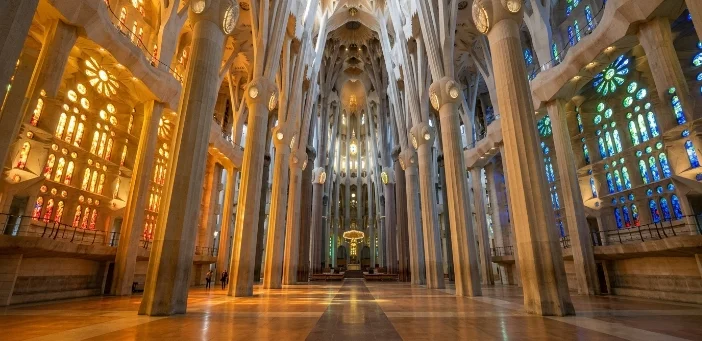
Here is a building that breaks every rule on this list. It’s not symmetrical. It’s not restrained. It does not honor proportion in any classical sense. The columns inside are tilted — Gaudí designed them to lean at the angles a tree branches at, because he was obsessed with the idea that nature had already solved every structural problem and architects were idiots for not paying attention. He worked out the load distribution using upside-down models with weighted strings — gravity doing the math for him.
Enter and the columns grow out like a wood of stone. The light enters on stained glass which changes to cool blues on one side of the nave and warm reds and golds on the other, as the day changes. It is not a silent building. It is gigantic and overpowering and somewhat insane and it is the nearest thing to the emotional effect of a great Gothic cathedral which is precisely what Gaudi sought.
Two things worth knowing:
- The construction has been funded almost entirely by private donations and ticket sales for over 140 years. No state money, no Vatican money. Just visitors.
- It only got formal building permits in 2019. For 137 years it was, technically, an illegal construction. Spain shrugged.
Gaudí once said, when asked why he was working so slowly, “My client is not in a hurry.” He meant God. The line is probably apocryphal but it’s the kind of thing he would have said.
The Quick Tour: Five More That Belong in the Conversation
I could keep going at length on each of these, but you’ve got a life to live. Quick passes:
The Cathedral of London, St. Paul. Thirty-six years was spent on it by Christopher Wren, following the Great Fire of London in 1666, which leveled the medieval cathedral that had occupied the site. The thing is the dome, the second-largest in the world after St. Peter’s in Rome. Wren constructed it as a triple shell: an outer shell dome which you can see outside the city, an inner shell dome which you can see inside the floor and a secret brick cone in between which does the actual structural work. It’s a magic trick.
Basilica of St. Mark, Venice. And if the Alhambra is a garden of Paradise, the St. Mark’s is a treasure chest of Paradise. The interior, more than 8,000 square meters of gold mosaic, amassed over eight centuries, illustrating a basically complete Bible and a good deal of Venetian self-mythology. The four bronze horses of the loggia were stolen in Constantinople in 1204 and Venice has been courteously refusing to give them back, ever since.
Neuschwanstein, Bavaria. Constructed during the 1860s and 70s by Ludwig II of Bavaria, who was the Mad King and who emptied his wallet to erect fairy-tale castles in the Alps. It inspired the Sleeping Beauty castle which was made by Disney. Architecturally it is a pastiche, a 19th-century Romantic confection aping medieval styles, but so committed to the bit as to outgrow pastiche and become it’s own thing. A good winter watch, as the snow doubles the illusion.
Hallgrímskirkja, Reykjavík. A 20th-century Lutheran church that looks like a glacier wearing a cathedral. The architect, Guðjón Samúelsson, modeled the façade on the basalt columns you find in Iceland’s lava flows. Time Out ranked it the highest European entry on their global “most beautiful buildings” list. It’s polarizing — some people think it’s brutalist and ugly. I think it’s the most honestly Icelandic building ever made.
Versailles. Less a building than a thesis statement: that the French monarchy was God’s regent on earth and you, peasant, should be impressed. The Hall of Mirrors works on you whether you want it to or not. The gardens are arguably the better art.
| Building | One-Line Verdict |
| St. Paul’s | A dome that’s actually three domes pretending to be one |
| St. Mark’s | Eight centuries of gold mosaic. You will run out of neck. |
| Neuschwanstein | Fantasy committed to so completely it loops back to sincere |
| Hallgrímskirkja | The lava flow that became a church |
| Versailles | Power, made into a building, then made into a garden |
So, Which One Wins?
None of them. All of them. You knew that going in.
But I should really say to the question and you are the one who asks it–here I would come down. The most significant building on this list is the Parthenon. The most renowned is the Eiffel Tower. The Alhambra is the one that I would most like to revisit. The most ambitious is Sagrada Família. And Sainte-Chapelle is what I believe is the prettiest, in the narrower sense of the word that which does the most to your nervous system in the least space, with the least explaining that is required.
The category is real but it’s also slippery. “Pretty” isn’t the same as “great.” Versailles is great and not particularly pretty. Brutalist housing in Marseille is, to a lot of people, ugly and also among the most important buildings of the 20th century. Beauty is doing a different job than significance.
What I’d encourage, if you’re using this article as a planning document for an actual trip: don’t try to see them all. Pick two. Pick the two that pull at you for different reasons — maybe one for the geometry person in you and one for the atmosphere person — and go properly, with time to sit in them. The Alhambra rewards three hours. Sainte-Chapelle rewards forty-five minutes on a sunny morning. The Parthenon rewards a whole afternoon on the Acropolis with a good guidebook. None of them reward a rushed selfie and a checked box.
Which one’s calling you? I’m curious.