
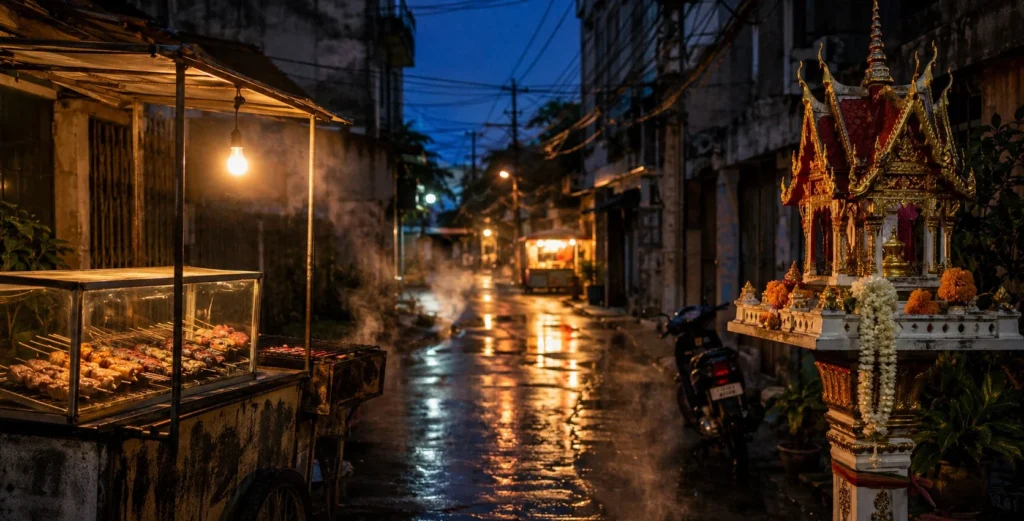
The first thing that got me wasn’t a temple or a beach. It was the smell of a Bangkok backstreet after rain — wet asphalt steam, a punch of durian husk from a cart nobody was manning and underneath all of it the sweet smoke of pork skewers going over coals. Somewhere a spirit house had a fresh jasmine garland draped on it, already wilting in the heat. I stood there with my bag still on my shoulder, not moving. You don’t ease into this country. It arrives all at once.
I’ve travelled a fair bit. Thailand is the only place that made me feel like every sense was being argued with simultaneously and somehow I didn’t mind losing.
The Paradox You Have to Make Peace With First
Here’s what nobody quite prepares you for. A glass tower goes up forty storeys, all chrome and air-con and a mall at the bottom selling the same things you’d find in Singapore or Dubai. And at the foot of it, on a little pillar, sits a spirit house — a tiny ornate dollhouse where the displaced land spirit is meant to live. Someone leaves it a strawberry Fanta. Red, for sweetness, for the colour of energy. Marigolds. A stick of incense, lit that morning.
I watched a security guard in a pressed uniform do exactly this outside a skyscraper, set the Fanta down, press his palms together, then go back to scanning passes. Ancient and hyper-modern, not fighting each other, just sharing a pavement. That’s the thing about Thailand — the locals call the national mood sanuk, roughly fun or joy, the instinct to keep things light and harmonious even with strangers. The “Land of Smiles” tag gets sold as marketing. It’s not. It’s a genuine social operating system and the spirit house and the skyscraper are both running on it.
Make peace with that contradiction early. It’s the soul of the whole trip and if you spend your time trying to file Thailand under “developing” or “modern” you’ll miss that it cheerfully refuses to be either.
Three Things That Will Get You in Trouble (And Why)
Bodies matter here in a way that’s easy to trample on without realising. I got it wrong twice in my first week. Let me save you the second time.
The rules sound like superstition until you understand the logic underneath — there’s an actual hierarchy of the body, top to bottom, sacred to profane.
| Body part | Status | What this means for you |
| Head | Most sacred | Never touch anyone’s head. Not a child’s, not affectionately. Don’t reach over a taxi driver’s seat to hand him money — you’re passing your hand over the holiest part of him. |
| Feet | Lowest, dirtiest | Never point your soles at a person or a Buddha image. Sitting in a temple, tuck your feet behind you, “mermaid-style,” soles pointing back and away from the altar. |
| Face (naa) | Governs everything | This is social, not physical. Public anger makes everyone lose face. The tourist yelling at a hotel clerk isn’t just rude — locally, they’ve committed something close to a moral offence. |
That last one took me longest to feel rather than just know. The loud foreigner at the front desk, going red, demanding — I used to find it embarrassing in the ordinary way. Here it lands differently. You’re not just being a pain. You’re forcing a loss of face onto a person who has no cultural permission to fight back and everyone watching feels the wrongness of it.
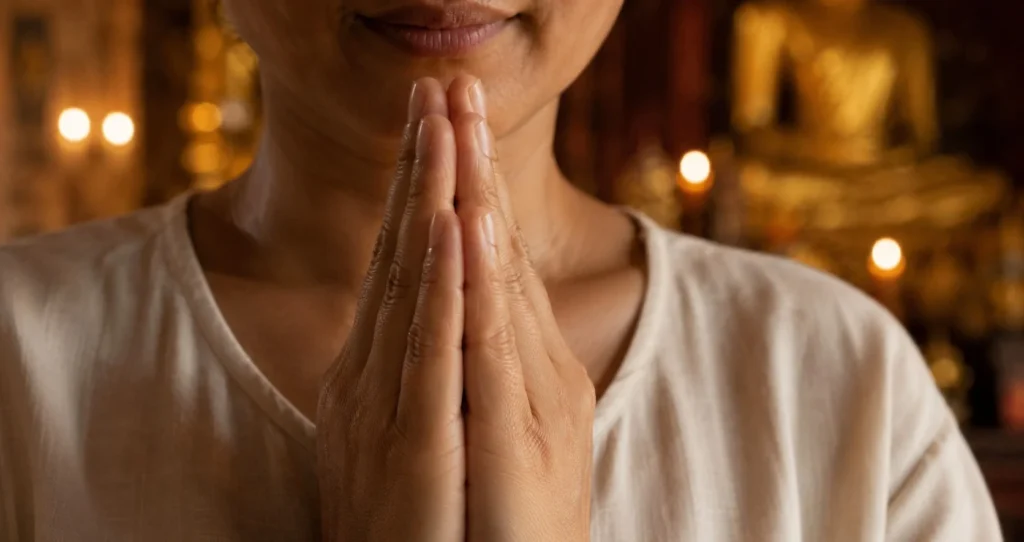
Then there’s the wai — the palms-together greeting at chest level. Tempting to fire it off at everyone, like a polite reflex. Don’t. You don’t initiate a wai to someone of lower social standing — a waitress, a child. You receive theirs. The height of your thumbs signals the respect: chest, chin, forehead, rising with the status of who you’re greeting. Get it slightly wrong and nobody will say a word — remember the face thing — they’ll just quietly note that you didn’t know. So learn it before you need it.
Don’t Treat It as One Country
Thailand isn’t a place, it’s about four places wearing the same flag. Lump them together and you’ll plan the trip wrong — too long in the wrong city, rushing the part that would’ve undone you.
Bangkok Runs on Water, Not Roads
Everyone tells you Bangkok is traffic. It is. But the city’s real spine is the Chao Phraya River and once I started moving by water the whole place reorganised itself in my head. The river doesn’t show you a postcard. It shows you the actual gradient of the city — the gilded spires of the Grand Palace one minute, then twenty minutes downstream the crumbling Portuguese bones of Santa Cruz Church over in Thonburi, a colonial ghost most visitors never clock.
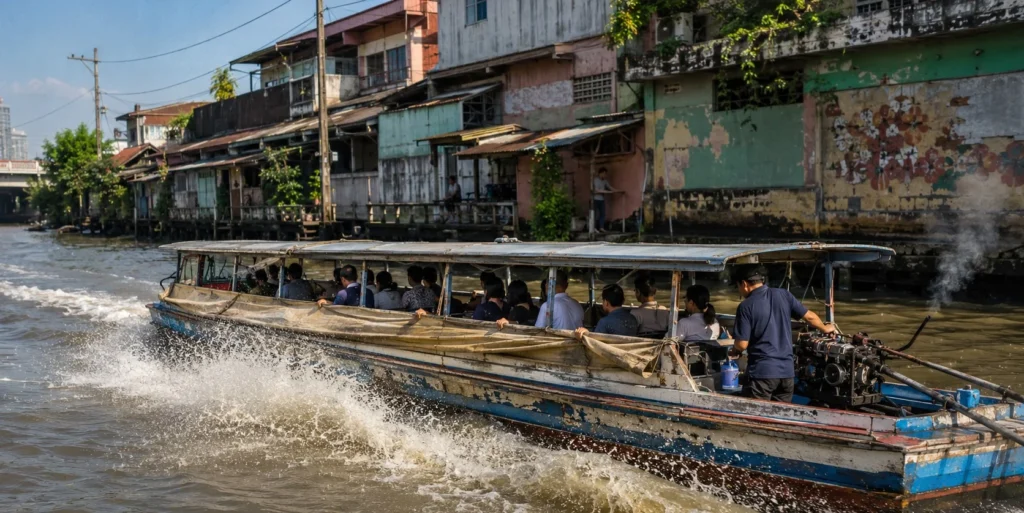
And then there’s the canal. The Khlong Saen Saep boat is a commuter service that feels like a dare. Gritty, splashy, terrifyingly fast — they pull a tarp up the side so you don’t get soaked by the brown wash and you cling to it while the boat slams between stops past tin-shack communities and fading murals. It’s not a tour. It’s how people get to work. I rode it with no destination one afternoon just for the story of it, which I realise is exactly the kind of thing the people actually commuting did not have the luxury of doing.
A note on the name, because it delighted me: Bangkok’s full ceremonial name is the longest place name in the world. It translates, roughly, as “City of angels, great city of immortals, magnificent city of the nine gems, seat of the king, city of royal palaces, home of gods incarnate, erected by Vishvakarman at Indra’s behest.” Nobody says that. They say Krung Thep — “City of Angels” — the first two words and get on with their day.
Chiang Mai Wakes Up Slowly, Except at 5:30am
Go north and the tempo drops. Chiang Mai sits inside an old square moat with the misty bulk of Doi Suthep watching over it and it’s filled the moat-town with digital nomads, artists and people very serious about coffee.
That coffee has a backstory worth knowing. The micro-lot beans coming out of the northern hills exist because of Royal Project initiatives that replaced opium farming, decades back. So when you’re handed a carefully poured cup in some plant-filled café, you’re drinking the end of a long, deliberate transformation. Pair that with the farm-to-table cooking up here — chefs genuinely foraging local herbs, not putting “foraged” on a menu as decoration — and the North starts to feel like a place that thinks hard about where it’s food comes from.
But the thing that stayed with me was the alms round. On Wualai Road at 5:30am, before the city’s awake, you kneel barefoot on a thin plastic mat and offer sticky rice to a slow, silent line of saffron-robed monks. Here’s the part to get right: this isn’t a photo op. It’s tak bat, a transaction of merit and it only works if you bring silence and respect to it. I watched a tourist crouch-walk down the line with a phone six inches from a monk’s face and I felt the whole street wince without making a sound. Kneel. Offer. Let it be quiet. You’ll feel why people get up in the dark for it.
The South Is Paradise and the Problem With Paradise
Then the islands, which are gorgeous and which is also where the trip gets a conscience.
Maya Bay — the beach from The Beach — got loved nearly to death. They shut it for four years to let the coral reef claw it’s way back. Sit with that. The exact place that a film turned into a global must-see had to be closed because everyone came. That’s not a fun fact. That’s the central knot of modern travel and you’re holding one end of the rope.
So I went looking for the south that doesn’t make the highlight reels:
- Phuket’s old town, not Patong. Skip the neon. The good stuff is the Sino-Portuguese shophouses, dim sum breakfasts and the On-On Hotel, a backpacker landmark standing since the 1920s.
- Railay, at low tide. Famous for rock climbing, sure. But when the tide drops a sandbar surfaces and you wade knee-deep to a hidden cave shrine stuffed with carved wooden lingam offerings left by fishermen — raw animist faith, no signage, no entry fee.
- The Emerald Cave, for the proper off-grid tale. Morakot Cave on Koh Mook, down in the deep south near Trang. You swim 80 metres through a pitch-black tunnel — actually dark, the kind where you reach for the person ahead — and come out into a hidden lagoon ringed by sheer cliffs, open to the sky. Cathedral-quiet. I came up gasping and then just stopped talking.
Here’s my honest steer. If you only do the Andaman big-hitters, you’ll have a lovely time and you’ll have seen what everyone saw. The deep south — Trang, Satun — is where Thailand still feels found rather than sold.
Every Plate Has a Postcode
The mistake is thinking Thai food is a cuisine. It’s a set of regional arguments and each dish carries a geography in it. Learn to taste where you are.
I Went South to Find a Persian Ghost
Massaman curry doesn’t taste like the rest of Thai cooking and there’s a reason. It’s a Muslim-influenced dish from the south and the spices in it — cinnamon, cardamom, the warm ones — came up the old maritime trade routes from Persia centuries ago. You’re not eating a curry. You’re eating an artifact of the spice trade that happens to still be warm.
CNN Travel once named it the best food in the world, which is the sort of ranking I’d normally roll my eyes at. But it gave me an excuse for a quest and quests are how you actually learn a country. So I chased a proper Massaman down south and the version I found — slow-cooked, the potato gone soft enough to collapse, that low cinnamon hum under the chilli — tasted like something that had travelled a very long way to reach the bowl. Which, in a sense, it had.
Isaan: Where Sticky Rice Is a Tool, Not a Side
The northeast — Isaan — makes the food I’d fly back for. It’s loud, funky, mortar-and-pestle cooking with no interest in being pretty.
- Som tam — green papaya salad, pounded to order, the thud-thud of the pestle audible three stalls away.
- Larb moo — minced pork, toasted rice powder, fish sauce, a charred funk that sounds wrong on paper and is perfect in the mouth.
- Khao niew — sticky rice. And here’s the thing to understand: in Isaan it isn’t a side dish. You pinch off a wad, roll it into a ball with your fingers and use it to scoop, sop, carry. It’s a utensil, a vessel and honestly the beating heart of the whole regional table.
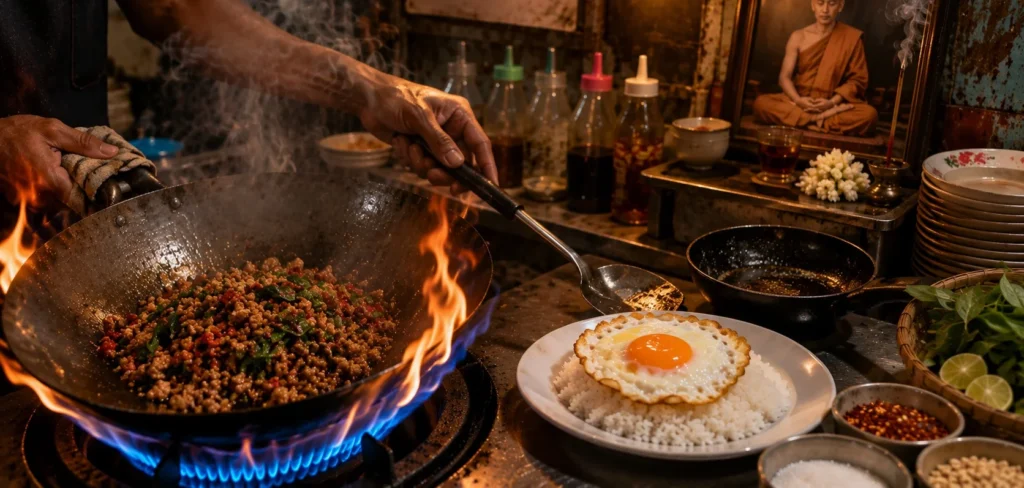
A small piece of street-food fluency that’ll mark you as someone who knows: order pad kra pao — holy basil stir-fry — “khai dao,” with a crispy-edged fried egg on top and “phet phet” if you want it properly spicy. And how do you spot the stall worth queuing at? Look for a shrine to a beloved king or monk on the wall and a queue that’s already forming before 11:45am. Locals know before the lunch rush. Follow them.
The Mango Sticky Rice Moment
Mango sticky rice had it’s global main-character moment in 2022 when a Thai rapper ate it on stage at Coachella and suddenly a classic that locals had quietly loved forever was everywhere. I’m glad. It deserves the fuss. Ripe mango, warm coconut-soaked sticky rice, a pinch of salt cutting the sweet — it’s the Thai sweet-salty-creamy trinity in one spoon. One catch: it’s seasonal, peaking around April and May. Out of season you’ll still find it, but you’ll be eating a memory of the real thing.
| Region | The dish to chase | What it tells you about the place |
| South | Massaman curry | Old trade routes, Muslim influence, Persian spice on the wind |
| Northeast (Isaan) | Som tam, larb, sticky rice | Rural, bold, hands-on, no pretension |
| Central / Bangkok | Pad kra pao, street stir-fries | Fast, balanced, the everyday genius of Thai cooking |
| North (Chiang Mai) | Foraged farm-to-table, micro-lot coffee | Slow, considered, rooted in a real transformation story |
Moving Through It Without Losing the Plot
Take the Night Train at Least Once
The overnight 2nd-class sleeper from Bangkok to Chiang Mai is a rite of passage dressed up as transport. You board to ordinary seats and at some point an attendant comes through and — there’s no other word — transforms the carriage. Your seat folds down into a private bunk, crisp sheet, a blanket, a curtain you can pull against the world. Around 1,000 baht. You lie there swaying as the fluorescent-lit countryside smears past the window and you sleep the strange good sleep of a moving train. Flights are faster and you’ll regret taking one.
Bangkok Belongs to the GrabBike
Grab is the Uber of Southeast Asia and you’ll want it day one. But the move most visitors miss is the GrabBike — a motorcycle taxi you hail through the same app. In Bangkok’s traffic a car will sit and stew; the bike threads the gaps, runs the white lines and gets you there while the taxi’s still at the lights. Terrifying the first time. Indispensable by the third. Helmet on, bag clamped between you and the driver’s back and go.
For the rest:
- Get a local SIM or eSIM. An AIS tourist SIM with unlimited data is the difference between a confident detour down an alley and a genuinely lost afternoon. Sort it at the airport.
- Lineman for food delivery — it’s in Thai, but it’s where the real stalls live.
- Google Translate with the Thai offline pack downloaded before you need it. The camera translate on a menu has saved me more than once.
And then, if you’ve got the nerve, the Khlong Saen Saep canal boat I mentioned earlier — not for getting somewhere, but for seeing the city’s back door at speed.
A Visa Note, Because It Moves
Most Western passports get a visa exemption on arrival by air — and the length has been a moving target. It’s been bumped from 30 days up to 45 at points to encourage tourism and it’s the kind of rule that changes with the political wind, so check the current allowance against an official source before you fly rather than trusting a blog (including this one). Land border crossings are more restrictive — limited entries per calendar year — which becomes a real source of friction if you’re trying to stay long-term.
The Elephant Thing — Read This Before You Book Anything
This isn’t optional in a modern travel piece, so I’ll be plain.
Don’t ride elephants. An elephant’s spine isn’t built to carry a howdah — the chair — with people in it. And the animals are made rideable through phajaan, a documented process of breaking a young elephant’s spirit. There’s no gentle version. A trek operator’s smile doesn’t change what happened before you arrived. Riding is either unknowing complicity or the deliberate kind and now you know, so it’s only one of those.
The good model exists and it’s better anyway. Saddle-off sanctuaries like Elephant Nature Park near Chiang Mai and community projects run with Karen mahouts, let you walk alongside the animals — watch them mud-bathe, learn from indigenous Karen knowledge about how they’re cared for. The story there is rehabilitation, not performance and watching an elephant just be an elephant in the forest is worth ten of any trek.
The Smile Is Sometimes a Shield
A few social realities that’ll save you money and embarrassment.
The classic gem scam is so polished it’s almost a performance. A friendly, well-dressed stranger near the Grand Palace mentions it’s closed today — Buddhist holiday, what a shame — but there’s a special jewellery sale on and here’s a cheap tuk-tuk that’ll run you over. Every beat of it is a script. The Palace isn’t closed. The tuk-tuk’s in on it. The gems are worthless. What got me wasn’t the deceit, it was how charming the whole thing is — a small underground economy running on warmth.
Two subtler things. First, a Thai “yes” or a smile isn’t always agreement — sometimes it’s a way to avoid the discomfort of saying “no” to you. Ask directions and get a vague point and the person may simply be saving face for not knowing. The smile is a shield as often as it’s a welcome. Read past it gently.
Second, dual pricing. National parks and some sites charge Thais one rate and foreigners a much higher one. The reflex is to call it unfair. I’d sit with it differently — it’s a small meditation on privilege and access in a developing economy and the few hundred baht extra is not the thing worth losing face over.
Ten Thousand Light and the Field the Morning After
I saved the festival for last because it taught me the most and not in the way I expected.
If you’re in Chiang Mai on the November full moon, two festivals fold into one. Loy Krathong is the water half — you take a small float made of banana leaf, fold it into something like a lotus, set a candle and incense in it and let it go on the river. It carries off your misfortunes, your grudges, the year’s accumulated bad luck. Then there’s Yi Peng, the northern Lanna sky half — paper lanterns, khom loy, launched up into the dark.
I stood on a riverbank for the lantern release and I’m not going to pretend I was composed about it. Thousands of them, lifting together, silent — no fireworks crack, no music, just this slow upward drift of warm light until the sky looked like it had been turned upside down and filled with embers. People around me had stopped talking. You don’t clap at something like that. You just watch your own small light go.
And then the morning.
I went for a walk early and the same fields and waterways were strewn with the after — wire lantern frames tangled in branches, scorched paper, banana-leaf floats going soft and grey at the water’s edge. Thousands of them become litter. The thing that had felt transcendent the night before had a cost lying right there in daylight and there’s no honest way to hold the beauty without also holding that. I’d released a light too. I was in the field, both nights.
That’s Thailand, in the end. Not the smile on the brochure — the whole thing. A spirit house at the foot of a tower. A beach loved nearly to death and then nursed back. A curry that crossed an ocean to reach your bowl. A festival that’s breathtaking and wasteful in the same breath and asks you to feel both.
My GrabBike driver said something on my last night that I keep coming back to. I’d asked him, in my broken phrasebook Thai, whether he’d been to the islands everyone photographs. He laughed and shook his head. “For you,” he said, nodding back toward the city, toward home, toward the ordinary streets that aren’t anyone’s bucket list. Then, after a beat, tapping his chest: “This one, for me.”
I didn’t fully get it until I’d left. The Thailand worth finding was never the one in the photographs. It was the one the people who live there are quietly, unshowily in love with — the backstreet, the night train, the bowl eaten standing up at a stall with a queue. Go for the beaches if you must. Stay for that.