
While green card holders may travel abroad, permanent resident is not synonymous with unfettered ability to travel in and out: rules have bite and 2025 added wrinkles to know. The chances of being able to re-entry are dependent on a host of factors, such as how long you were away, what documents you have, and whether your country of origin is on a U.S. travel ban list (spoiler: it’s unlikely that you are on the list, but maybe your family is). Check this out before you reserve.
Reentry Documents: What You Must Show at the U.S. Border
Here’s the short version: no green card, no entry. That sounds obvious, but you’d be surprised how many people travel with an expired card thinking it’ll be fine because “they know me at the airport.” It won’t be fine.
When you land at any U.S. port of entry, a CBP officer will ask for your valid, unexpired Permanent Resident Card (Form I-551). That’s the baseline. On top of that, they’ll typically want to see:
- Your valid foreign passport
- Any other identity documents you’re carrying — national ID, U.S. driver’s license, etc.
The officer uses all of this to determine admissibility on the spot. They’re not just checking that the card exists — they’re building a picture of who you are and whether your situation raises any flags.
People forget one thing: look at the expiry dates, both on the passports, well in advance of travel. The guideline is that you should have at least six months after the planned return date. Expires 2 weeks after arrival in the country? This is something you don’t want to speak to CBP at 6am after a 14-hour flight.
The U.S. Department of State’s travel website is the best place to start for what vaccines you need, if you need an onward ticket, all of that and more for country-specific entry and exit requirements at your destination.
How Long Can a Green Card Holder Stay Outside the U.S.?
This is where most people get tripped up. There’s a persistent myth that as long as you’re under a year, you’re automatically fine. Not quite.
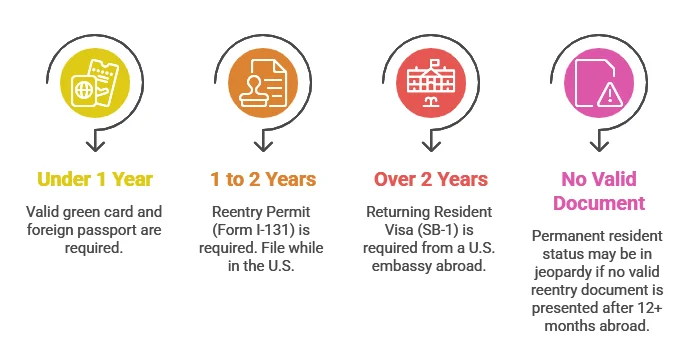
Under One Year — Generally Okay, But Not Bulletproof
Short trips don’t typically threaten your status. But a CBP officer can still question whether you genuinely intend to live in the U.S. permanently. They look at the full picture:
- Did you keep a U.S. address?
- Are you filing U.S. taxes as a resident?
- Do you have a job, bank account, property, or family ties here?
- Was the trip clearly temporary in nature?
If the answers point toward “this person doesn’t really live here anymore,” even a 10-month trip can become a problem.
One to Two Years — Get a Reentry Permit Before You Leave
Going away for over one year? Apply for Reentry Permit (Form I-131) prior to departure. This document, which is usually good for up to two years, enables you to re-enter the U.S. without having to seek a returning resident visa from an embassy in another country. It signals intent. This is not a guarantee of admission, but does make a huge difference.
Two non-negotiables on this: you must be physically present in the U.S. when you file, and again for your biometrics appointment. Don’t leave and try to file remotely — it doesn’t work that way.
Over Two Years — the Returning Resident Visa (SB-1)
If your reentry permit has expired or you never got one, you’re looking at applying for an SB-1 Returning Resident Visa at a U.S. embassy or consulate wherever you are. The bar is higher here. You’ll need to demonstrate that:
- Your extended stay was due to circumstances genuinely outside your control
- You maintained your intention to return as a permanent resident throughout
You will be required to fill out Form DS-117 and take an interview. It can’t be done, but it is not easy. Then, if you haven’t been outside this country for over a year and a day without a re-entry permit, your permanent status may already be at risk.
The 2025 U.S. Travel Bans: What Green Card Holders Need to Know
As early as 2025, news came out that certain countries would be subject to stricter entry restrictions, which likely made headlines for the green card-holding residents of these countries. The positive news is that the travel bans typically don’t apply to green card holders. Also exempt are dual nationals who are traveling on a passport from a non-designated country.
However, “exempt from the ban” does not mean “not at all affected. So what exactly did happen and what does it mean for you?
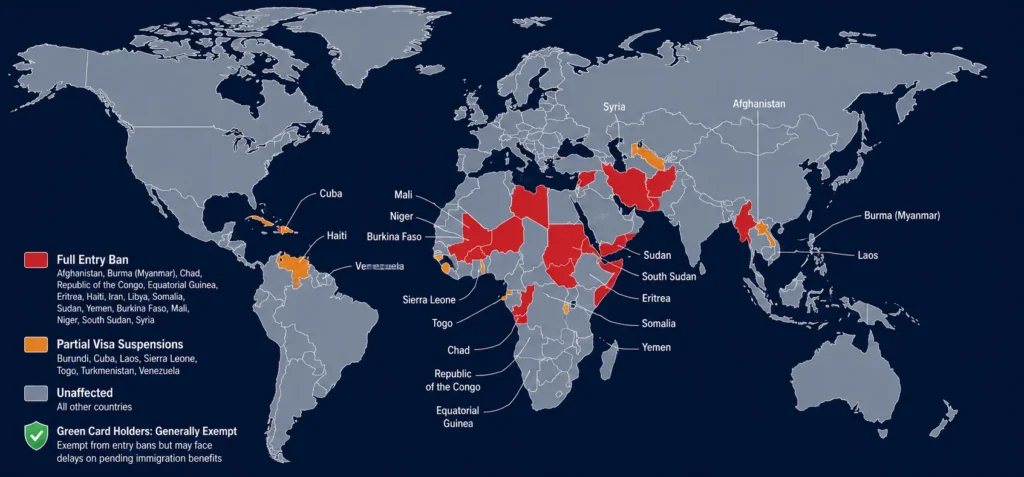
The Two Tiers of Restrictions
The proclamations carved out two categories:
Full Entry Bans — initially covering 12 countries, then expanded. The complete list now includes:
- Burma (Myanmar), Chad, Republic of the Congo, Equatorial Guinea, Eritrea, Haiti, Iran, Libya, Somalia, Sudan and Yemen
- Subsequent additions: Burkina Faso, Mali, Niger, South Sudan, Syria
Partial Visa Suspensions — restricting certain visa categories for nationals from:
- Burundi, Cuba, Laos, Sierra Leone, Togo, Turkmenistan, Venezuela
The Part That Does Affect Green Card Holders
The answer is not so clear cut. Although it is still possible to apply in person for immigration benefits (green cards) from these countries, the policy climate has created a slowdown in the processing of immigration cases from nations of origin. If you are awaiting a green card renewal or are applying for naturalization or any other advantage – and you are one of these nations – you may find yourself in a line that is waiting for no one.
Traveling while a benefit is pending? Worth a conversation with an immigration attorney before you book that ticket. Not to be alarmist, but the landscape shifted fast in 2025 and some of those shifts are still settling.
For current reporting on how these bans are being enforced and challenged, Reuters and AP have been tracking developments closely — worth a search for their latest dispatches before you travel.
Visa-Free Countries for Green Card Holders
One underappreciated perk of holding a U.S. green card: it unlocks visa-free access to a decent number of countries that your home country passport might not. This always works in combination with your valid passport — the green card alone isn’t enough — but together, the two documents open doors.
The Most Practical Destinations
Canada and Mexico are the obvious ones. Cross-border trips are routine for millions of green card holders, and neither requires a separate visa for tourism. Much of the Caribbean falls into this category too.
Beyond the neighborhood, here’s a sampling of countries where a valid U.S. green card facilitates visa-free entry:
- Albania — up to 90 days
- Anguilla — up to 90 days
- Aruba — up to 30 days
- The Bahamas — up to 30 days
- Belize — up to 30 days
- Bonaire — up to 90 days
- Ecuador — visa-free entry
- South Korea — visa-free for Jeju Island specifically
- Several Pacific island nations also extend this benefit
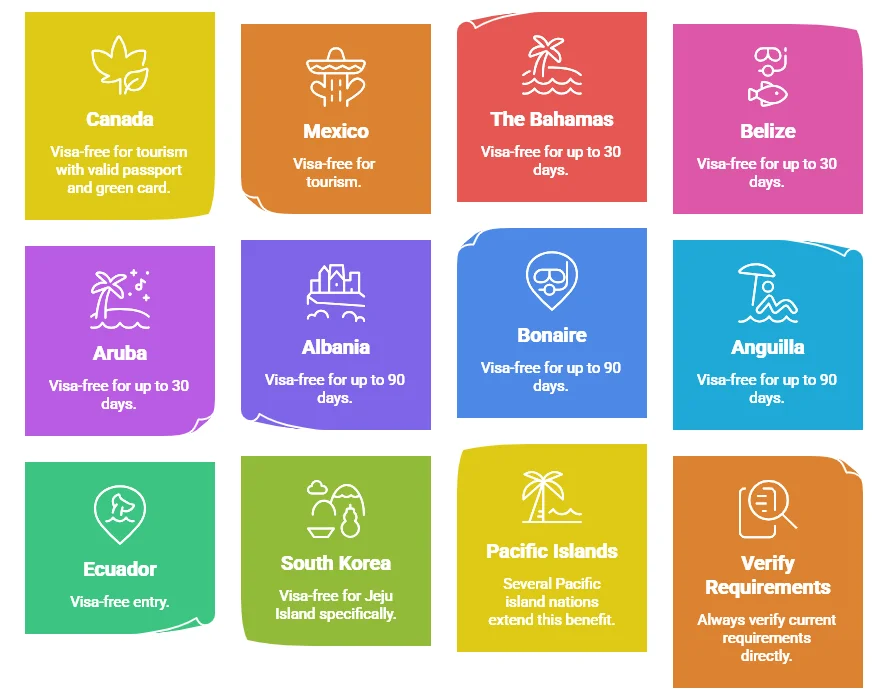
Some remarks are in order. This list is subject to change — countries change their entry policies (sometimes without notice). Nothing can be more important than checking with the embassy/consulate of the country to which you are travelling to find out the current requirements before travelling. Keep in mind: visa-free doesn’t imply unlimited stay or work permit. The rules that apply to that visit for each country remain in effect.
Also worth noting — this benefit is specifically tied to a valid green card. Expired card, no benefit. Another reason to stay on top of renewal timelines.
Special Situations: Criminal Records, Secondary Inspection & More
Most green card holders cross the border without incident. But certain situations flip the experience entirely — and knowing about them in advance is genuinely useful, not just legal fine print.
Secondary Inspection: What it Actually Means
CBP officers have very broad authority to conduct secondary inspections on any traveler, regardless of whether they possess a green card or not, and to question them further. It can occur for every type of reason, some which are quite ordinary. A name that matches to a database, discrepancy in travel history, occasionally random selection.
Being sent to secondary doesn’t mean you’ve done something wrong. What it does mean is that a more thorough review of your immigration history and admissibility is happening. During that process, one thing worth knowing: you have the right to request to speak with an immigration attorney. Whether that request gets immediately accommodated varies, but asserting it matters.
Don’t argue, don’t overshare, answer what’s asked. People who’ve been through it — and there are detailed threads on this exact topic on Reddit’s r/immigration — generally say staying calm and direct is what gets you through fastest.
Traveling With a Criminal Record
This one’s serious. Green card holders with certain criminal convictions face real risk of being denied reentry and placed into removal proceedings — even for older convictions, even for things that felt minor at the time.
The categories that trigger the most scrutiny:
- Crimes involving moral turpitude (CIMTs) — theft, fraud, certain assault charges fall here
- Felony convictions
- Multiple convictions, even misdemeanors
- Drug-related offenses
The frustrating part is that “I served my time” doesn’t reset the immigration clock. A conviction from years ago can resurface the moment you present your green card at a port of entry after international travel. If you have any criminal history, consult an immigration attorney before you travel. Not after something goes wrong at the border — before you leave.
Other Situations Worth Flagging
A few additional scenarios that can complicate reentry, even without criminal history:
- Unresolved immigration violations — prior overstays on old visas, even before you got the green card, can sometimes be raised
- Gaps in U.S. tax filing — not filing as a U.S. resident while abroad is one of the factors CBP considers when assessing whether you’ve abandoned status
- Travel to certain countries — not banned ones necessarily, but destinations that may prompt additional security screening based on current geopolitical conditions
None of these are automatic bars to entry. But they’re conversations you’d rather have prepared for.
Practical Travel Tips for a Smooth Reentry
A lot of reentry headaches are entirely avoidable. These aren’t exotic precautions — just habits that experienced green card travelers tend to develop over time.
Before You Leave
- Check both documents. Green card and passport — valid, unexpired, ideally with six months of runway beyond your return date. Put a reminder in your phone for renewal deadlines.
- If you’re going past a year, file Form I-131 first. USCIS’s page on the Reentry Permit walks through the process. Don’t leave this until the last minute — processing times fluctuate and biometrics appointments need to happen while you’re still on U.S. soil.
- Make copies of everything. Physical copies in your luggage, digital copies in your email. Green card, passport photo page, any reentry permit.
What to Carry When You Land
Documents that demonstrate your U.S. ties travel well in a folder:
- Recent pay stubs or employment verification letter
- Latest U.S. tax return (or at least the first page)
- Utility bill, lease agreement, or property deed showing your U.S. address
- Bank statements from a U.S. account
You probably won’t need any of it. But if a CBP officer starts asking questions about your residency intentions, having these ready changes the conversation completely.
A few other things
- Don’t overstay in a country where you’re on visa-free entry as a green card holder — it can complicate both that country’s future entry and your U.S. reentry narrative
- If your trip keeps extending for legitimate reasons, document why. Medical records, employer letters, anything that establishes the delay wasn’t a choice
- Know the current travel advisories for where you’re going — travel.state.gov updates these regularly
Final Thoughts
Green card status is genuinely valuable — and also genuinely fragile in ways that aren’t always obvious until something goes wrong at a border. The rules aren’t designed to trap people, but they do require engagement. Staying on top of document validity, understanding what extended absence actually triggers, knowing your rights during secondary inspection — none of this is complicated once you know it.
The 2025 policy shifts added a layer of complexity, especially for those from the newly designated countries. Even with the ban exemption, the downstream effects on benefit adjudication are real and worth monitoring.
When situations get complicated — criminal history, absences stretching past a year, pending immigration benefits — an immigration attorney isn’t a luxury. It’s cheap insurance against outcomes that are very hard to reverse once they happen.
Travel well. Just travel informed.