
On July 21, 2025, United Airlines Flight UA770 — a Boeing 787-9 Dreamliner flying from Barcelona to Chicago — made an unplanned emergency landing at London Heathrow after the crew detected a cabin pressurization issue at 37,000 feet. All 257 passengers and 12 crew members landed safely at 4:55 PM BST. No one was hurt. The aircraft was parked for inspection, and United arranged hotels, meals, and rebooking for affected passengers. Here’s the full breakdown of what happened, why it happened, and what it means for you as a traveller.
So, What Actually Happened Up There?
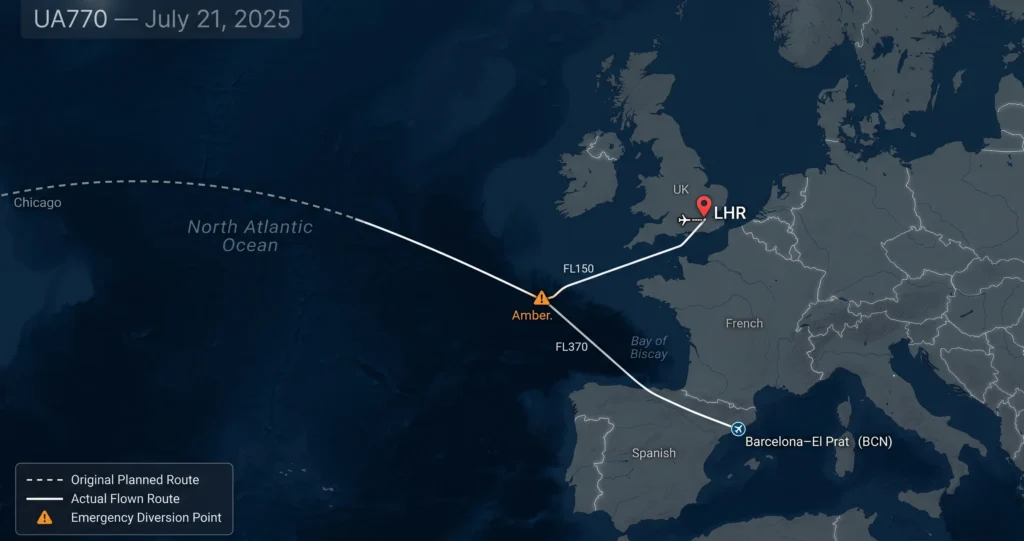
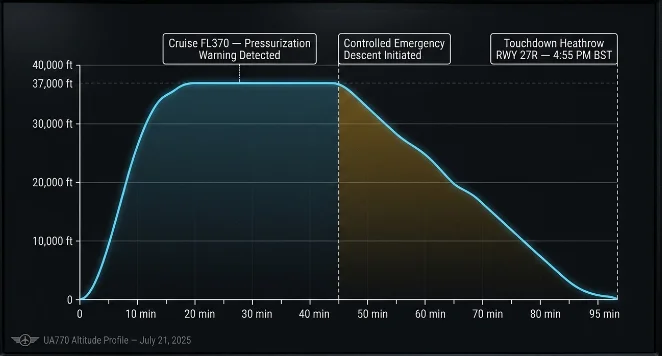
Somewhere over the North Atlantic — about 90 minutes out of Barcelona — something triggered an alert in the cockpit of UA770. The crew noticed a cabin pressurization warning. Not the kind of thing you ignore at 37,000 feet.
Here’s a quick snapshot of the flight before we get into the details:
| Detail | Information |
| Flight | UA770 |
| Aircraft | Boeing 787-9 Dreamliner |
| Route | Barcelona (BCN) → Chicago O’Hare (ORD) |
| Date | July 21, 2025 |
| Incident Location | Over North Atlantic, 37,000 ft |
| Emergency Code | Squawk 7700 |
| Diversion Airport | London Heathrow (LHR) |
| Landing Time | ~4:55 PM BST, Runway 27R |
| People Onboard | 269 (257 passengers + 12 crew) |
| Injuries | None |
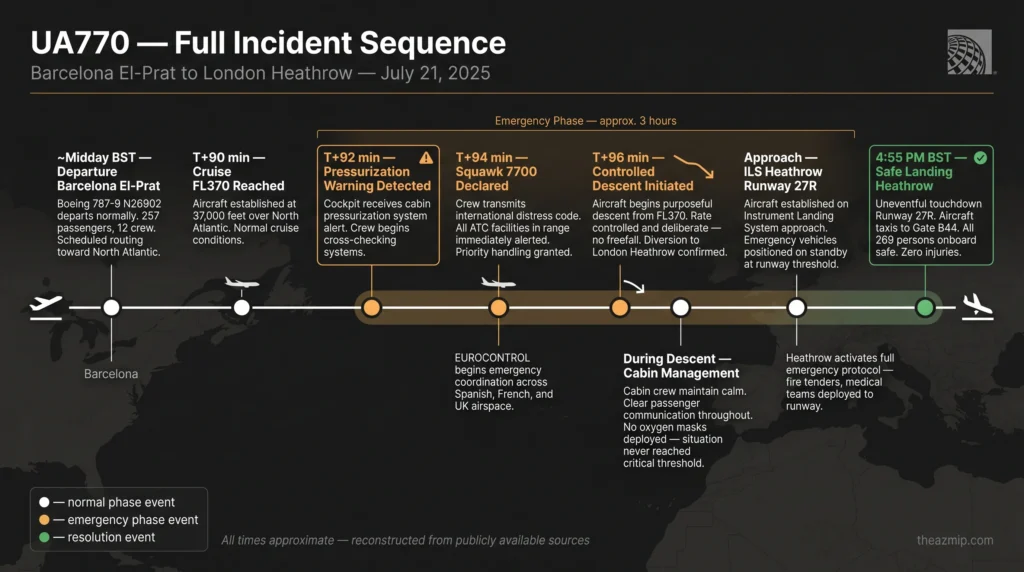
The pilots did exactly what they’re trained to do — declared an emergency, started a controlled descent, and rerouted toward the nearest suitable airport. London Heathrow, one of the best-equipped airports in the world for handling exactly these situations, became the destination.
What Is Cabin Pressurization — And Why Does It Matter?
Quick aviation lesson, because this is genuinely interesting.
Commercial aircraft fly at altitudes where the outside air is far too thin to breathe. At 37,000 feet, the air pressure is roughly a quarter of what it is at sea level. Without pressurization, passengers and crew would lose consciousness within minutes — no exaggeration.
So the aircraft’s systems constantly pump compressed air into the cabin, maintaining pressure equivalent to sitting at around 6,000–8,000 feet altitude. You barely notice it. Until something flags a problem.
When UA770’s cockpit received that warning, the crew couldn’t know immediately whether it was a sensor glitch or an actual pressure drop developing. Either way, FAA regulations are clear — when pressurization is in question at cruise altitude, you descend and you divert. That’s not a judgment call, that’s protocol.
Worth noting: no oxygen masks dropped in the cabin during this flight. That’s actually significant. Masks deploy automatically when cabin altitude exceeds 14,000 feet — the fact they didn’t means the situation never reached that threshold. The crew caught it early.
What’s Squawk 7700?
You might’ve seen this term in news coverage and wondered. Aircraft transponders communicate with air traffic control using four-digit codes. Squawk 7700 is the universal distress signal — it immediately flags the flight to every ATC facility in range as an aircraft declaring a general emergency.
The moment UA770 punched in 7700, controllers across EUROCONTROL’s network knew. Priority clearance, cleared airspace, emergency services on standby at the destination. It’s a system that works — and in this case, it worked exactly as designed. A good Wikipedia overview of transponder codes explains the full system if you’re curious.
How the Crew Handled It — And Why It Matters
This is honestly the part of the story that doesn’t get enough credit.
Declaring an emergency is one thing. Managing 257 passengers who have no idea what’s happening — while simultaneously running through checklists, coordinating with ATC across three countries, and flying the aircraft — that’s a different skill set entirely.
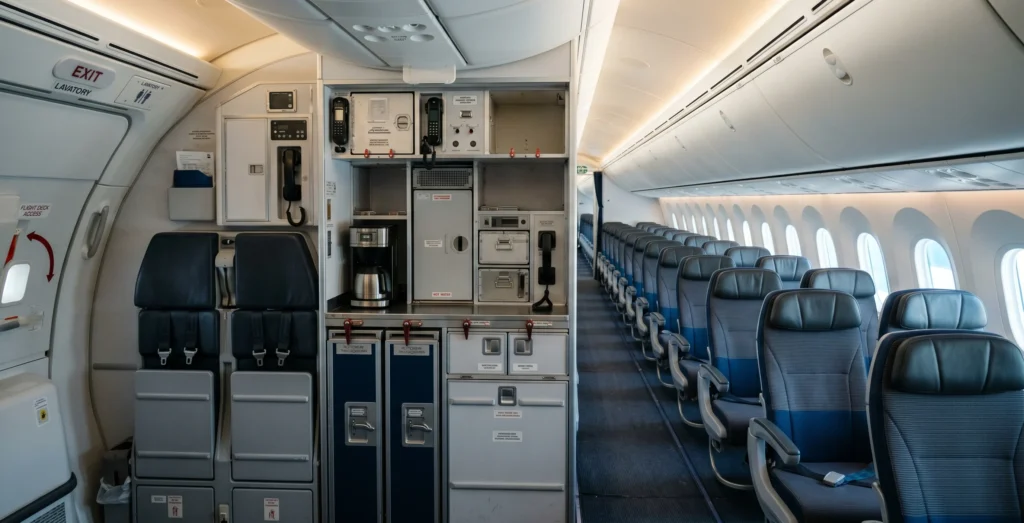
From what passengers reported afterward, the cabin crew were calm, clear, and professional throughout. No panic, no vague announcements that leave everyone staring at each other. Just straight communication. And that matters more than most people realise — a calm cabin is a safe cabin.
What the Pilots Did, Step by Step
- Received the pressurization warning alert in the cockpit.
- Cross-checked systems to assess severity.
- Declared emergency via Squawk 7700 — alerting all ATC in range instantly.
- Began a controlled descent — deliberate, not a dive.
- Coordinated with EUROCONTROL for priority routing through Spanish, French, and UK airspace.
- Used the Instrument Landing System (ILS) at Heathrow for approach guidance.
- Touched down on Runway 27R without incident.
The whole sequence — from warning to wheels down — is essentially a rehearsed drill. Pilots train for this repeatedly in simulators. Which is exactly why it looked routine from the outside, even though nothing about an emergency diversion is actually routine.
What the Cabin Crew Did
- Kept passengers calm and informed throughout the descent.
- Followed emergency communication protocols without triggering unnecessary alarm.
- Notably, did not deploy oxygen masks — confirming the pressure situation never became critical.
- Coordinated with ground staff at Heathrow for smooth disembarkation.
One thing worth flagging — passenger accounts from this flight were genuinely positive about crew communication. That’s not always the case in diversions. There’s a Reddit thread discussing passenger experiences during emergency diversions where you’ll find plenty of contrasting stories from other flights. The difference almost always comes down to how well the crew communicates.
The Landing and What Happened After
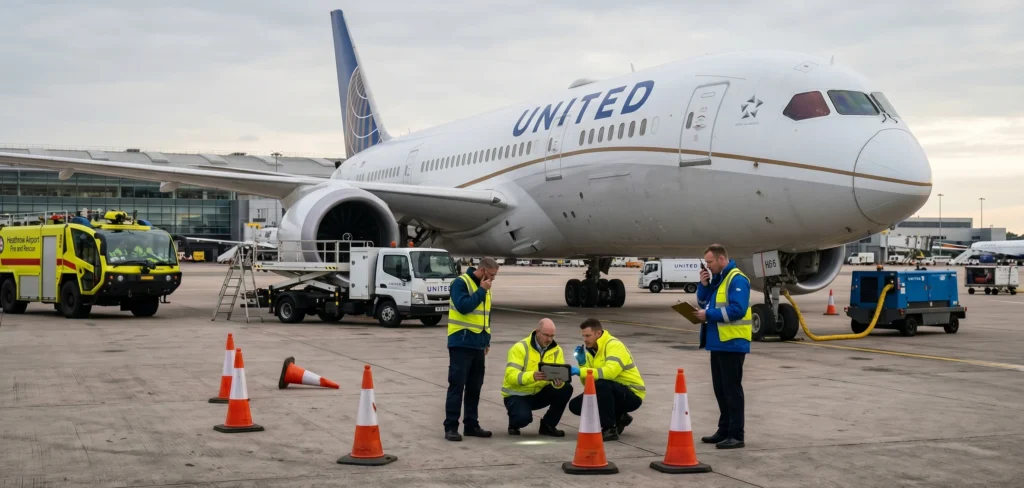
UA770 touched down at Heathrow at approximately 4:55 PM BST on Runway 27R. Emergency vehicles were standing by — standard procedure when a Squawk 7700 flight is inbound — but weren’t needed. The aircraft taxied normally to Gate B44.
Then came the part that frustrates most passengers: the waiting.
The aircraft needed inspection before anyone could make decisions about the onward journey. Engineers went through the pressurization systems while 257 people figured out what to do with an unexpected afternoon in London.
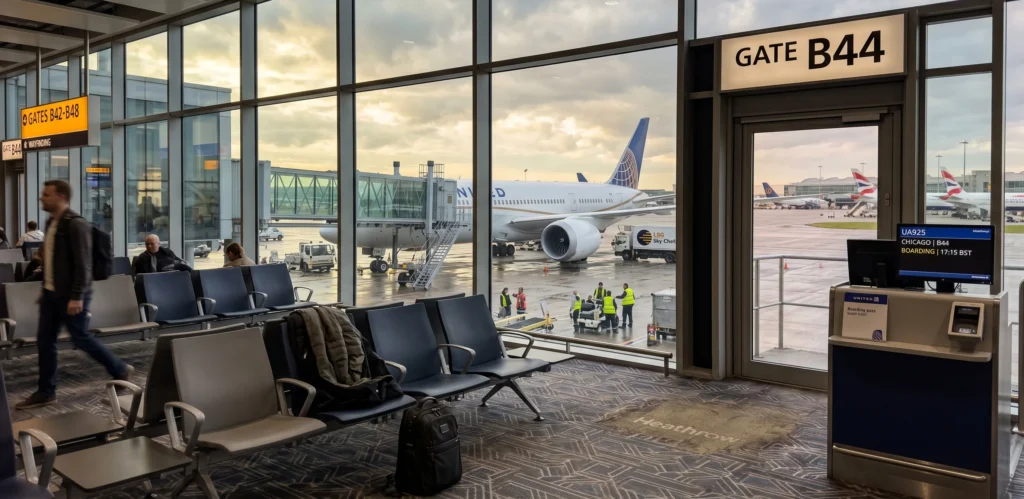
United’s ground response, by most accounts, was organised:
- Hotel vouchers issued for overnight accommodation.
- Meal vouchers provided.
- Rebooking assistance offered for onward travel to Chicago.
- Some passengers transferred to alternative flights departing same day where seats were available.
Your Rights When a Flight Diverts — Know Them
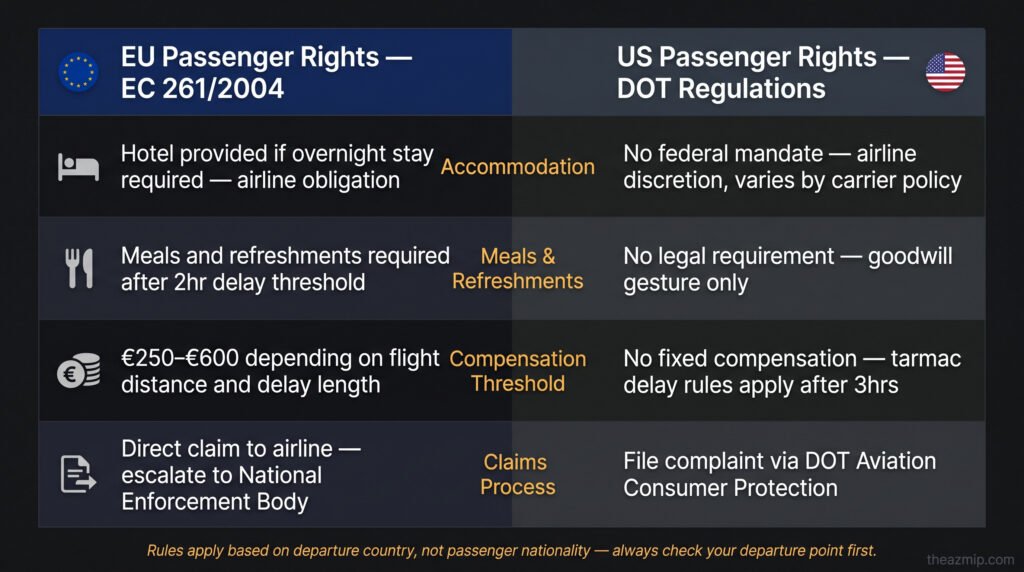
Here’s where it gets practically useful. A lot of passengers don’t know what they’re entitled to when something like this happens. Quick breakdown:
If you were on this flight departing from Barcelona (EU departure):
- EU Regulation EC 261/2004 likely applies.
- You’re entitled to care — meals, refreshments, accommodation if overnight stay required.
- Compensation depends on whether the delay was caused by “extraordinary circumstances” — a genuine technical fault can sometimes fall into that category, though airlines often dispute it.
If connecting onward from Heathrow to Chicago:
- US DOT rules kick in for the US-bound leg.
- DOT passenger rights guidelines are worth bookmarking honestly.
General tips if you’re ever on a diverted flight:
- Keep your boarding pass and any vouchers — you’ll need them for claims.
- Ask ground staff explicitly what you’re entitled to — don’t wait for them to volunteer it.
- Document everything: times, what you were told, what was offered.
- If compensation is denied, AviationADR handles UK-based disputes and is free to use.
What Actually Caused the Diversion? The Technical Side
Right, so this is where things get a little murky — and that’s worth being upfront about.
United Airlines confirmed the emergency immediately after landing. What they didn’t do was release a detailed technical explanation. That’s pretty standard — airlines don’t speculate publicly while an investigation is ongoing, and honestly, you wouldn’t want them to.
What the reports do tell us:
The confirmed part: A cabin pressurization system alert triggered in the cockpit. That’s what initiated everything.
The unconfirmed part: One source — and it’s worth stressing this wasn’t corroborated by the majority of reporting — suggested a seal leak in the secondary hydraulic system may have contributed. The theory being that dropping hydraulic pressure affected braking systems enough that the crew preferred not to attempt a transatlantic continuation and landing at O’Hare. Interesting if true. Unverified as of now.
The passenger rumour: A few early accounts mentioned passengers noticing a strange smell or odd noise before the descent began. These details never made it into any official or semi-official reporting, so file that under “possibly true, possibly just anxiety talking.”
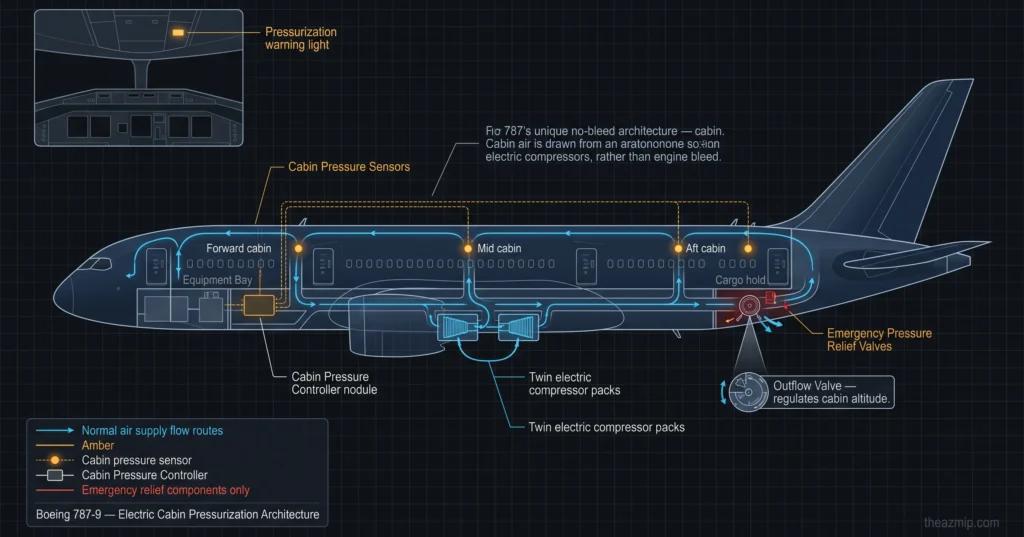
The aircraft sat at Gate B44 for diagnostic testing after landing. Engineers examined both the pressurization and life-support systems. Beyond that — no final technical report has been publicly released. The FAA reportedly launched a formal probe, though specific findings haven’t surfaced yet.
Which brings up something worth saying plainly: the absence of a public explanation isn’t a cover-up. Aviation investigations take time because getting them right matters more than getting them fast. The NTSB’s investigation process is a good read if you want to understand how methodical this stuff actually is.
Has This Happened Before? Putting It in Context
Diverting a flight mid-Atlantic isn’t common. It’s also not unheard of. The 787’s health monitoring systems are specifically designed to flag issues early — which means crews sometimes divert as a precaution when older aircraft might have continued flying without detecting the problem at all. Whether that’s reassuring or unsettling probably depends on your relationship with flying.
Here’s how UA770 stacks up against a few comparable incidents:
| Date | Flight | Aircraft | Cause | Outcome |
| July 21, 2025 | UA770 (Barcelona–Chicago) | Boeing 787-9 | Pressurization warning | Diverted to Heathrow, no injuries |
| April 7, 2008 | UA941 (Frankfurt–Chicago) | Boeing 777-200 | Squawk 7700 declared | Diverted to Heathrow |
| December 4, 2025 | UA803 (Washington–Tokyo) | Boeing 777-200 | Engine issue on takeoff | Returned to Dulles, no injuries |
| 2025 (various) | UA2606 (Houston–Toronto) | Boeing 737 | In-flight emergency | Diverted to Cleveland |
Pattern worth noticing — Heathrow keeps coming up as a diversion airport for transatlantic United flights. That’s not coincidence. Its location, runway capacity, and emergency infrastructure make it a natural choice for anything going wrong over the North Atlantic or European airspace.
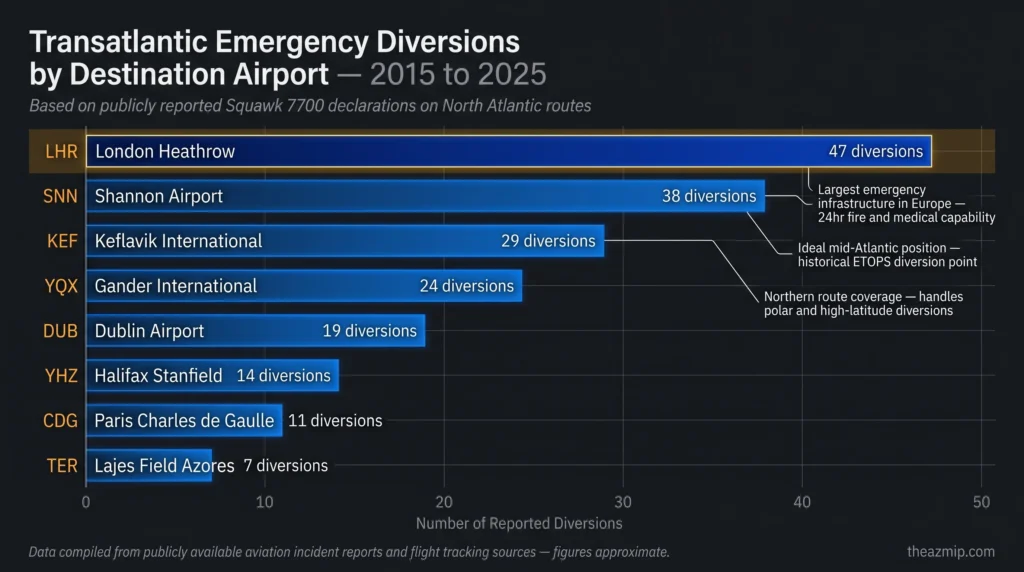
One broader stat that appeared in reporting around this incident: technical diversions have reportedly increased around 12% year-over-year, with aging long-haul fleets and spare parts shortages cited as contributing factors. That’s an industry-wide conversation worth watching — a Wikipedia overview of aviation safety statistics gives useful background context on how these trends are tracked globally.
What This Incident Actually Tells Us About Modern Aviation Safety
Genuinely — and this isn’t corporate spin — the UA770 diversion is a story about safety systems working.
Think about the chain of events: a sensor detected an anomaly, the crew acted on it immediately without waiting to see if it got worse, three countries worth of airspace coordination happened seamlessly, a major international airport had emergency services standing by within minutes, and 269 people walked off that plane without a scratch.
That’s not luck. That’s decades of protocol refinement, crew training, and technology investment functioning exactly as intended.
A few things that stood out from an aviation safety perspective:
- No oxygen masks deployed — means the crew caught and acted on the warning before cabin altitude ever became dangerous.
- Controlled descent throughout — no sudden drops, no structural stress on the aircraft.
- EUROCONTROL coordination was seamless — priority routing through multiple national airspaces without delay.
- Heathrow emergency services on standby — activated the moment Squawk 7700 was received, standard but worth appreciating.
Aviation experts commenting on the incident used the phrase “textbook emergency response.” That’s genuinely high praise in an industry where textbook means nobody got hurt.
For nervous flyers specifically — this incident is actually worth sitting with for a moment. The reason you heard about UA770 is precisely because the outcome was safe. The systems flagged a potential issue before it became a real one. That’s the whole point. A good Quora thread on how pilots handle pressurization emergencies breaks down the pilot perspective in plain language if you want to go deeper on that.
What Should You Actually Do If Your Flight Diverts?
Most travellers never think about this until it’s happening to them. And when it is happening — announcement crackling overhead, plane banking in the wrong direction, person next to you already spiralling — that’s not the ideal moment to figure it out.
So here’s the practical stuff, upfront.
In the Air
- Don’t panic at the descent. A controlled descent after a pressurization warning is precautionary. The crew caught something early — that’s the system working, not failing.
- Listen to cabin crew announcements carefully — they’ll tell you what they know when they know it. Badgering flight attendants mid-emergency for information they don’t yet have helps nobody.
- Leave your carry-on alone if evacuation is ever called — it sounds obvious until you’re in that moment. FAA safety guidelines are worth a quick read before any long-haul flight honestly.
- Note the time — if you’re thinking about compensation later, timestamps matter
On the Ground at the Diversion Airport
This is where most passengers feel lost. You’ve landed somewhere you didn’t plan to be, your connecting flight is evaporating, and the gate area is chaos.
A few things that actually help:
- Get to a United (or airline) representative before joining any queue — the queue forms fast.
- Ask explicitly: “What am I entitled to right now?” Hotel, meals, rebooking — don’t assume they’ll volunteer it.
- Screenshot or photograph any vouchers, written offers, or signage — paper gets lost.
- If you have travel insurance, call them from the diversion airport — not two days later from home. Some policies have time-sensitive claim windows.
- Check whether your credit card has travel protection built in — many do and most people forget.
After You Get Home
If you feel the compensation offered wasn’t adequate:
- EU departures — file under EC 261/2004. Your airline has to respond within a set timeframe.
- UK departures post-Brexit — similar rules apply under UK261.
- US legs — DOT’s Aviation Consumer Protection handles complaints and has a straightforward online form.
- Stuck on what you’re owed? Quora’s travel community has genuinely useful threads from people who’ve been through exactly this.
The Bigger Picture — A Note for Frequent Flyers
Here’s something that rarely gets said plainly in aviation coverage: the fact that UA770 made headlines is partly a function of how rare serious outcomes actually are.
Pressurization warnings happen. Diversions happen. What doesn’t happen — with any regularity — is those events turning into tragedies. The global commercial aviation fatality rate is, statistically, extraordinarily low. You know this intellectually. But reading about a Boeing 787 declaring an emergency over the Atlantic can still spike the anxiety.
Worth anchoring to the specifics of this case. The 787-9 Dreamliner’s onboard health monitoring system — one of the most advanced on any commercial aircraft flying today — flagged this issue. Not a passenger, not a visual inspection on the ground. The aircraft essentially told the crew something needed attention. They listened. Everyone went home.
That’s the story here, really. Not a near-miss. A system catch.
Quick Recap — Everything You Need to Know
If you’ve skimmed to the bottom, here’s UA770 in plain terms:
- What: Cabin pressurization warning triggered mid-flight over the North Atlantic.
- When: July 21, 2025, approximately 90 minutes after departing Barcelona.
- Aircraft: Boeing 787-9 Dreamliner — one of the most technically advanced passenger jets flying.
- Response: Crew declared Squawk 7700, executed controlled descent, diverted to Heathrow.
- Outcome: Safe landing, zero injuries, full emergency protocol followed.
- Cause: Confirmed pressurization alert — exact technical fault still under FAA investigation.
- Passengers: Received hotel, meals, rebooking from United Airlines ground staff.
- Lesson: Modern aviation safety systems work — this incident is evidence of that, not a contradiction of it.