
The KZ Sportsmen Classic 130BH is a 16-foot, ultra-light travel trailer that is designed to be used by small families that do not need to purchase a larger truck to go camping. The four-person sleep capacity is achieved through a personal front bed and an actual rear bunkhouse, full bathroom and functional kitchen and weighs in at an estimated 2,580 lbs dry enough to be towed by most of the minivans and mid-size SUVs. Its prices range between approximately 11,991 on the low end to approximately 20,995 in most dealers with the MSRP being approximately 29,000. When you need a bunkhouse trailer that is kid-friendly and will not compel you to upgrade your vehicle, the 130BH is one of the simplest yes choices in its category.
Why the 130BH Is Turning Heads at the Campground
This is the situation almost all new RV shoppers find themselves in. You fall in love with a roomy bunkhouse trailer at the dealer lot, you begin to envision the kids in their own beds at a lakeside campground and then the salesperson nonchalantly says that you may very well need to tow that with a half-ton truck. The $25,000 trailer has suddenly become a 50,000 truck, the dream cools down quickly.
That’s exactly the trap the KZ Sportsmen Classic 130BH is designed to help families avoid.
This little trailer has been quietly building a reputation in r/GoRVing threads and on dealer lots as the travel trailer that lets families with a Honda Pilot, Toyota Highlander, Chrysler Pacifica or Jeep Grand Cherokee actually start camping this season — not three years from now after they’ve saved up for a truck. It’s part of a broader shift toward compact, towable-by-anything RVs that even mainstream outlets like NPR have noted is reshaping who gets to be an RVer.
Light but not heavy does not make a good family-trailer. It has to have a actual bunkhouse for the children, an actual bathroom when there is an emergency in the early morning and maybe enough kitchen to serve up more than just hot dogs three nights in a row. It was not whether the 130BH was light or not, it is obvious it is. The issue is, did KZ drag it off and leave the trailer not look like a tent on steroids?
We will begin with the numbers and then take it step by step, as to what they signify in the way of your weekend at the lake.
Key Specifications at a Glance
KZ has revised a few of the 130BH in the 2025-2026 model years and you will find a few slight differences between the specs on which dealer listing or brochure you draw them. The table below presents the two years next to each other so that you can see what is changing exactly.
KZ Sportsmen Classic 130BH Specifications (2025 vs. 2026)
| Spec | 2025 Model | 2026 Model |
| Unloaded Vehicle Weight (UVW) | 2,580 lbs | 2,640 lbs |
| Dry Hitch Weight | 270 lbs | 290 lbs |
| Gross Vehicle Weight Rating (GVWR) | 3,500 lbs | 3,500 lbs |
| Cargo Carrying Capacity (CCC) | 920 lbs | 860 lbs |
| Exterior Length | 16′ 9″ | 16′ 1″ |
| Exterior Width | 7′ 6″ (90″) | 7′ 6″ (91.2″) |
| Interior Height | 6′ 6″ (78″) | 6′ 6″ (78″) |
| Fresh Water Tank | 20 gallons | 20 gallons |
| Gray Water Tank | 32 gallons | 26 gallons |
| Black Water Tank | 26 gallons | 32 gallons |
| Awning | 9′ Power | 9′ Power |
Now, what do those numbers actually mean when you’re standing in the driveway looking at your tow vehicle?
- UVW of ~2,580–2,640 lbs. This is the weight of the trailer when it comes out of the factory, without any water, propane, food, clothes or bike of the kids. This makes the 130BH very accessible to towables with a tow rating of 3,500 lbs – a tremendous segment of the family SUV and minivan market. The Honda Pilot (up to 5,000 lbs), Toyota Highlander (up to 5,000 lbs), Chrysler Pacifica with tow package (3,600 lbs) and Jeep Grand Cherokee (up to 6,200 lbs) have significant headroom above the 130BH loaded. Such headroom is important, as NHTSA towing safety guidelines are quite explicit that you must never tow at the absolute limit of your car.
- Dry Hitch Weight of 270–290 lbs. This is the downward force on your hitch ball. It’s well within the capacity of standard Class III hitches found on most family-haulers and it’s light enough that you can crank the trailer onto the ball with a manual tongue jack without breaking a sweat.
- GVWR of 3,500 lbs. This is the absolute maximum the trailer is allowed to weigh — empty trailer plus everything you load into it. Subtract UVW from GVWR and you get the cargo capacity.
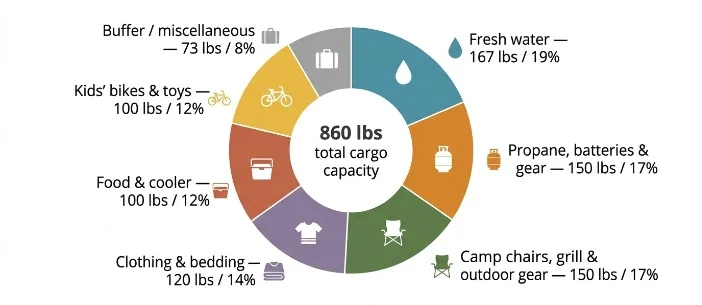
- CCC of 860–920 lbs. This is your real-world packing budget. It seems like a lot until you consider that a full 20-gallon fresh water tank itself weighs approximately 167 lbs, two full propane tanks bring the total to about 60 lbs or so and family camping equipment add up very quickly. It is doable, but you will want to pack considerately, which will be discussed in the following section.
- Interior height of 6′ 6″. Most adults under about 6’4″ can stand fully upright inside, which is genuinely uncommon in trailers this small. No hunchback shuffle to get from the bed to the bathroom at 2 a.m.
- Tank capacities of 20 / 26 / 32 gallons. Modest by full-size trailer standards, but realistic for the trailer’s weight class. A family of four using water carefully can comfortably go 2–3 days between refills and dump-station visits.
The headline takeaway: KZ kept the 130BH on the right side of the line where “ultra-lightweight” stops being a marketing word and starts being an actual capability your existing family vehicle can deliver on.
What Makes It a Great Family Vacation Trailer
Specs are one thing. What you actually care about is whether the family will enjoy spending a long weekend inside this trailer. Here’s where the 130BH earns its bunkhouse stripes.
Sleeping Arrangements: Real Beds, Real Privacy
The single biggest design decision KZ got right was giving everyone their own dedicated sleeping space. No nightly dinette-to-bed conversion ritual, no kids sleeping on a fold-down couch.
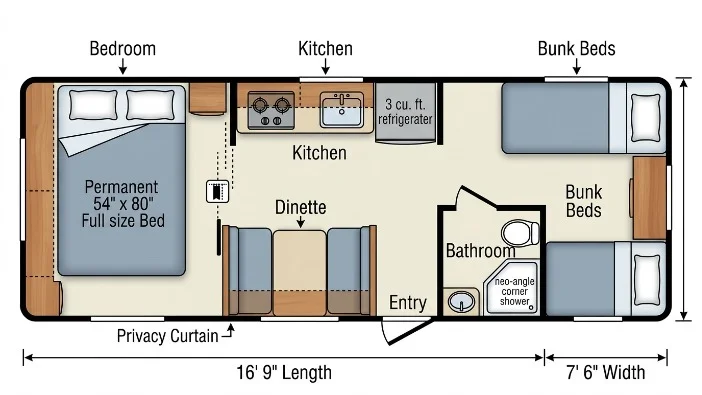
- Front bedroom: A 54″ x 80″ bed (essentially a full mattress) sits at the nose of the trailer, with privacy curtains separating it from the main living area.
- Rear bunkhouse: Two real bunk beds at the back of the trailer, sized for kids and smaller teens. This is genuinely rare in a 16-foot trailer.
- Optional dinette conversion: If you ever need to squeeze in a fifth person — a cousin tagging along, a sleepover at the campsite — the dinette folds down for an extra small bed.
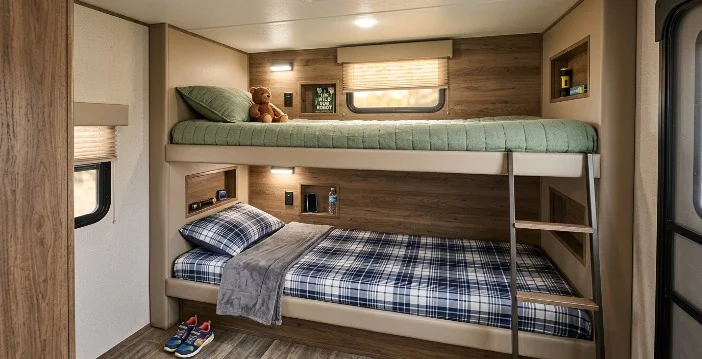
You will like this layout at a glance in case you have ever attempted to persuade a 9 year old that the dinette they ate spaghetti at is now their bed. The children have their cave; their parents their door (or rather their curtain). All people sleep better and that implies that all people will have more fun the following day. The r/GoRVing Reddit posts are brimming with comments about how parents say they learned the same thing: a real bunkhouse is what makes the difference between camping with children and surviving with children.
The Bathroom: Small, but Yours
A private bathroom in a trailer this small is the feature that most surprises first-time visitors. It includes:
- A neo-angle shower (the corner-cut shape is what makes it fit)
- A toilet
- A small sink with a vanity
It’s not a spa. You won’t be doing your skincare routine in there. But on a rainy night at a state park where the bathhouse is a quarter-mile walk through mud, you will be deeply, deeply grateful it exists.
The Kitchen: Honest About What It Is
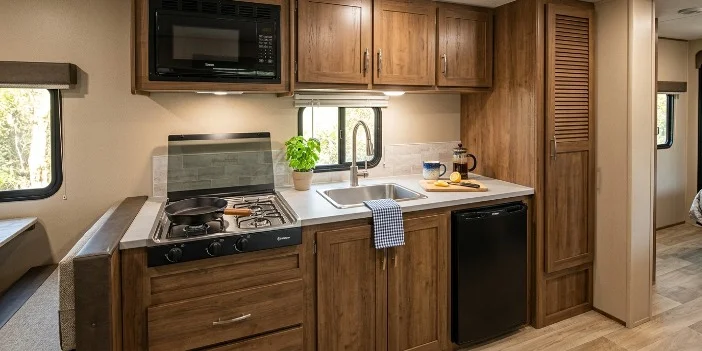
The galley is small but covers the basics:
- Two-burner cooktop
- Microwave
- 3 cu. ft. refrigerator
- Single-basin sink
- Overhead cabinetry plus pantry storage
- Tankless on-demand water heater (on 2026 models) — a nice upgrade that means endless hot water for dishes and showers
You are not cooking a Thanksgiving turkey in here and you would want to have a folding prep table to cook outdoors. But pancakes and sandwiches and pasta and the old-fashioned camping foil-pack dinners? It works fine. A typical family will wind up doing dinner out on propane griddle anyway and half the fun.
Storage: More Than You’d Expect
KZ engineered storage into pretty much every available cubic inch:
- Overhead cabinets running along both walls.
- Under-bed storage in the front bedroom.
- Under-bench storage in the dinette.
- Wardrobe near the bedroom.
- An exterior trunk door for camp chairs, hoses and dirty gear.
The catch is that 860–920 lb cargo capacity. The trailer has room for more stuff than it’s rated for, so the discipline of packing matters. Here’s roughly how a typical family weekend breaks down:
Towability: The Headline Feature
This is where the 130BH stands out of nearly all other bunkhouse trailers in the market. It is towable with a loaded weight that remains comfortably under 3,500 lbs.:
- The majority of mid-size SUVs (Honda Pilot, Toyota Highlander, Ford Explorer, Jeep Grand Cherokee, Subaru Ascent).
- Numerous minivans that come with the factory tow package (Chrysler Pacifica, Toyota Sienna, Honda Odyssey).
- Half-ton trucks, obviously, with massive headroom.
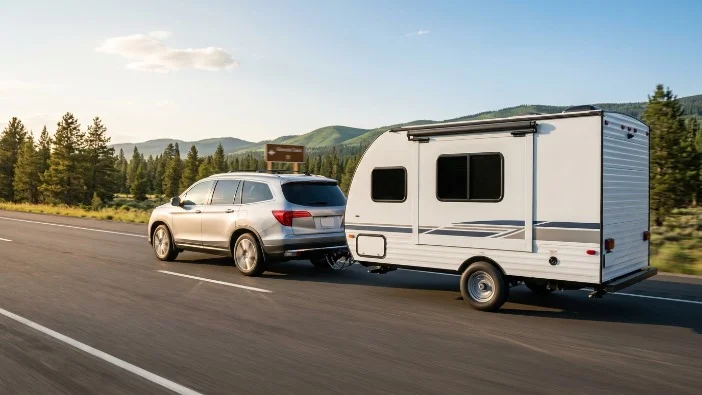
Should you wish to get into details of matching a tow vehicle to a trailer in a responsible manner, the starting point is the NHTSA towing safety page. The brief: in the real world, do not exceed 80 percent of your vehicle’s actual tow rating, install a hitch of the correct rating and do not omit the brake controller.
Year-Round Comfort and Outdoor Living
A 13,500 BTU air conditioner handles July in the Carolinas; a 20,000 BTU furnace handles October in the Rockies. The 9-foot power awning extends with the push of a button to give you a shaded outdoor “second room” — which, honestly, is where you’ll spend most of your daylight hours anyway. Stabilizer jacks at all four corners eliminate the trampoline effect when someone walks across the floor at night.
Real-World Pricing and What to Expect
Here’s where shopping for the 130BH gets interesting — because the gap between MSRP and what people actually pay is enormous.
KZ Sportsmen Classic 130BH Pricing Snapshot
| Pricing Tier | Price Range | Notes |
| Manufacturer’s Suggested Retail Price (MSRP) | ~$29,000 | The sticker price you’ll see on the window. Almost nobody pays this. |
| Typical dealer asking price (new, 2025/2026) | $11,991 – $20,995 | Wide range based on region, dealer and options. |
| Common “out-the-door” range | $15,000 – $22,000 | After taxes, fees and any add-ons. |
| Sample financing example (Canada, 240 months @ 7.99%) | ~$54/week | Roughly $234/month — useful as a ballpark, not a quote. |
A few things worth understanding before you walk onto a lot:
- MSRP is theater. RV pricing works closer to mattress-store math than car-dealer math. The “$29,000” sticker exists mostly so the dealer can show you a $13,000 “discount.” What matters is the out-the-door price compared to what other dealers within driving distance will sell the same trailer for. Use RV Trader and dealer websites to triangulate.
- Regional pricing varies a lot. Trailers are bulky and expensive to transport and therefore a unit that is lying on lots in Indiana (where majority are produced) will be cheaper than the same in Florida or California. When you are located close to a big manufacturing belt, then you have leverage.
- End-of-model-year deals are real. Discounts on 2025s usually come in the best around September through December when dealers clear on 2026s coming in. You can save time, you see, you can save.
- Financing math gets ugly fast. A 240-month (20-year) RV loan at 7.99 per cent will appear cheap on a weekly basis, but you will end up paying approximately twice the price of the trailer during the period of the loan. The overall financial guidance of the sources such as Investopedia and most credit unions all agree that that with shorter terms, more down payments and that an RV is a depreciating asset (which it surely is), you will be fine. One such sanity check is that you would be happy with the payment even without the trailer being used in a season.
- Don’t forget the hidden costs. Budget for: a weight-distribution hitch and brake controller (~$500–$800 installed), insurance ($300–$700/year), storage if you can’t park it at home ($600–$2,400/year), an annual service ($200–$400) and campground fees ($25–$80/night). The budget discussion begins with the purchase of trailers and not its conclusion.
How It Compares to the Competition
The 130BH doesn’t exist in a vacuum. The “lightweight family bunkhouse” category has been one of the fastest-growing slices of the RV market since the pandemic-era camping boom and a few competitors show up on every shopper’s shortlist. Here’s how the 130BH measures up against the three you’ll most likely cross-shop.
KZ Sportsmen Classic 130BH vs. Top Competitors
| Model | Unloaded Weight | Length | Sleeps | Bunk Beds | Slide-Out | Key Distinction |
| KZ Sportsmen Classic 130BH | 2,580 lbs | 16′ 9″ | 4 | Yes | No | Lightest bunkhouse in its class — towable by minivans and most mid-size SUVs. |
| Jayco Jay Feather Air 17BHSL | 3,750 lbs | 20′ 6″ | 5 | Yes | Yes | More interior space thanks to the slide, but ~1,200 lbs heavier. |
| Winnebago Micro Minnie 2100BH | 4,100 lbs | 21′ 11″ | 5 | Yes | Yes | Most spacious of the four, but needs a real half-ton truck. |
| Forest River r-pod RP-153 | 2,479 lbs | 15′ 7″ | 3 | No | No | Slightly lighter, distinctive teardrop styling — but no bunkhouse. |
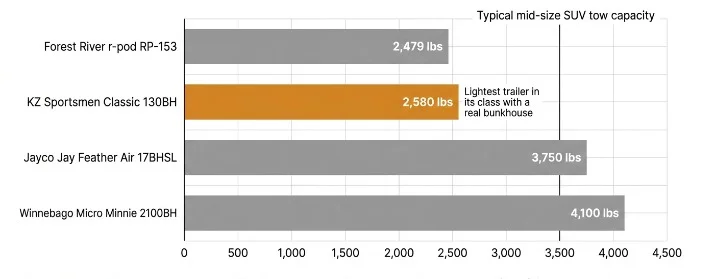
Here’s how to read that table when you’re actually shopping:
- vs. Jayco Jay Feather Air 17BHSL. The Jayco gives you a slide-out, which makes the interior feel dramatically bigger when you’re parked. That’s a real advantage if you’ll be spending rainy days inside. The trade-off is 1,170 lbs of extra weight — enough to push you out of “any mid-size SUV” territory and into “you probably want at least a Tahoe or a half-ton” territory. If you already own a heavy-duty tow vehicle, the Jayco is genuinely tempting. If you don’t, the math gets ugly fast.
- vs. Winnebago Micro Minnie 2100BH. The Micro Minnie is a beautifully built trailer with a reputation for above-average fit and finish and at nearly 22 feet with a slide it’s almost a different category of camping experience — closer to a small apartment than a tent on wheels. But at 4,100 lbs unloaded (and easily 5,000+ lbs loaded), you’re absolutely looking at a half-ton truck as the minimum tow vehicle. That’s the crucial difference: the Micro Minnie is for families who already have or are willing to buy, a serious tow rig.
- vs. Forest River r-pod RP-153. The r-pod is the closest direct competitor on weight — actually 100 lbs lighter than the 130BH. It has a cult following, particularly among couples and the iconic curved profile turns heads at any campground. But the RP-153 sleeps three and has no real bunkhouse. For a family of four with two kids who need their own beds, the r-pod simply doesn’t solve the problem the 130BH was built to solve.
The pattern that emerges across the comparison: the 130BH wins decisively on the “lightest trailer with a real bunkhouse” axis. If that’s your top criterion — and for a lot of new RV families, it should be — there isn’t really a closer competitor.
Pros and Cons
After all that, here’s the honest scorecard.
Pros
- ✅ Genuinely towable by family vehicles. Most mid-size SUVs and tow-package minivans handle it without breaking a sweat. This is the single biggest reason families buy this trailer.
- ✅ Real bunkhouse. Two dedicated kids’ beds in a 16-foot trailer is impressive engineering.
- ✅ Private full bathroom. Toilet, sink and shower in a trailer this small is rare and genuinely useful.
- ✅ Stand-up interior height. 6’6″ of headroom means you’re not stooped over for the entire trip.
- ✅ Strong storage layout. Overhead, under-bed, under-bench, exterior trunk — they used the space well.
- ✅ Affordable entry point. Real-world prices in the $15,000–$22,000 range make RV ownership accessible without a five-figure tow vehicle upgrade.
- ✅ Four-season ready. A/C plus a 20,000 BTU furnace means you can camp in shoulder seasons too.
Cons
- ❌ Cramped on rainy days. No slide-out means the interior feels tight when four people are stuck inside.
- ❌ Modest kitchen. Two burners and limited counter space make elaborate meals a stretch — plan to cook outside often.
- ❌ Small water tanks. A 20-gallon fresh tank means careful water use and frequent refills, especially with kids who like long showers.
- ❌ Tight cargo capacity. 860–920 lbs goes faster than you’d think; weigh-in discipline matters.
- ❌ Spec inconsistencies between sources. Different dealers and brochures list slightly different numbers — verify the exact unit you’re buying.
The verdict in one sentence: The 130BH trades interior spaciousness for towability and price and if those are the trade-offs you’re willing to make, it’s one of the best-balanced family trailers on the market.
Who Is This Trailer For? (And Who Should Look Elsewhere)
Picture a few real families and you’ll know quickly whether the 130BH belongs in your driveway.
The 130BH is a great fit if you are:
- A family of four with two kids under about 12, currently driving a mid-size SUV or minivan and unwilling to buy a truck just to start camping.
- A couple with one child who wants a real bedroom for the kid, not a converted dinette.
- New to RVing and want to test whether the lifestyle clicks before committing to a bigger rig.
- A grandparent who wants a kid-friendly trailer for occasional trips with grandkids.
- Someone who camps mostly in established campgrounds with hookups, not extended off-grid boondocking.
- A weekend warrior planning trips of 2–4 nights, mostly within a few hours of home.
Look elsewhere if you are:
- A family of five or six — you’ll outgrow it immediately.
- Planning months-long full-time RV living. The interior simply isn’t built for that.
- A serious off-grid boondocker who wants to disappear into national forest for a week. The 20-gallon fresh tank will be your bottleneck.
- Someone who already owns a half-ton truck — you have the capability for a bigger trailer with a slide and you’ll probably enjoy the extra space.
- A frequent destination cook who wants to make real meals indoors. The galley will frustrate you.
- Tall — really tall. If anyone in the family is over about 6’2″, the bunk beds get uncomfortable fast.
A useful framing question: are you buying a trailer to make camping easier or are you buying a vacation home that happens to roll? The 130BH is firmly the first thing. If you want the second, keep looking.
Conclusion: Is the 130BH Your Family’s Next Adventure Partner?
The KZ Sportsmen Classic 130BH succeeds because it makes a clear, honest trade-off and executes it well. It is not the roomiest trailer at the campground. It is not the most luxurious. It will not impress your neighbor who just bought a 35-foot fifth wheel.
What it does do is solve the single biggest barrier that keeps families out of RVing: the assumption that you need a truck to start. With a Honda Pilot, a Highlander, a Pacifica or any number of vehicles already sitting in driveways across the country, families can hitch up the 130BH this weekend and be at a state park by dinner. That’s not a small thing. That’s the difference between RVing being something you talk about and RVing being something you actually do.
For somewhere between $15,000 and $22,000 — less than a lot of people spend on a single family vacation to a Disney resort — you get a kid-friendly bunkhouse on wheels that opens up years of weekend adventures. The kids get their own beds. You get your own bedroom. Everyone gets a bathroom. And nobody has to buy a new truck.
If that math works for your family, the 130BH isn’t just a reasonable choice. It’s a genuinely smart one.
FAQ
Yes, with the right setup. Most current minivans with the factory tow package — the Chrysler Pacifica, Toyota Sienna and Honda Odyssey — are rated to tow between 3,500 and 3,600 lbs, which gives you headroom over the 130BH’s 3,500 lb GVWR. You’ll want a properly installed Class III hitch and a brake controller and you should follow NHTSA’s towing safety guidance on staying well within your vehicle’s rated capacity.
With practice, about 15–20 minutes. The basic sequence is: level the trailer, drop the stabilizer jacks, connect to shore power and water, extend the power awning and you’re done. First-timers should expect 30–45 minutes for the first few trips while everyone learns the rhythm.
Probably not, unless you specifically want the tankless on-demand water heater that newer units include. The core trailer is fundamentally the same and the 2025 will almost always be a better deal as dealers clear out inventory. The exception is if you find a 2026 with a strong end-of-year discount in late 2026 — at that point, the newer warranty clock starts in your favor.