
At a Glance: The Historian’s Packing List Pack broken-in walking shoes, a large scarf for cathedral dress codes, a universal adaptor, merino layers for wild weather swings and a hidden money belt. None of this is random. Every item answers a problem that European travelers have wrestled with for centuries — the cobblestones, the sacred decorum, the patchwork of national plug standards, the Alpine cold, the pickpockets. Pack light, pack versatile and you’ll be carrying solutions that pilgrims and Grand Tourists worked out the hard way.
Before you zip up the suitcase, here’s a thought. In 1760, a young English aristocrat, on his Grand Tour, filled his trunks with oilskins to ward off Alpine showers, a portable writing desk and a tough stick to cover the muddy roads between Rome and Naples. The mud is now for the most part covered by paving. Why he was bringing what? They still live in your hotel wall socket and walk around on every old street.
Packing for Europe was never just a weather problem. It’s a conversation with the forces that laid the cobblestones, set the cathedral dress codes and decided what shape your plug needs to be. Let’s go item by item and tie each one to the history that made it essential.
Footwear That Survives the Centuries
Pack this:
- Two pairs of broken-in, supportive walking shoes with non-slip soles.
- One smart enough for a museum or dinner, one workhorse for all-day sightseeing.
- Nothing brand new — your feet will hate you.
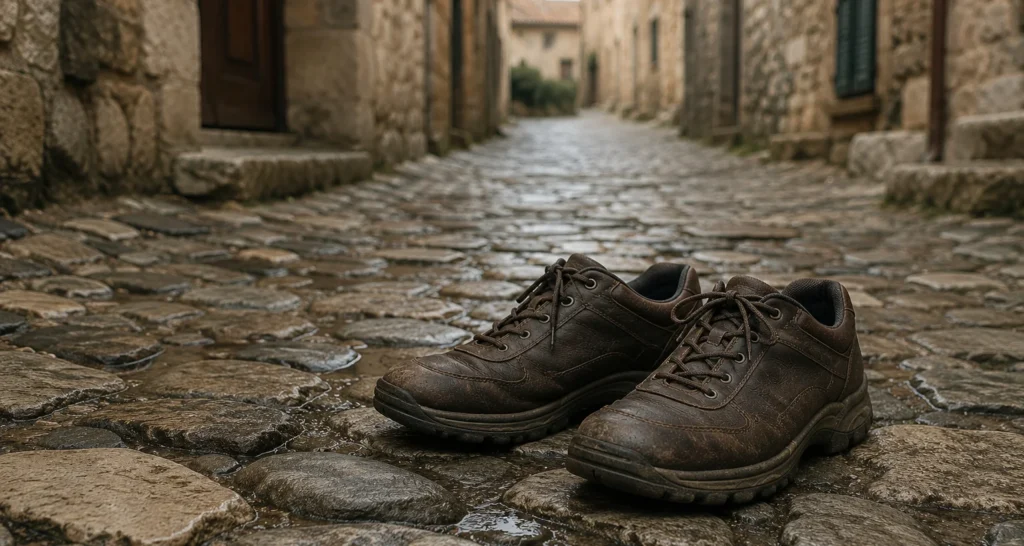
Europe’s old districts are layered like a manuscript scraped clean and rewritten. The stones underfoot in Rome’s Trastevere, Prague’s Old Town or Edinburgh’s Royal Mile aren’t decoration. They’re functional road surfaces laid down anywhere from the medieval period to the 1800s and they were built to last, not to be kind to your ankles. Roman basalti — big polygonal paving stones — have been punishing walkers on the Via Appia for over two thousand years. Medieval towns used rounded river cobbles that turn lethally slick the moment it rains. By the 19th century, Paris and Vienna had moved to granite setts, rectangular and a touch smoother, but still no one’s idea of level ground.
The guests in front of you griped all day long. In 1786, Goethe took a stroll through Verona and complained about the terrible street where he was unable to raise his gaze from the pavement for a second. His solution were very thick-soled leather boots, sometimes studded with metal to grip. Yours is a soft sole, soft trainer. If you twist an ankle on the Rue Saint-Jacques, you’ll be in very long, very limping line with visitors. Much of this travel wisdom is derived from the 18th century passion for the Grand Tour.
A dark, low-profile shoe in black or brown passes as smart-casual nearly everywhere — same logic the Grand Tourist used when he wanted one sturdy boot that could do double duty.
The Modesty Kit: A Scarf Is a Cultural Key
Pack this:
- One large, lightweight scarf or pashmina.
- Clothing that covers shoulders and knees without fuss.
- A foldable tote, handy for stashing layers.
The dress code at St. Peter’s in Rome, the Duomo in Florence or the Sagrada Família isn’t a modern mood. It’s centuries of sacred decorum written into the rules. From the early Church through the Counter-Reformation, a cathedral’s interior was treated as a physical stand-in for the Heavenly Jerusalem — walking in casually exposed was an insult and one that ended up codified in canon law and local custom. When mass tourism arrived in the 19th century on Thomas Cook’s railways, the guardians of these sites started turning away bare arms and shorts at the door. That hasn’t really changed.
The scarf has a history of it’s own. After Napoleon’s campaign to Egypt, the large, all-purpose shawl was introduced to the European fashion world as a wardrobe essential when cashmere shawls were brought back by the soldiers and scholars returning from Egypt, the Empress Joséphine made them fashionable. The wrap around the shoulders before entering into an old basilica is a fashion that is two hundred years old!
One scarf does a lot: shoulder cover, train-warmth, a privacy screen on a sleeper, instant compliance at any church door. Keep it at the top of your daypack, not buried in the case.
The Electrical Time Machine: Adaptor and Power Bank
Pack this:
- A universal travel adaptor with built-in USB ports.
- A compact power bank.
- A short charging cable.
Why should there be so many plug shapes in 1 continent? Blame fragmented industrialisation. With the advent of electricity in the late 19th and early 20th centuries, each country developed it’s own electric grid based on it’s own specifications. The three-pronged BS 1363 plug first appeared in the 1950s as a result of the post-war housing reconstruction, each plug having a fuse as a safety precaution. The Schuko socket (patented in the 1920s) in Germany is deep and recessed, with earth clips for a strong grip. Italy went it’s own way with a 3-pin design; Switzerland had an odd 6-pin!
One would think the EU would’ve got this sorted out. Standardised currencies, borders and a thousand norms of industry – but the plug socket stood firm. It’s the Europlug with those two round pins, it’s in use in most of Europe and then it’s in the UK, Ireland, Malta and Cyprus and it’s not. So in your bag is a small diplomatic pouch because there was a century of electrical nationalism which nobody thought to resolve.
The power bank deserves a nod too. It’s the descendant of the Romantic poet’s portable inkwell and writing case — the tool for capturing the moment before it slips away. Byron and his crowd needed paper and ink at hand. You need a charged phone to map, translate and photograph. The instinct to document is the same. Only the gadget changed.
Layering in the Shadow of the Little Ice Age
Pack this:
- Merino wool base layers.
- A packable insulated jacket or fleece.
- A waterproof, breathable shell.
- T-shirts, a light sweater, wrinkle-resistant fabrics.
European weather really has a wild history and it continues to influence what to take along. The Little Ice Age, which lasted from ~1300 until ~1850, brought the continent some harsh winters and cool, unpredictable summers. Holland’s canals were frozen for weeks. Frost Fairs were held on the ice of the Thames. Harvests of grapes were devastated in northern France. This volatility only began to slowly dissipate as modern tourism was emerging, but it did leave it’s mark: drafty old buildings, a keen sense of culture for thick wool and shoulder seasons that are indecisive.
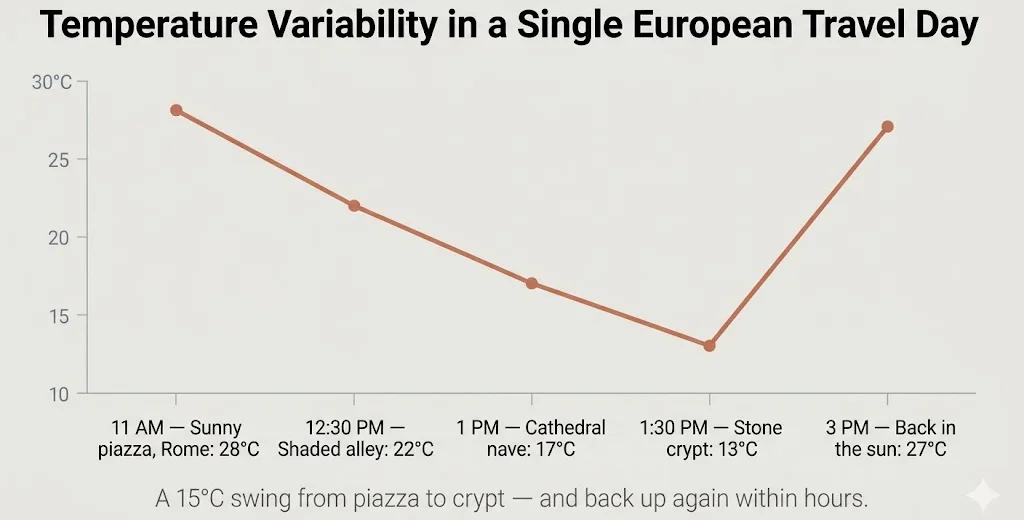
Climate change has not been able to subdue the swing. A European summer day can turn so quickly from warm Mediterranean weather to cold Alpine air, that it’s not too much to say that it happens overnight during a train ride. In 1816, Byron traversed the Alps in heavy rain, snow and unexpected blazing sun — thanks to Mount Tambora’s eruption — the Year Without a Summer. He replied, “waistcoats on waistcoats, a heavy cloak, a fur-lined coat” Your is lighter, smart and it’s the principle that hasn’t changed: when it comes to temperature, be prepared for a sudden drop from the sunlit piazza to the 12th-century stone crypt.
Merino is the historically fitting pick. Europe’s great textile centres, from Flanders to Florence, built their fortunes on wool — the same trade that funded those cathedrals you’ll be covering your shoulders to enter.
Money and Security: The Money Belt Is Ancient
Pack this:
- A slim hidden money belt or neck pouch.
- Two types of card — debit and credit, ideally contactless.
- A coin purse.
- A dummy wallet holding a little cash.
The money belt isn’t a tourist cliché. It’s the direct heir of the medieval pilgrim’s scrip — a small leather pouch worn against the body — and the hidden belt of the Grand Tour. When young milords crossed the Alps, their father’s London bankers arranged letters of credit with correspondent banks in Paris, Venice or Naples. Those letters, sewn into a coat lining or a flat belt under the shirt, were worth a fortune, which made them the favourite prize of the highwaymen and confidence tricksters working the great roads. Henry Fielding’s Tom Jones runs the hero through one lost purse after another. The lesson landed.
Modern pickpocketing on the Barcelona Metro or in a packed Roman piazza is the same craft, just smaller in scale. Petty theft was endemic in the big 19th-century cities. The fix has never changed: keep your documents and main bankroll separate from your daily spending money. A slim belt under your clothes, a neck pouch, a decoy wallet in your pocket — that’s the layered security streetwise travelers have always relied on.
Don’t skip the coin purse. Euro coins carry real value and you’ll collect €1 and €2 pieces fast. Each has a common side and a national reverse — a map of Italy, the Brandenburg Gate, Ireland’s Celtic harp — so your change becomes a little history collection rattling around in your pocket.
The Quick Reference
| Historic Challenge | Your Modern Packing Solution |
| Roman and medieval cobblestones | Supportive, non-slip walking shoes |
| Cathedral modesty codes, 4th century on | Large scarf, knee-covering clothing |
| Electrical nationalism, 1880s–1920s | Universal adaptor with USB |
| Little Ice Age and Alpine passes | Merino layers, waterproof shell |
| Brigands, highwaymen, pickpockets | Hidden money belt, dummy wallet |
| Schengen’s fragile open borders | Passport, printed and digital backups |
So you’re not really packing clothes and gadgets. You’re assembling a portable adaptation to a landscape shaped by pilgrim’s feet, holy law, industrial rivalry and the long dream of a borderless continent. Every well-chosen item in that bag reaches back through the centuries. Travel well — and travel historically.