
All that is required for chasing history’s greatest mysteries is curiosity, and perhaps a plane ticket, without a whip and a fedora. The tales of crowns eaten by tidal marshes, rooms adorned with amber panes torn apart in less than two days by Nazi soldiers and jewels stolen from a locked safe before a king could put them to use abound in Europe. These aren’t myths. They’re recorded, discussed by historians, and in some instances, continue to be scanned for using ground-penetrating radar. This article looks at three of the world’s most fascinating lost artifact stories of the continent, where they occurred, what we do know, what we don’t, and importantly, where one can go today to experience the shadow of these mysteries. There is no need to embellish this strange history.
The Legendary Amber Room – Russia’s Vanished Masterpiece
Six tons of amber. Gold leaf. Mirrors. Carved cherubs. The Amber Room was more than a room: It was a statement, and one that begs the question, “What were 18th-century rulers competing over?”
It was created around 1701 by Prussian King Friedrich I, with the design for the sculpture by sculptor Andreas Schlüter and the amber craftsmanship by Gottfried Wolfram. This filled up more than 180 square metres of wall area at Charlottenburg Palace. Then in 1716, it was presented to Peter the Great as a gesture of goodwill in the hope of a strong alliance with the Swedes and, after it was transferred by Friedrich to Peter, it became a permanent part of the Catherine Palace near St. Petersburg.
For two centuries, it sat there. Then 1941 happened.
The Germans took the whole room down in 36 hours as they moved through the Soviet Union. Packed it up, shipped it off to Königsberg (Kaliningrad, Russia), and put it on display. And then, as the Red Army closed in during 1945 — it vanished. Every explanation ranging from bombing, bunkers, secret tunnels and private collectors have been floated. Occasionally, over the decades, a few pieces of amber have appeared. The bulk? Still gone.
A replica was reconstructed in 2003 in Russia, and is open to the public in Catherine Palace, outside St. Petersburg. It’s so impressive and somehow the idea that it’s a recreation makes it more rather than less scary.
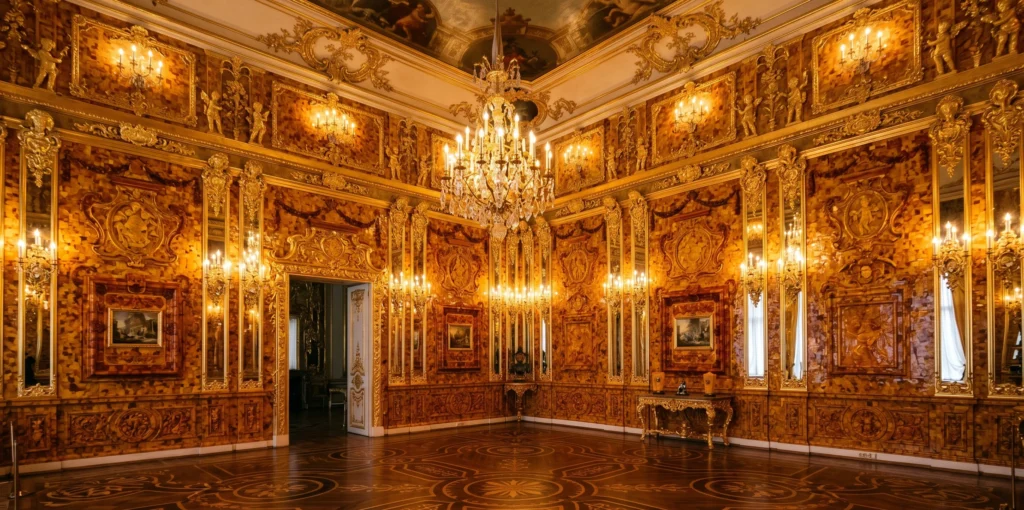

Quick facts:
- Weight of amber panels: approximately 6 tons
- Time taken to dismantle by German forces: 36 hours
- Current status: Missing. Reconstruction open to visitors at Catherine Palace.
King John’s Lost Treasure – England’s Medieval Mystery
Not good press for King John – Magna Carta, loss of Normandy, general reputation for tyrannical. But his last misfortune was the oddest of all – he lost the crown jewels somewhere in the tidal mudflats of eastern England.
October 1216. John was crossing The Wash, a tidal estuary in Lincolnshire, with a baggage train of crowns, gold, silver plate, relics, royal documents – all the tangible remains of the English monarchy. A sudden tide came in. The wagons sank. John rode ahead and was able to survive. The treasure didn’t.
It was recorded in the Middle Ages. West Norfolk and King’s Lynn Archaeological Society have carried out geophysical surveys. After eight hundred years, nothing has been extracted from that mud that is conclusive.
There’s a wrinkle worth knowing: some regalia apparently survived for his son Henry III’s coronation shortly after. Either duplicates existed, not everything sank, or the chroniclers exaggerated. Historians still argue about it.
John died of dysentery nine days after the crossing. Make of that what you will.
The flatness and windiness of Lincolnshire and Norfolk, and the fact that it is tidal, sucks the breath out of you, considering what’s probably below. King’s Lynn itself has a good medieval centre of interest and the True’s Yard Fisherfolk Museum provides local information.

The Stolen Irish Crown Jewels – A Dublin Castle Heist
This one reads like an Agatha Christie novel — except nobody solved it.
The Irish Crown Jewels were presented to William IV in 1831, and were the ceremonial jewels of the Most Illustrious Order of St. Patrick, established in 1783. Diamonds, emeralds, rubies, knight collars. Under the care of Ulster King of Arms Sir Arthur Vicars in the safe of Dublin Castle’s Bedford Tower.
Between June 11 and July 6, 1907 — they disappeared. No forced entry. No broken safe. King Edward VII was due to arrive for a royal visit within days.
The safe hadn’t been forced. Duplicate keys existed. Access had been… casual, to put it generously. Vicars was dismissed in disgrace, always maintained his innocence, and was shot dead by the IRA in 1921, reportedly with a note pinned to him reading “spy.” Whether that was connected — nobody knows.
Theories range from republican nationalists to personal vendettas to British smuggling. Nobody was ever charged. The jewels were never recovered, and they’d be worth millions today.
Dublin Castle is open to visitors and frankly worth an afternoon regardless — the Bedford Tower still stands, and there’s something genuinely eerie about standing where those jewels sat for over a century before someone walked off with them.
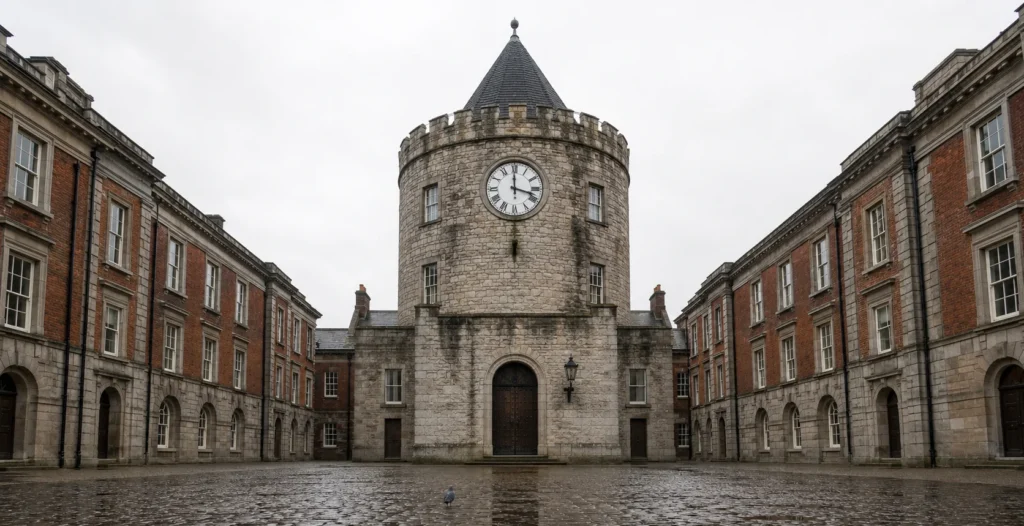
| Jewel Feature | Detail |
| Created | 1783 |
| Gifted by | King William IV, 1831 |
| Stolen | Between June–July 1907 |
| Location | Bedford Tower, Dublin Castle |
| Status | Never recovered |
Other Lost Treasures Worth Chasing
The Amber Room, King John’s hoard, the Dublin heist — those three get most of the attention. But pull at the threads a little further and Europe unravels into a whole network of vanished things, each with its own strange story.
Llywelyn’s Coronet – Wales’s Stolen Crown
Wales had one native-born Prince of Wales. Just one. Llywelyn ap Gruffudd died in 1282, and Edward I — never subtle about conquest — took his coronet to London as a trophy. It sat in Westminster Abbey for centuries.
Then in 1303, during a massive theft from the Abbey treasury, it vanished. Gone from records entirely. When Cromwell’s forces later destroyed royal regalia in the 1640s, nobody even knew if there was anything left to destroy.
If you need some background knowledge about Llywelyn’s time, Cardiff’s Amgueddfa Cymru – Museum Wales has plenty of Welsh history to offer. The history of that coronet is part of a wider Welsh story of being ruled over by the English, and the loss of that coronet is more the loss of a tail than a treasure hunt.
The Library of Ivan the Terrible – Russia’s Ghost Collection
Somewhere under Moscow — maybe. Possibly never existed at all.
Presumably, Ivan the Terrible collected large numbers of rare ancient writings, Greek and Latin manuscripts, Byzantine rarities. The “Golden Library.” It has been the subject of speculation for centuries. Some believe that it is located in the tunnels of the Kremlin. Others believe that it’s the legend that got legs.
What makes it compelling isn’t just the treasure — it’s the idea that an entire body of ancient knowledge might be sitting under a city of twelve million people, completely inaccessible. The State Historical Museum in Moscow holds remarkable collections from Ivan’s period if you’re curious about the era.
Medieval Relics – The Black Market of the Middle Ages
Here’s something that doesn’t get taught enough: medieval Europe ran a thriving underground trade in saints’ bones, fragments of the True Cross, vials of the Virgin’s milk. Churches stole from each other — there’s actually a Latin term for it, furta sacra, meaning “holy theft” — because relics brought pilgrims, and pilgrims brought money.
The 1204 Sack of Constantinople scattered Byzantine relics across the continent in ways historians are still untangling. Venice’s St. Mark’s Basilica holds some of the most significant surviving pieces, including what are believed to be the remains of St. Mark himself — brought from Alexandria in 828, reportedly smuggled past Muslim customs officials hidden under pork and cabbage.
That’s not fiction. That happened.
The Reformation, the French Revolution, centuries of warfare — each wave destroyed or scattered relics further. Most are gone permanently. A few surface at auction houses with murky provenance and immediately become someone else’s legal problem.

Why These Treasures Vanished – And Why It Matters
Wars explain a lot. The Amber Room — WWII looting on an industrial scale. Llywelyn’s coronet — conquest and deliberate cultural suppression. Medieval relics — political and economic competition between institutions that needed pilgrimage revenue to survive.
But negligence does at least as much damage as warfare. The Irish Crown Jewels weren’t taken by an invading army — someone with casual access to a key just walked off with them. King John’s baggage train didn’t sink because of enemy action. A tide came in and nobody planned for it.
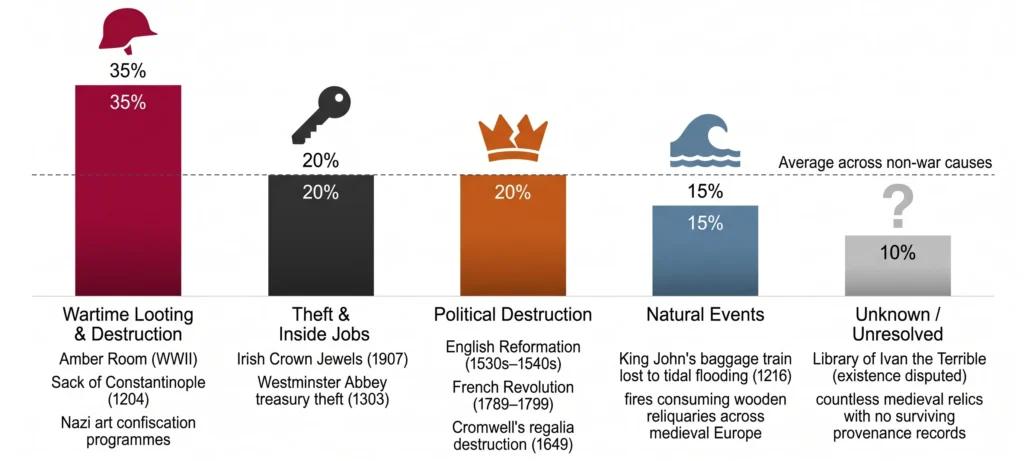
What archaeology is recovering — slowly, with ground-penetrating radar and sonar surveys — suggests that “lost” often means “buried and waiting.” The Wash surveys keep finding anomalies. Kaliningrad has been excavated repeatedly. Technology keeps improving.
The harder truth is that plenty of these objects were melted down, broken apart for components, or sold off in pieces across centuries. The amber panels might be sitting in private collections right now. The Irish jewels might have been broken up within months of the theft. History doesn’t always have a satisfying ending.
Where to Go – A Traveler’s Guide to Europe’s Lost Artifact Sites
You can’t visit the treasures themselves. But you can stand where they stood, which is its own strange thing.
| Location | Connection | What to See Today |
| Catherine Palace, Pushkin, Russia | Amber Room’s original home | Reconstructed Amber Room, palace gardens |
| The Wash, Lincolnshire, England | King John’s lost baggage train | Tidal landscape walks, King’s Lynn medieval town |
| Dublin Castle, Ireland | Irish Crown Jewels theft site | Bedford Tower, State Apartments tours |
| St. Mark’s Basilica, Venice | Byzantine relic repository | Pala d’Oro, Treasury collection |
| Museum Wales, Cardiff | Welsh medieval history | Llywelyn-era exhibitions |
| State Historical Museum, Moscow | Ivan the Terrible’s era | 16th-century Russian artifacts |
Every one of these is genuinely worth visiting on its own merits, completely independent of the mystery angle. The mystery just adds a layer.
Conclusion – History’s Greatest Unfinished Stories
The thing about lost artifacts is that their absence does something to history that presence can’t. The reconstructed Amber Room is beautiful — but it’s the missing original that makes people keep writing about it eight decades later. King John’s treasure is probably unrecoverable mud at this point, but that uncertainty keeps the story alive in a way a museum display never would.
These weren’t fictional adventures. Real people lost these things, stole them, buried them, watched them sink. Real archaeologists are still out there with radar equipment hoping to find them.
If any of this caught your interest — go. Walk through Dublin Castle and think about those duplicate keys. Take the train to King’s Lynn and look out at that flat, tidal horizon. Stand in the reconstructed Amber Room and try to imagine the original. Travel has a way of making history stop being abstract.
The artifacts may be gone. The places aren’t.