
The best thing about Edinburgh is that most of the best things to do are free. The National Museum of Scotland, all three national galleries, St Gile’s Cathedral, Calton Hill, climbing an extinct volcano in the middle of the city: none of it costs a penny. Before you plan a single day, that is the fact to build around.
There is one new cost worth knowing about first, though, because it lands right now.
Budget For The New Visitor Levy Before Anything Else

From 24 July 2026, Edinburgh charges a 5% visitor levy on paid overnight accommodation, making it the first city in the UK to bring in a tourist tax. Edinburgh becomes the first city in the United Kingdom to introduce a formal, statutory visitor levy on overnight accommodation, with it’s 5% Visitor Levy launching on 24 July 2026. It applies to hotels, B&Bs, hostels, self-catering flats and Airbnb-style lets alike and it catches everyone, including UK and Scottish residents.
The practical details that affect your budget:
- The 5% is charged on the room rate before VAT, so on a £150 room you pay about £7.50 a night and on a £60 hostel bed roughly £3.
- The fee is capped at the first five consecutive nights of any stay and applies year-round at the same rate.
- A transitional rule protects travelers who booked early: any stay booked and paid for (in full or in part) before 1 October 2025 is exempt from the levy, even if the stay itself falls after the July start date.
It is not huge, but it is real and it stacks on a city where August accommodation already costs a fortune. Factor it in and move on.
The Icons That Actually Earn The Hype
Not every famous sight is worth your time. These three are.
Edinburgh Castle sits on Castle Rock over the whole city and holds the Crown Jewels, the Stone of Destiny and the 15th-century siege gun Mons Meg. The One o’Clock Gun fires every day except Sunday. It is the one paid attraction I would tell you to book timed tickets for well ahead, because in summer and all through August it sells out.
Arthur’s Seat is the opposite: free, wild and the best view in the city. The extinct volcano rises to 251m inside Holyrood Park and the main summit climb takes about 30 to 45 minutes. Go at sunrise or sunset and the light does the work for you. If a full climb is too much, the Salisbury Crags path underneath gives you nearly the same panorama for half the effort.
The Royal Mile runs downhill from the Castle to the Palace of Holyroodhouse and the trick is to get off it. The cobbled closes and wynds branching from the main drag are where the real character hides, which brings us to the part most visitors miss.
The Free Museums And Galleries Are Genuinely World-Class
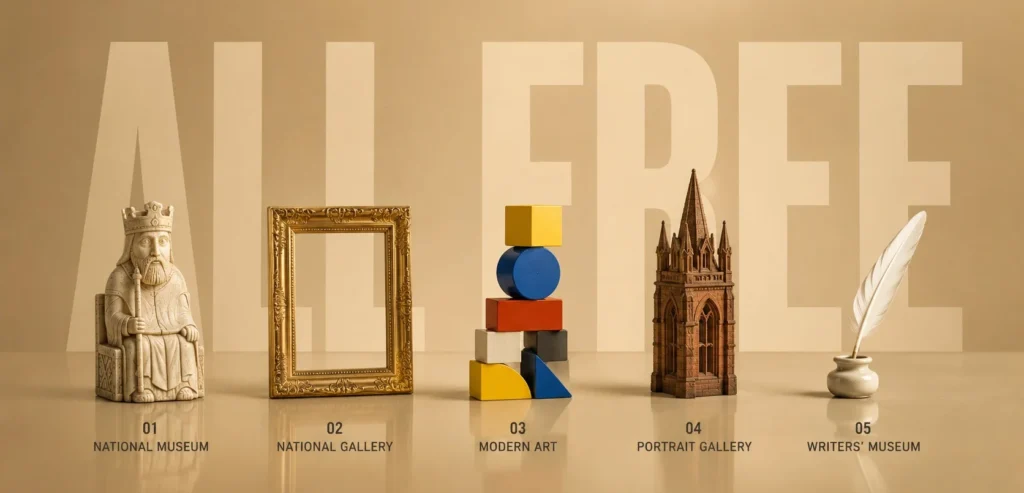
This is where Edinburgh quietly outclasses most European capitals and it costs nothing. Worth your time, all free to enter:
- National Museum of Scotland on Chambers Street, home to the Lewis chessmen and a rooftop terrace with sweeping views.
- Scottish National Gallery on the Mound, with Botticelli, Vermeer, Van Gogh and Raeburn’s Scottish icons.
- Scottish National Gallery of Modern Art, holding Dali, Picasso, Warhol and a Charles Jencks landform in the grounds.
- Scottish National Portrait Gallery, a red sandstone neo-Gothic palace with Mary Queen of Scots and Robert Burns on the walls.
- The Writer’s Museum off the Lawnmarket, dedicated to Burns, Scott and Robert Louis Stevenson.
Two paid ones are still worth it. The Real Mary King’s Close is a guided tour through a preserved 17th-century street sealed beneath the Royal Mile and it books out, so reserve ahead. Camera Obscura is five floors of illusions and a Victorian rooftop periscope and it is the reliable win with kids.
Old Town Closes, Hidden Gardens And The Underground City
Give the Old Town a full day on foot. Victoria Street, the curved and colourful row that supposedly inspired Diagon Alley, is packed with independent whisky, cheese and vintage shops. Below it, the Grassmarket sits under the castle with old pubs and a proper square. A short walk away, Greyfriars Kirkyard is beautiful and slightly eerie, famous for the loyal terrier Greyfriars Bobby and, for Harry Potter fans, a scattering of familiar names on the gravestones.
The secret the tour crowds walk straight past: Dunbar’s Close Garden, a tranquil 17th-century-style walled garden tucked just off the Royal Mile and White Horse Close, a restored coaching-inn courtyard at the bottom of the Canongate. Both are free, quiet and thirty seconds from the chaos.
Head To Leith And Follow The Water
Leith, the old port, is now the city’s best eating district and home to the Royal Yacht Britannia, the Queen’s floating residence for 44 years, permanently moored at Ocean Terminal. You tour the state apartments, the crew’s quarters and the engine room and finish with tea on the Royal Deck.
To get there the good way, walk the Water of Leith. The stretch from Dean Village, a storybook cluster of old mills and half-timbered houses fifteen minutes from the West End, through Stockbridge and down to the Modern Art Gallery is the loveliest urban walk in Edinburgh. Look out for Antony Gormley’s cast-iron figures standing in the river along the way.
The Day Trips Worth Leaving The City For
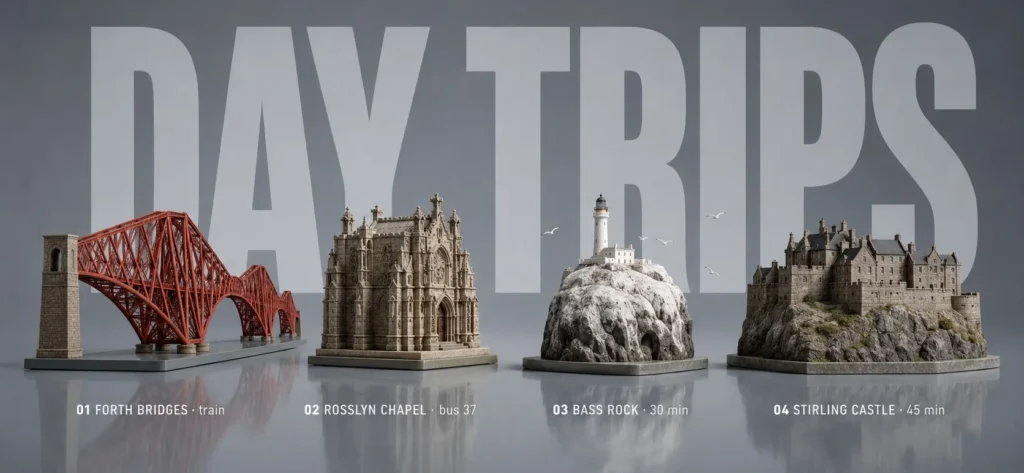
Edinburgh is a brilliant base. Half a day or a full day gets you to:
- South Queensferry and the Forth Bridges by train, for a boat trip to Inchcolm Island and it’s medieval abbey and puffins.
- Rosslyn Chapel by the Lothian 37 bus, the carving-covered 15th-century chapel made famous by The Da Vinci Code.
- North Berwick in 30 minutes by train, for a golden beach, the Scottish Seabird Centre and boat trips to Bass Rock and the world’s largest northern gannet colony.
- Stirling Castle in 45 minutes by train, childhood home of Mary Queen of Scots.
- Glasgow in 50 minutes, for a completely different, grittier energy and the free Kelvingrove and Riverside museums.
Practical Things That Make The Trip Smoother
Getting around is easy and cheap. Edinburgh is compact and walkable and Lothian Buses run everywhere with contactless tap-on, tap-off and a daily cap of £5. The tram links the airport to the centre and Leith.
When to go depends on your tolerance for crowds. August turns the whole city into the Edinburgh Festival Fringe, the largest arts festival on earth, which is thrilling and exhausting in equal measure and it means booking accommodation six to twelve months ahead and paying peak prices. For the same city at a calmer pace, May, June or September are better and Hogmanay at New Year is it’s own spectacular event if you do not mind the cold.
The weather does what it wants. Carry a waterproof even in July and expect the haar, a thick sea fog, to roll in and swallow the castle without warning. Wear shoes you can climb cobbles and a volcano in.
Put it together and Edinburgh rewards the walker with a decent jacket and a booked-ahead castle ticket more than it rewards the big spender. Most of what makes it one of the best things to do in Scotland is free, on foot and out in the weather.