
Step off the overnight ferry at 07:30 and the first thing Lerwick gives you is the smell of the harbour. Salt, diesel, fish, cold air. This is the capital of the Shetland Islands and the only real town for a hundred miles in any direction, a place of about 7,000 people sitting in a sheltered natural harbour on the east coast of Mainland. It is nearer to Bergen than to Edinburgh and the name is Old Norse, Leirvík, muddy bay. Everything worth knowing about Lerwick, Scotland flows from one fact: the sea made it, feeds it and still runs it.
A Town The Sea Built
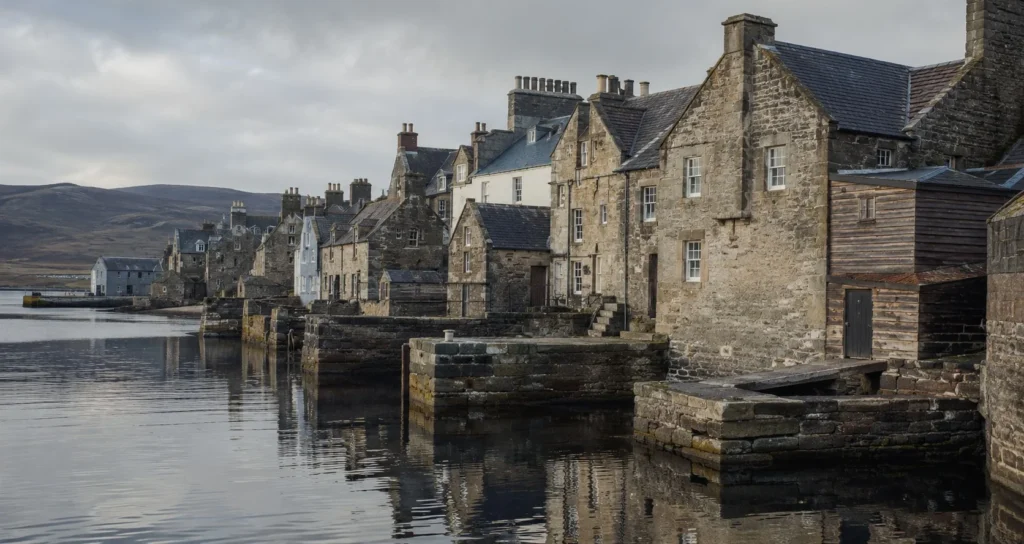
Lerwick has always faced outward. It started in the 17th century as a rough marketplace and haven for the Dutch herring fleets and it grew because boats kept arriving. They still do. On any given morning fishing vessels tie up a few metres from a visiting cruise liner and the whole town is built to touch the water.
The clearest sign of that past is the lodberries, the 18th-century stone warehouses and merchant houses that sit right on the shoreline with their own private piers pushing out into the sea. A lodberry was a private landing place, somewhere a merchant could bring goods straight off a boat. Robertson’s Lodberry, the lime-harled one, is the most photographed building in Shetland and once you have seen it you understand why every postcard uses it.
Just back from the water runs Commercial Street, the old main drag, a narrow flagstone lane with tight side alleys called closses branching off it. It has kept it’s character in a way most British high streets simply have not, still full of independent shops selling knitwear, jewellery and local crafts. Walk it slowly. The whole centre is tiny and entirely walkable and rushing it misses the point.
Ancient Stone And A Glass Cinema In The Same Eyeline
Here is the thing that makes Lerwick more than a pretty harbour: the deep past and the sharp present sit right next to each other, in the same view.
On the ancient side, Clickimin Broch stands on a small loch at the southwestern edge of town, one of the most complete and accessible Iron Age brochs in Scotland. It is a massive drystone tower on a site where people lived more or less continuously from the Bronze Age through to a Norse longhouse and it is free and open all year. A short way off, Fort Charlotte is a five-sided artillery fort from 1665, built to guard the harbour in the Anglo-Dutch Wars, cannons still in place, views straight over the sound.
Now look the other way. Mareel is the UK’s northernmost cinema and music venue, a sleek glass building on the waterfront with two screens, a live auditorium and a café-bar and it anchors a genuinely thriving arts and music scene. A few hundred metres from a 1,000-year-old Norse site, people are watching new-release films and catching live gigs.
The building that ties it all together is the Shetland Museum and Archives at Hay’s Dock. It is a five-star, award-winning museum on a restored 19th-century dock, with a landmark tower visible around the harbour and more than 3,000 objects inside covering everything from Shetland’s geology to the herring boom to the Shetland Bus, the wartime operation that ran boats between here and Nazi-occupied Norway. Traditional vessels hang from the ceiling. Entry is free. If you do one indoor thing in Lerwick, do this.
Fire In January, No Darkness In June
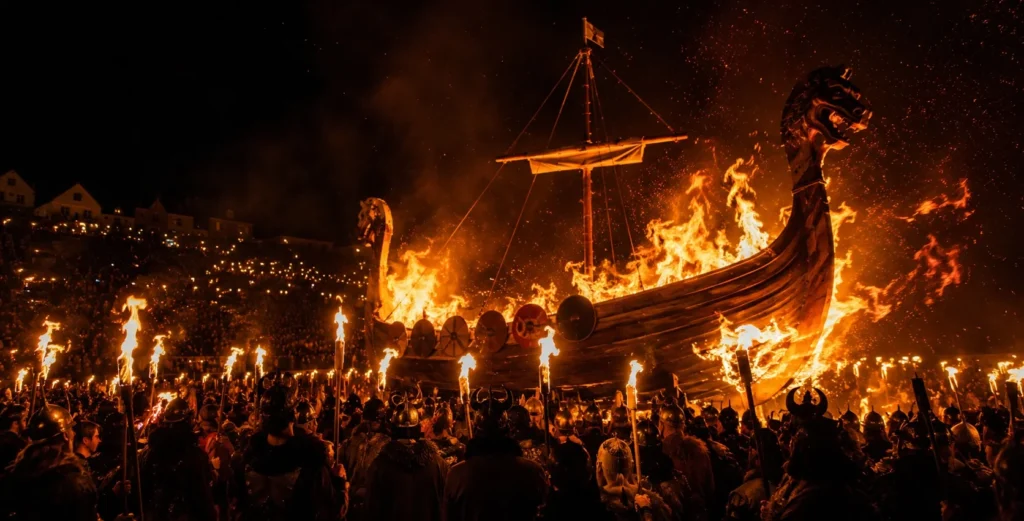
Two opposite events define the Shetland year and both are worth planning a trip around.
The famous one is Up Helly Aa, held on the last Tuesday of January, a date fixed so firmly it does not move for weather. It is Europe’s largest fire festival and for all the Viking imagery it is not an ancient rite; it was invented in the 1870s and became sacred by repetition. More than 900 costumed guizers form squads, led by the Guizer Jarl in full armour, parade through the streets with flaming torches and hurl those torches into a purpose-built replica longship that burns in a public park. Then the squads spend the entire night moving between halls, performing sketches and songs until morning.
One detail almost every travel article still gets wrong: since the 2023 festival, the Lerwick committee dropped the men-only rule and women and girls can now join squads for the first time in the event’s history. In 2024 the Jarl Squad itself included female members, the Jarl’s own daughter and three nieces. If a guide tells you Up Helly Aa is a men-only spectacle, it was written before 2023 and never updated.
The practical warning is simple. The street procession is free to watch, but the hall parties are strictly ticket-only, non-transferable and mostly for locals and beds on the night book out more than a year ahead. Treat it like a wedding, not a weekend away.
Then comes the opposite. Around the June solstice, Lerwick enters the Simmer Dim, a twilight that never fully darkens, handing you 19 or more hours of usable light and long luminous evenings where it simply refuses to get properly dark. The two phenomena are the same coin: a place this far north swings between a January with barely six hours of grey light, which is exactly why you build a fire festival then and a June with almost no night at all.
If neither extreme suits you, two gentler festivals sit in between. The Shetland Folk Festival in early May is a four-day, community-run event that pulls in world-class musicians for hall concerts and loose pub sessions and is famously welcoming. Shetland Wool Week in late September or early October draws knitters from around the world, built around the native Shetland sheep and it’s fine lace-weight wool, with Lerwick as the hub.
What The Water Gives You
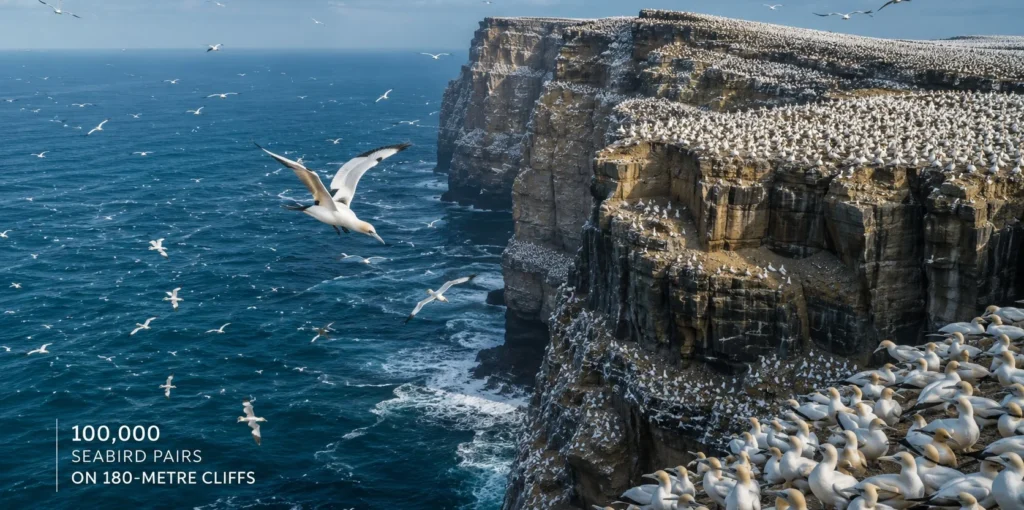
The sea that built the town also stocks it’s larder and fills it’s skies and both are a short step from the harbour.
For wildlife, Lerwick is more launch point than destination in itself, though seals haul out on rocks right in the harbour and otters work the coast if you stay quiet and patient. The trip to make is Noss National Nature Reserve: a short ferry to Bressay, a crossing to Noss, then a circular cliff-top walk past 180-metre sandstone cliffs holding over 100,000 breeding seabird pairs, gannets, guillemots, puffins and the great skuas locals call bonxies. Boat tours from the harbour also hunt for porpoises, dolphins, minke whales and orcas and orca sightings have grown noticeably more frequent in recent years.
For food, seafood comes first and always. Langoustines, scallops, mussels, crab, salmon and cod come off the boats daily and the Shetland name is a quality mark rather than marketing. Look also for three properly local things: reestit mutton, salted and air-dried into the backbone of a rich tattie soup; Shetland black potatoes, small and dark with a purple ring inside and a nutty, floury bite; and heather-grazed Shetland lamb, noticeably sweet for it. When you want to sit down, The Dowry is the standout, an eclectic, locally sourced place that turns into a good bar at night. Fjara Café Bar on Sea Road has floor-to-ceiling windows over the bay for coffee and cake, Fort Café inside the fort does artisan coffee and waffles and the Peerie Shop Café on the Esplanade is the cosy local favourite for homemade soup and hot chocolate.
Getting There And Getting It Right
You almost always come through Aberdeen and you have two ways north.
By sea, NorthLink runs the overnight ferry seven nights a week, year-round. It is the longest internal ferry route in the UK, 216 sea miles and the only commercial passenger service to Shetland, so there is no shopping around. The direct sailing takes about 12 to 13 hours; if it calls at Kirkwall in Orkney, budget 14 to 15. You leave Aberdeen around teatime and dock five minutes from the town centre at 07:30. Book something to sleep in: a reclining seat is cheapest, sleeping pods sit in the middle at £30 per person and a private cabin costs more but earns it’s money when the crossing is rough, which it often is. Cabins and vehicle spaces sell out in summer, so book weeks ahead.
By air, Sumburgh Airport is 25 miles south, with Loganair flying from Aberdeen, Edinburgh, Glasgow, Inverness and Kirkwall, plus seasonal flights from Bergen. A connecting bus meets flights and runs 45 to 60 minutes into town. It is faster than the ferry and weather-dependent in it’s own way; fog at Sumburgh is a real thing.
Once you have arrived, you will not need a car for Lerwick itself. For the rest of Mainland, buses run from the Viking Bus Station and a network of small roll-on ferries reaches the islands.
Last piece of advice and it matters more here than almost anywhere: pack for the wind, not the temperature. Summer averages 12 to 15°C, winter stays mild for the latitude thanks to the Gulf Stream but is relentlessly wet and windy and the local line about four seasons in one day is not a joke. A properly waterproof, windproof jacket is the single thing that decides whether you enjoy the trip.