
Twelve years of Mediterranean travel and I still can’t rank them, because the sea doesn’t work like that, Sicily and a car-free Spanish islet with fifty residents aren’t competing for the same trip. What I can do is give you the whole shape of it, from the volcanic giants at one end of the map to the pastel-house specks at the other, so when someone says “the Mediterranean islands” you actually know what they mean.
The Five Titans
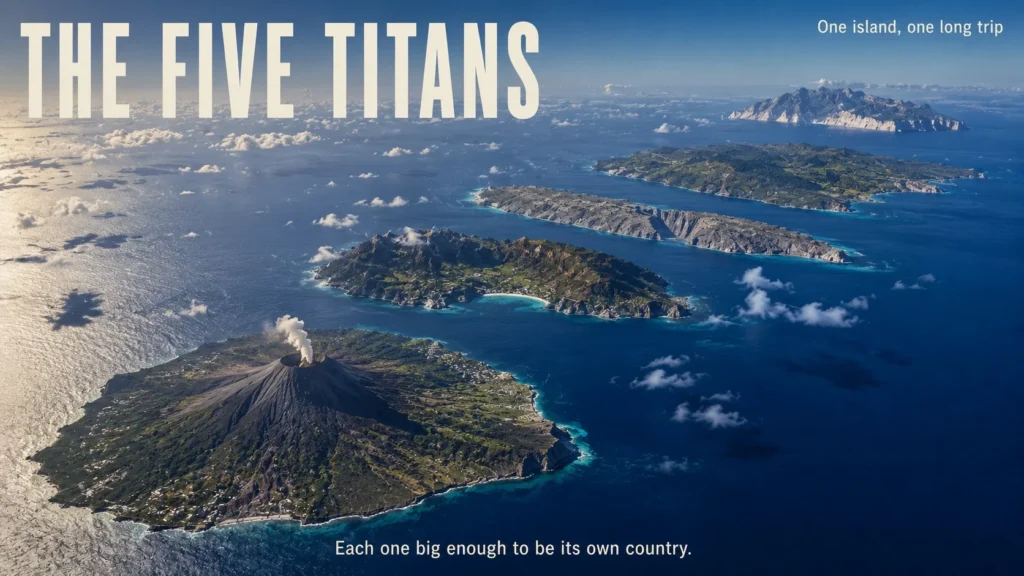
Sicily
If you have one island for one long trip, this is it. Mount Etna is Europe’s most active stratovolcano and the reason Sicilian soil grows what it grows; the northeast is Greek theaters and Roman mosaics stacked on each other, the southeast is Baroque towns rebuilt after the 1693 earthquake with a uniformity that startles you when you first drive into Noto. What actually stays with me is the food, though, the spleen sandwich in Palermo is the outlier, but the arancini, the fish couscous in Trapani that came in from North Africa and stayed, the breakfast granita that ruined every American iced coffee for me forever.
Sardinia
Sicily’s opposite personality. Sardinia is inland-facing, mountainous and much older than most guidebooks acknowledge, the Nuragic civilization left more than 7,000 stone tower-fortresses on this island alone and Su Nuraxi di Barumini is the one to see if you only see one. The coast does the Instagram work (the calas at Golfo di Orosei are as close to Caribbean water as Europe gets), but the interior is where the pastoral culture lives, roast suckling pig and pecorino sardo and the crackly flatbread called pane carasau that keeps for weeks. Different island entirely, from Sicily.
Crete
Big enough to feel like it’s own country, which is basically what Cretans consider it. The Minoans built the palace at Knossos, the Venetians fortified Chania and Rethymno, the resistance against the Ottomans still shapes the local identity. Ridges run east to west with the Samaria Gorge cutting sixteen kilometers through the White Mountains and the south coast has palm groves that don’t feel European. Order the dakos and the graviera, drink whatever raki the kafenion owner brings you.
Cyprus
The world’s last divided capital sits at it’s center, which tells you everything about how many cultures have overlapped here. Troodos has painted Byzantine churches you can visit alone, Crusader castles cling to crags in the north and halloumi comes from villages that have been making it for centuries. Commandaria wine has kept it’s name longer than any other wine in the world.
Corsica
France on paper, thoroughly it’s own place in practice. The GR 20 hiking trail through granite peaks is one of Europe’s hardest and best; Bonifacio’s citadel is carved directly into the limestone cliff. Napoleon was born in Ajaccio and the polyphonic singing tradition is on UNESCO’s intangible heritage list. Corsican charcuterie is the reason to come if you don’t hike.
The Archipelagos
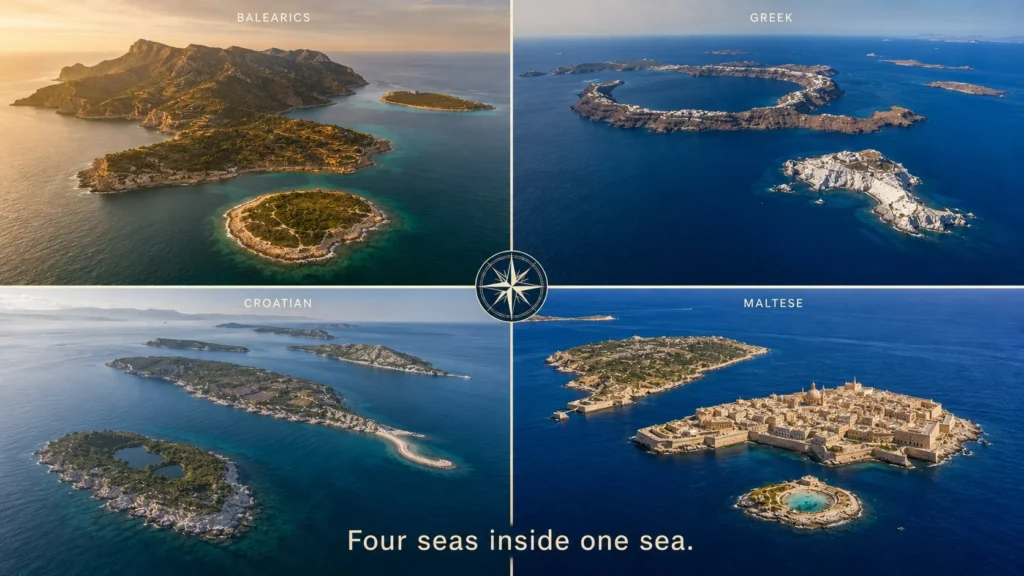
The Balearics
Four islands, four completely different vacations. Mallorca is the one people underestimate, the Serra de Tramuntana on the northwest coast is UNESCO-listed, terraced with olive groves that predate the Reconquista and the drive down to Sa Calobra is genuinely one of the great roads in Europe. Chopin spent a winter in Valldemossa. Menorca is the quieter sister, a Biosphere Reserve with stone-age burial chambers older than the pyramids and a 185km coastal path called the Camí de Cavalls that circles the entire island. Ibiza is more than the clubs, the fortified upper town Dalt Vila is a UNESCO site and the north keeps it’s hippie-market weirdness. Formentera, the tiny one you reach from Ibiza by ferry, is where the water goes ridiculous, Ses Illetes is a Posidonia seagrass reserve and the color of the shallows there is not a filter.
The Greek Islands
Too many to properly do justice, so the ones that matter:
- Santorini is a drowned volcano and yes it looks like the photos; drink the Assyrtiko wine grown in basket-shaped vines on volcanic ash.
- Mykonos is flat, whitewashed and honest about being a party island, the LGBTQ+ scene has been established for decades and the windmills predate the DJs by 400 years.
- Naxos and Paros are the practical Cyclades, greener, cheaper, with real villages and unfinished ancient statues lying in Naxos’s marble quarries.
- Milos is the geology island, all eroded white rock at Sarakiniko and emerald sea caves at Kleftiko.
- Amorgos has the cliffside Hozoviotissa Monastery from The Big Blue, if you saw that film in the ’90s and never forgot it.
The Ionians, off the west coast, are greener, wetter and more Venetian. Corfu‘s old town has a cricket pitch left by the British and a Napoleonic French arcade in the same square. Zakynthos has Shipwreck Beach, the one enclosed cove with the rusted freighter, though the crowds now match the photos. Kefalonia‘s underground Melissani cave and the white-cliff sweep at Myrtos are the two you’ll remember.
And the Dodecanese in the far east, Rhodes with the world’s best-preserved Crusader old town, Kos where Hippocrates taught medicine at the Asclepeion, Patmos where St. John received the Book of Revelation in a cave you can still enter.
The Croatian Islands
Different rhythm entirely, Adriatic karst limestone, lavender fields, sparser and stonier than anything Greek. Hvar has one of Europe’s oldest public theaters (1612) and an interior of half-abandoned lavender villages worth the drive. Brač is where the shape-shifting Zlatni Rat spit is and the same white limestone quarried here built Diocletian’s Palace and the White House. Korčula is the fishbone-plan medieval town with the traditional Moreška sword dance. Vis was closed as a military base until 1989, which is why it still feels found, Stiniva Cove is the hidden pebble beach you’ve seen in aerial shots. And Mljet is a national park of two saltwater lakes with a 12th-century Benedictine monastery on an island inside the larger lake, which is peak Mediterranean nesting-doll geography.
The Maltese Archipelago
Three islands the size of a decent county between them. Malta itself has the Ħal-Saflieni Hypogeum, a 5,000-year-old subterranean burial complex acoustically engineered before writing existed and Valletta’s St. John’s Co-Cathedral holds Caravaggio’s Beheading of St. John, his largest painting and the only one he signed. Gozo is the rural, greener sister and Comino is basically empty except for the Blue Lagoon, which does the tropical-illusion thing better than most tropical lagoons.
The Specialist Islands Worth Making a Trip For
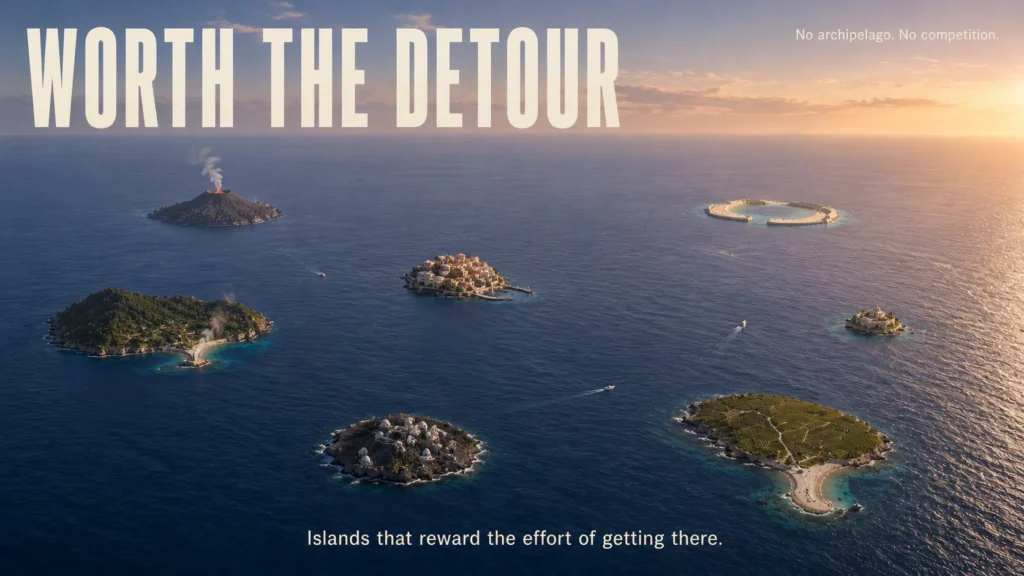
The islands that don’t fit any archipelago but reward you disproportionately for the effort:
Ischia, in the Bay of Naples, is Europe’s densest concentration of thermal springs, natural mineral pools, fumarolic mud and a beach at Sorgeto where hot spring water bubbles up through the sand into the sea. It’s neighbor Procida was Italian Capital of Culture in 2022 for being unapologetically working-class, all pastel fishermen’s houses tumbling down to the Marina Corricella. Neither is Capri, which is the third island in that bay, Capri is the limestone cliff one, with the Blue Grotto and the Faraglioni sea stacks and Emperor Tiberius’s ruined pleasure villa on top of the hill.
The Aeolian Islands off Sicily are a seven-island volcanic arc where Stromboli erupts mildly every few minutes and you can watch the glowing bombs at night from a boat, I’ve done this twice and I’d do it again tomorrow. Pantelleria sits closer to Tunisia than to Sicily and grows capers wild in black volcanic rock; the local architecture is white-domed stone cubes called dammusi that catch rainwater on the roof.
The Turkish islands nobody in Western Europe mentions: Bozcaada near the Dardanelles is a proper wine island with a Venetian castle and streets that still look Greek because they were, until 1923. Gökçeada is the sparse windswept one where kitesurfers and abandoned Greek villages coexist.
Off France, Porquerolles is a car-free national park with water clearer than the mainland Côte d’Azur, you cycle through a vineyard to reach Plage Notre-Dame. And the Frioul archipelago fifteen minutes off Marseille has the Château d’If, which if you’ve read The Count of Monte Cristo is enough reason on it’s own.
Two singular ones worth the trouble: Elafonisos in the Peloponnese, a flat sandy island separated from the mainland by a wadeable strait, has Simos Beach, a double crescent of white sand and dunes with water so shallow and clear it doesn’t register as the same sea. And Tabarca off Alicante is Spain’s smallest inhabited island, a walled Genoese fishing village on a treeless islet, one traditional dish (caldero, rockfish and rice), no cars.