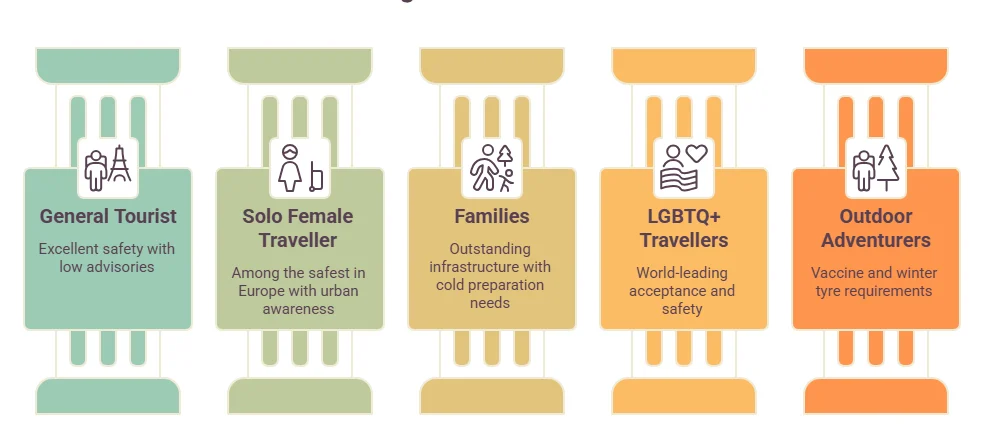
Both Finland and Denmark sit at the safest end of the global travel spectrum. Every major government — the US, UK, Canada, Australia — currently rates both countries at their lowest advisory level. That said, a few specific things deserve your attention before you book.
Key takeaways:
- 🇫🇮 Finland: Safe nationwide, but stay well clear of the Russian border — the UK FCDO advises against travel within 10km of it and all land crossings remain closed indefinitely.
- 🇩🇰 Denmark: Copenhagen’s terrorism threat sits at Level 4 (“Significant”) — the highest sustained level in Western Europe — driven largely by tensions around the Koran burning incidents of 2023-24.
- Petty theft is the most likely problem in both capitals, particularly around transport hubs.
- ETIAS authorization is now mandatory for US, UK, Canadian and Australian visitors — don’t skip this.
- Verdict: Two of Europe’s safest destinations, with a handful of real but manageable risks worth knowing before you land.
How Safe Are Finland and Denmark, Really?
Genuinely, very safe. I’ve found that travel warnings for Scandinavia tend to alarm people more than the actual conditions warrant — and the data backs that up.
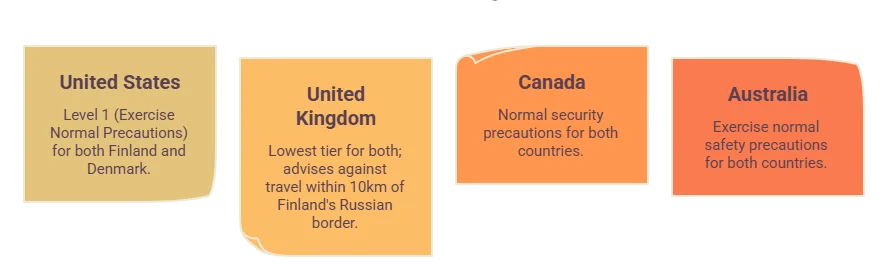
The US State Department rates both countries at Level 1: Exercise Normal Precautions — the same level as Canada or Japan. The UK’s FCDO, Canada, Australia and New Zealand all echo that assessment for general travel to both countries.
Finland consistently ranks among the world’s least corrupt, most stable societies. Denmark isn’t far behind. Violent crime rates in both countries are low by any European standard, public infrastructure is excellent and healthcare — should you need it — is world-class.
That said, “safe” doesn’t mean “no warnings.” Both countries have specific, real advisories that matter — they just don’t define the entire trip.
Finland Travel Warnings: The Border Is the Big One
The Russia Border — Don’t Go Near It
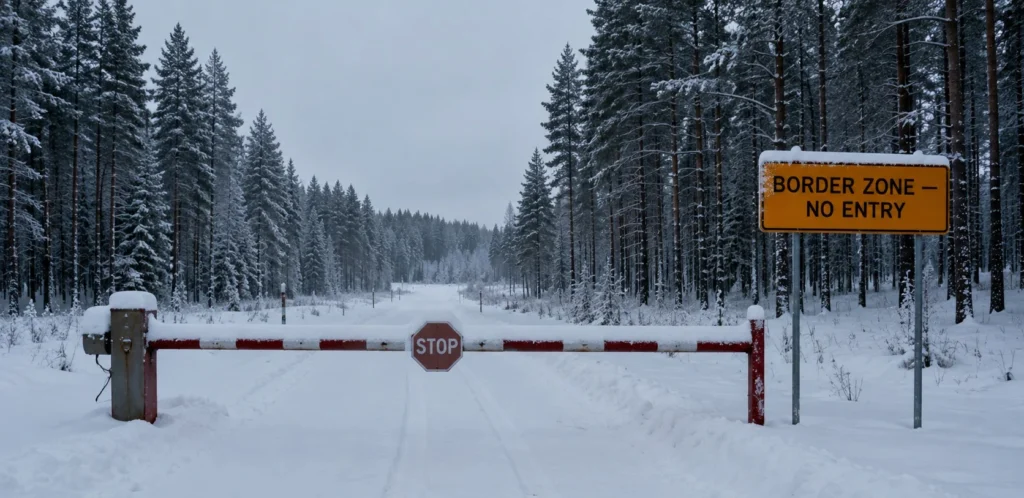
This is the warning that catches people off guard. Finland shares a long land border with Russia and since late 2023, every single land crossing has been closed — indefinitely. This followed Finland’s NATO accession and what the Finnish government called “instrumentalised migration” pressure from the Russian side.
The UK FCDO explicitly advises against all travel within 10km of the Finnish-Russian border. Canada and Australia carry similar language. Eastern border towns like Imatra, Lappeenranta and Salla are fine to visit — they’re popular destinations — but approaching the actual frontier zone is illegal and actively patrolled. All cross-border train and bus services are suspended until further notice.
If you’re planning a road trip through eastern Finland, just stay aware of where you are relative to the border. It’s not hard to avoid, but it’s worth knowing.
Terrorism — Low, But Not Zero
Finland’s terrorism threat level sits at 2 (Elevated) on a 1–4 scale, maintained by the Finnish Security Intelligence Service (Supo) since 2017. The last significant incident was the Turku stabbing that same year. Lone-actor attacks remain a theoretical risk — as they do across most of Europe — but nothing about Finland’s current situation demands extraordinary precautions. Normal urban awareness in crowded spaces is enough.
Crime, Weather and the Practical Stuff
Petty theft happens in Helsinki — pickpocketing around the Central Railway Station, Kamppi and on trams is the most common issue. Nothing unusual for a European capital, just don’t leave bags unattended.
Winter in Finland is it’s own category of hazard. Lapland temperatures drop to -30°C. Roads demand winter tyres — legally required from November 1 to March 31 — and moose collisions are a genuine risk on rural roads, not just a quirky warning. If you’re heading north in summer, pack mosquito repellent; the far north in July can be relentless.
One thing I’d flag for outdoor travelers: tick-borne encephalitis (TBE) exists in coastal and archipelago regions from spring through autumn, particularly around the Åland Islands and Turku archipelago. A TBE vaccine is worth considering if you’re spending time in forested areas. The Finnish Institute for Health and Welfare has current guidance on this.
Denmark Travel Warnings: Terrorism Level Is Higher Than Most People Expect
The Terrorism Threat — Level 4
This is the detail that surprises most travelers. Denmark’s terrorism threat is currently set at Level 4 (“Significant”) on a five-step scale by the Danish Security and Intelligence Service (PET). Level 5 is “Critical” — so Denmark sits one step below the maximum. That level has been in place since 2010, with occasional spikes to 5 during specific flashpoints.
The background matters here. Denmark became a named target for extremist groups following the 2005 Jyllands-Posten cartoon controversy and tensions escalated again after the 2023-2024 public Quran burnings, which triggered protests across Muslim-majority countries and renewed calls for attacks. The primary threat profile is lone actors or small cells — stabbings, vehicle-ramming, firearms — targeting public spaces, transport hubs and symbolic locations like Strøget, Copenhagen City Hall Square and the Christiansborg area.
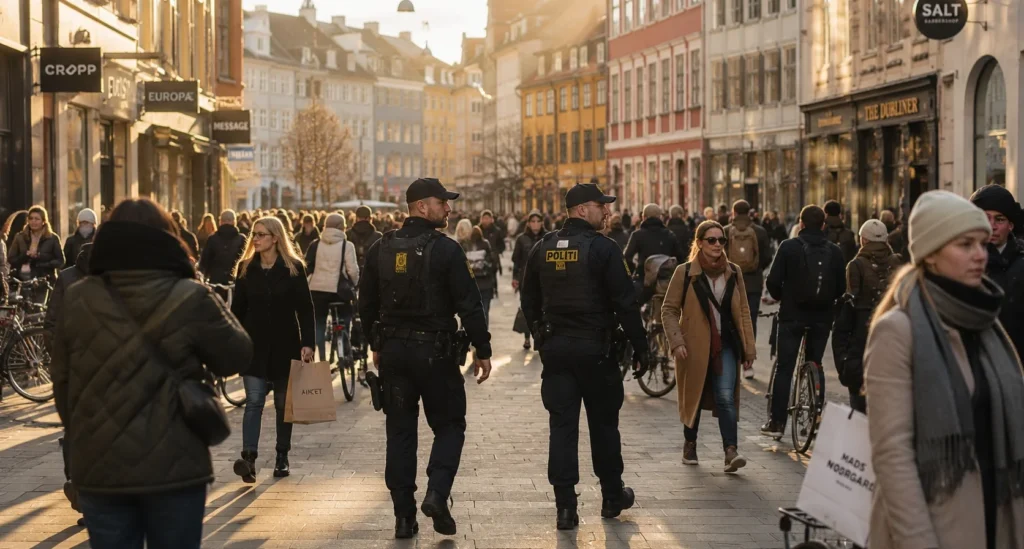
Does this mean Copenhagen feels dangerous? No — not at all. Visible armed police and military patrols at airports, train stations and major attractions are routine and precautionary. In my experience, the city feels relaxed and open. But the threat level is real, officially maintained and worth knowing — not to scare you off, but so you’re not caught off guard by the security presence.
Petty Crime in Copenhagen — Specific Spots to Watch
Copenhagen is safe, but it’s still a major European capital with active pickpockets. The hotspots are predictable: Copenhagen Central Station (København H), Nørreport, the Strøget pedestrian street and crowded S-train and metro carriages. Thieves typically work in pairs using distraction techniques — a bump, a question, someone pointing at something.
Standard precautions apply. Keep bags in front of you, don’t leave phones on café tables and be especially alert on public transport during rush hour. A Reddit thread on r/Copenhagen consistently flags Nørreport as the single highest-risk spot for bag theft — worth keeping in mind.
Christiania — Still Worth Visiting, With Caveats
Christiania is one of Copenhagen’s most visited neighborhoods and I’d still recommend seeing it during the day. But context helps. In 2024, Danish authorities demolished parts of the infamous Pusher Street to disrupt the open cannabis trade — a significant crackdown after years of gang-related shootings in the area. Violent incidents have decreased since then, but the neighborhood can feel edgy after dark and several governments specifically advise avoiding it at night.
Cannabis remains illegal in Denmark outside of Christiania’s historically tolerated grey zone — and even that tolerance has narrowed considerably. Possession of small amounts anywhere else can still result in fines and a criminal record. Don’t assume Copenhagen’s relaxed atmosphere extends to drug laws across the board.
Bicycles — Seriously, Watch Where You Step
This sounds minor until it happens to you. Copenhagen’s cycling infrastructure is world-class and locals use it at speed. Tourists wandering into bike lanes — especially stepping off a curb without looking left — cause regular collisions. Always check for cyclists before crossing any painted lane. If you’re renting a bike yourself, hand signals and lighting rules are enforced; police do issue fines.
Practical Advice Before You Go — For Both Countries
ETIAS: Don’t Skip This Step
As of mid-2025, the European Travel Information and Authorisation System (ETIAS) is mandatory for visa-exempt travelers — that means US, UK, Canadian, Australian and New Zealand passport holders, among others. It’s not a visa; it’s a pre-travel authorization. The process is online, costs €7 and is valid for three years. You apply before booking your carrier — not at the border.
Miss it and you won’t board. Airlines are required to check it.
Insurance — More Important Than People Think
EU citizens with an EHIC or GHIC card get state-provided treatment at reduced cost in both countries. Everyone else needs comprehensive travel health insurance. Medical evacuation from Lapland alone can cost tens of thousands of dollars without coverage. It’s not optional — it’s just a cost of the trip.
Emergency Numbers
Both Finland and Denmark use 112 for police, fire and ambulance. Save it before you land.
A Note on Digital Safety
Free Wi-Fi is everywhere in both countries — airports, cafés, hotels, public transport. Convenient, but public networks are public. A VPN is worth using if you’re accessing anything sensitive. Card and mobile payments are near-universal; carrying significant cash is unnecessary and makes you a more attractive target.
My Honest Takeaway
Finland and Denmark are genuinely two of the easiest destinations in the world to travel safely. The warnings that exist are real — the Russian border situation in Finland isn’t theoretical and Denmark’s terrorism level reflects an actual, sustained threat assessment — but neither changes the fundamental character of these places as welcoming, well-organized and low-stress to navigate.
What I’d actually focus on: get your ETIAS sorted early, buy proper travel insurance and if you’re heading to Finnish Lapland in winter, treat the cold and the road conditions with genuine respect. In Copenhagen, just watch where you step near bike lanes and keep your bag close around the main train stations.
Everything else is just good travel common sense — the kind that applies anywhere in Europe.