
If you just want to know what to buy — the VOCIC PackGo Z35 is the best pick for air travel (it actually fits in overhead bins, folded to roughly 12x12x12″). For a lighter, more premium feel, the Rollz Air at 10.9 lbs is hard to beat. Both handle long travel days without becoming a burden themselves. Details on everything else are below.
What “Lightweight” Even Means Here — Because It’s Vague
Twelve pounds sounds light. Until you’re hauling it down a jetway at 6am with a carry-on in the other hand.
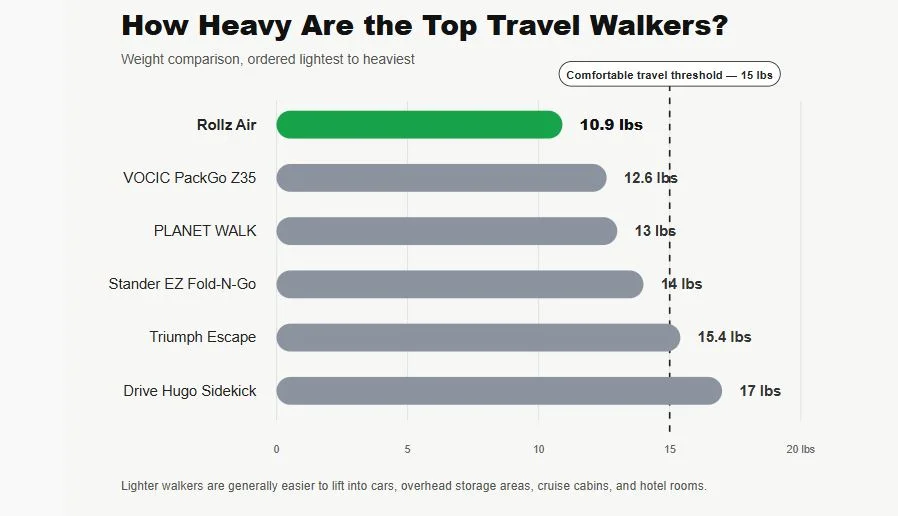
So let’s be specific. For travel walkers, lightweight generally means anything under 18 lbs — but the sweet spot most people actually want sits between 10 and 15 lbs. That’s the range where you’re not sacrificing stability just to shave ounces.
- Under 12 lbs — genuinely easy to lift. The Rollz Air (10.9 lbs) sits here. Carbon fiber frame, which sounds fancy but it’s genuinely why it stays under 11 lbs while holding up to 385 lbs of weight capacity. Worth knowing.
- 12–15 lbs — the realistic travel range for most people. VOCIC Z35 at 12.6, PLANET WALK at 13, Stander EZ Fold-N-Go at 14. These don’t feel like a burden.
- 15–18 lbs — heavier, but models like the Triumph Escape earn their weight with 8″ wheels that actually handle cobblestones.
One thing that gets overlooked: weight capacity matters just as much as walker weight. A walker that weighs 10 lbs but only holds 250 lbs isn’t the right call for everyone. The Rollz Air holds 385 lbs at under 11 lbs total — that combination is genuinely unusual in this category.
The Fold. Seriously, Start Here.
Everything else — wheels, seat, bag hooks — is secondary. The fold determines whether your walker travels with you or becomes the thing you’re working around.
There are basically three types worth knowing:
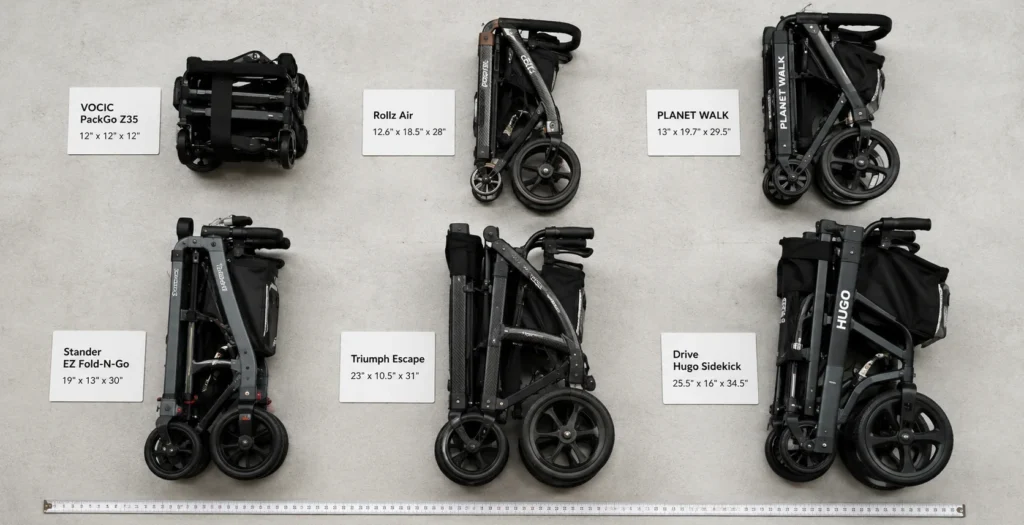
1. Overhead-bin folds. This is rare. The VOCIC Z35 does a six-way fold that gets it down to roughly one cubic foot — 12″x12″x12″. It even comes with a backpack case. TSA classifies walkers as medical devices, so they’re not counted against your carry-on limit, but fitting it in the overhead bin is a different thing entirely. The Z35 actually does it.
2. Standing folds. The Hugo Sidekick and Triumph Escape both fold and stand upright on their own. Sounds minor. Isn’t. In a cruise ship cabin or a small restaurant, having it stand in the corner rather than leaning and sliding is genuinely useful.
3. One-hand folds. The Stander EZ Fold-N-Go and PLANET WALK collapse with one hand. If you’re managing luggage, a door and a walker simultaneously — which happens constantly when traveling — this matters more than any spec sheet suggests.
Quick scenario breakdown:
| Travel Type | Best Fold Type | Recommended Model |
| Flying (cabin storage) | Ultra-compact / overhead bin | VOCIC PackGo Z35 |
| Cruise ship | Standing fold, compact | Stander EZ Fold-N-Go |
| Road trip | Any — prioritize wheel size | Triumph Escape |
| City / restaurant hopping | Standing fold, side-fold | Drive Hugo Sidekick |
| Train travel | One-hand quick fold | PLANET WALK |
Full Comparison: The Six Models Worth Knowing
| Model | Weight | Folded Size | Weight Capacity | Standout Feature | Best For |
| VOCIC PackGo Z35 | 12.6 lbs | ~12x12x12″ | 300 lbs | 6-way fold; overhead bin compatible | Air travel |
| Rollz Air | 10.9 lbs | Compact | 385 lbs | Carbon fiber; lightest + strongest | Luxury/frequent travel |
| Stander EZ Fold-N-Go | 14 lbs | 13″W x 10″D x 35.75″H | 250 lbs | Stands when folded; 3x fold | Cruises, car trunks |
| Triumph Escape | 15.4 lbs | 11″ depth | 300 lbs | 8″ wheels; outdoor terrain | Parks, uneven streets |
| Drive Hugo Sidekick | 17 lbs | Side-fold | 250 lbs | Stands upright; 8″ front wheels | Tight spaces |
| PLANET WALK | 13 lbs | Compact | 300 lbs | One-hand fold; detachable frame | Quick trips, trains |
The Wikipedia overview on rollator design is actually useful context if you want to understand why wheel diameter affects stability — it’s not marketing, there’s physics behind it.
Wheels: The Part Everyone Gets Wrong
Most people pick a walker based on weight and fold, then get to their destination and realize the wheels are useless on anything that isn’t a hotel lobby floor. Don’t do that.
Wheel size directly affects how the walker handles real-world surfaces — and “real-world” means cobblestones in Lisbon, gravel paths at a national park, wet pavement outside a cruise terminal. Wheel diameter and rollator stability have a documented relationship — bigger wheels roll over obstacles rather than catching on them.
Here’s how to think about it:
- 6″–7″ wheels — smooth surfaces only. Indoor malls, hotel corridors, airport terminals. The Stander EZ Fold-N-Go runs these. Fine for most city travel if you’re sticking to paved areas.
- 8″ wheels — the travel sweet spot. Triumph Escape and Hugo Sidekick both run 8″ fronts. Handle light outdoor terrain, slightly uneven sidewalks, gaps between pavement slabs. You notice the difference immediately.
- Pneumatic (air-filled) tires — the Helavo walker goes here. Actual off-road capability, lawn, gravel, packed dirt trails. Tradeoff is maintenance — you’re dealing with tire pressure, potential flats. Worth it if parks and nature are the whole point of the trip. Not worth it if you’re doing cities.
One thing worth flagging: research on fall prevention in older adults from the CDC consistently points to uneven surfaces as a major risk factor. Wheel size isn’t vanity — it’s a real safety variable when you’re navigating unfamiliar terrain.
The Seat Question — More Complicated Than It Looks
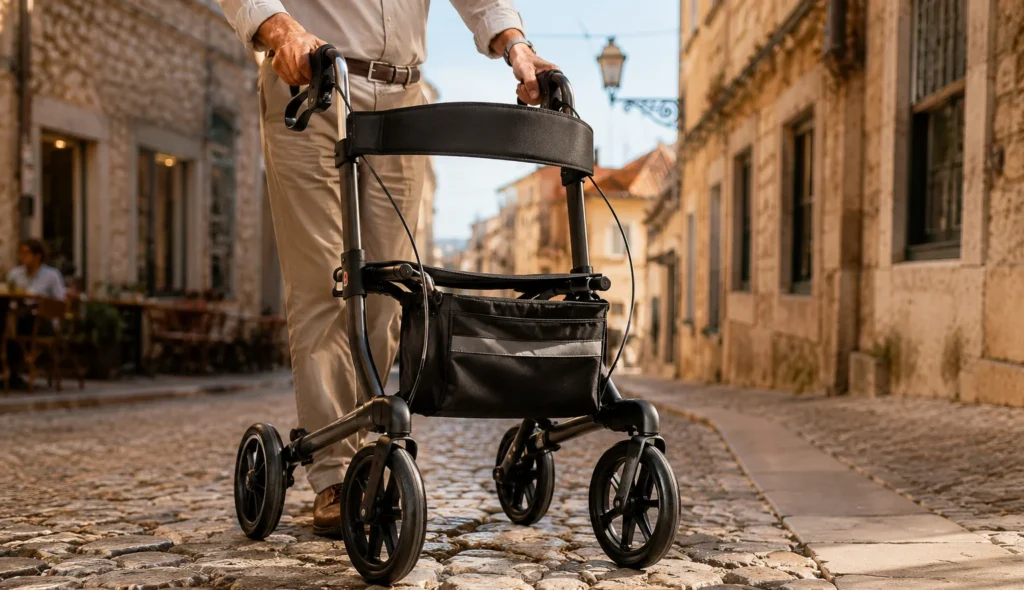
Every walker on this list has a seat. That’s not what matters. What matters is whether you’ll actually use it and whether it holds up after four hours walking through a museum.
A few things to check:
- Width. The Rolloy runs a 19″ seat, which is notably wider than standard. Sounds like a small thing. After a long day, it isn’t.
- Padding. Some seats are basically a canvas strap. Fine for a quick rest, genuinely uncomfortable for longer breaks. If you know you’ll be sitting regularly — not just occasionally — padding is non-negotiable.
- Seat height. Should match roughly the height of a standard chair. Too low and getting back up becomes its own ordeal. Some models offer adjustable seat heights; worth checking if you’re taller or shorter than average.
- Weight rating applies to sitting too. Not just walking support. Make sure the capacity covers your full body weight when seated.
An honest note: choosing the right mobility aid is something CDC and physical therapists both recommend doing with professional input — especially seat and handle height. A travel guide can get you close, but a PT can get it right.
Flying With a Walker — What TSA Actually Says
This trips people up. So let’s just be direct about it.
TSA explicitly allows walkers and rollators as medical devices — they go through security screening but are not counted against your carry-on allowance. That’s the rule. What it doesn’t mean is that the airline will let you bring any size walker into the cabin.
Cabin storage is a separate question governed by the airline, not TSA. Standard overhead bin dimensions run roughly 22″ x 14″ x 9″ — that’s the typical carry-on limit most U.S. carriers use. Most walkers don’t fold small enough. The VOCIC Z35 is the standout exception at 12x12x12″ folded.
For everything else, gate-checking is the move:
- Use the walker all the way to the gate.
- Gate agents take it there, it goes in cargo.
- It’s returned to you at the aircraft door on arrival — you don’t have to go to baggage claim.
It’s free. It works. The main downside is you don’t have it during the flight — so if you need to get up and move around the cabin, plan for that.
A few practical things people don’t think about until they’re standing at the gate:
- Notify the airline in advance. Most carriers have a mobility device notification option during booking. Use it. It smooths everything.
- Take photos of your walker before handing it over. If it comes back damaged — which does happen — documentation matters for any claim.
- Consider a padded travel bag. Gate-checked items go in cargo unprotected. A basic walker bag runs cheap and prevents a lot of grief.
Reddit threads on traveling with mobility aids are actually surprisingly useful here — real people documenting real experiences with specific airlines and airports. Worth a read before your first trip.
Which Walker for Which Trip — Actual Scenarios
Generic “best for outdoor use” labels don’t help much when you’re trying to decide between three models. So here’s how to think about it by trip type.
Flying somewhere specific and want it in the cabin: VOCIC PackGo Z35. Full stop. Nothing else folds small enough consistently. The backpack case it comes with is a genuine differentiator — you’re not improvising a solution, it’s built into the product.
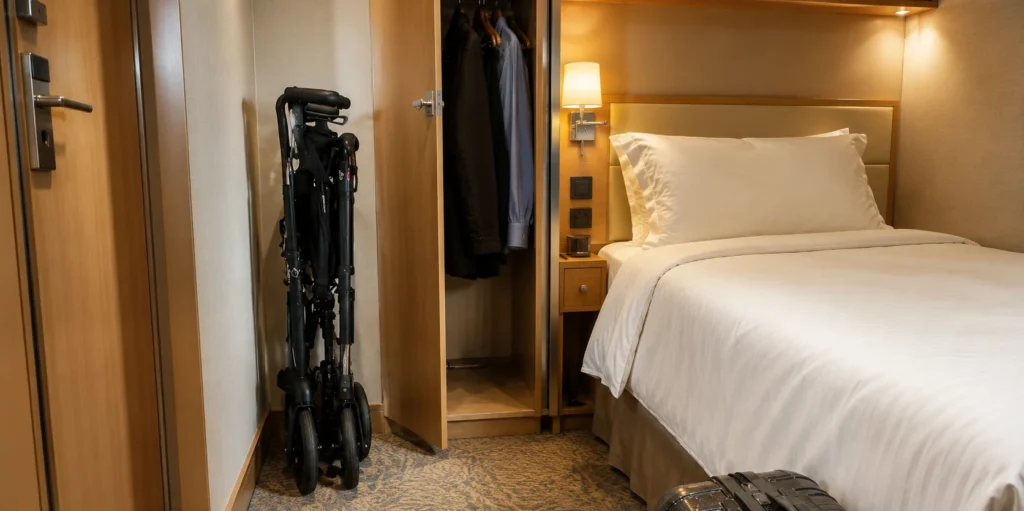
Cruise: Cruise ship cabins are notoriously small. Like, absurdly small. The Stander EZ Fold-N-Go wins here because it stands upright when folded — you put it in the corner and it stays there. That 3x fold also gets it into closets that other walkers simply won’t fit. Anyone who’s navigated a 150-square-foot cabin knows every inch matters.
European city break — cobblestones, cafes, uneven everything: Go with 8″ wheels minimum. Triumph Escape or Hugo Sidekick. Cobblestones aren’t just uncomfortable on smaller wheels — they’re actually destabilizing. The Hugo Sidekick’s side-fold design also means it tucks neatly beside a café table without becoming the thing everyone trips over.
National parks, outdoor trails, nature: The Helavo with pneumatic tires is the honest answer if terrain is genuinely rough. Packed gravel, grass, slight inclines — standard wheels struggle. Air-filled tires absorb it. Just know going in that you’re signing up for occasional tire pressure checks, same as a bicycle.
Road trips with varied stops: Triumph Escape handles this well. The 8″ wheels transition between parking lots, rest stops, gravel viewpoints without needing to think about it. Fits in most car trunks folded.
Train travel, quick urban errands, lots of getting on and off: PLANET WALK’s one-hand fold is the answer. You’re collapsing and reopening constantly — one-handed matters when the other hand is holding a rail or a bag.
Keeping It Running Mid-Trip
Most people skip this part. Then something goes wrong in Porto and they’re looking for an allen wrench in a pharmacy.
Before you leave:
- Test the brakes properly — not just a quick squeeze, actually lean your weight on them. They should hold. If there’s any slip or softness, adjust or service before the trip.
- Check every bolt. Folding mechanisms have multiple connection points. They loosen with use. A two-minute check prevents a wobbly walker two weeks in.
- Clean the wheels. Dirt and hair wrapped around axles creates drag and uneven rolling. Sounds minor until one wheel is moving differently than the others.
During the trip:
- Wet environments kill brakes. Beach towns, rainy cities, cruise ship pool decks — wipe down brake pads if they’ve gotten wet before you rely on them.
- Sand gets into everything. If you’ve been anywhere near a beach, check the folding mechanism. Sand in the pivot points makes folding stiff and, eventually, damages the mechanism.
- Carry one small tool. A mini multi-tool or basic hex key set weighs almost nothing and handles 90% of minor adjustments. Most walkers use standard hex bolt sizes.
Wikipedia’s overview of assistive mobility device maintenance is sparse, honestly — the more useful resource is checking your specific model’s manual before departure, not after something stops working.
What the Market Is Actually Moving Toward
Worth mentioning because it affects buying decisions — especially if you’re thinking long-term.
The direction is clear: walkers are being designed around travel anxiety, not just mobility. The VOCIC Z35’s whole concept is built on eliminating the gate-check problem. The Rollz Air using carbon fiber isn’t just premium aesthetics — it’s an engineering response to the demand for sub-11-lb walkers that don’t compromise on capacity.
Expect more of this. Modular designs, lighter materials, folds that are genuinely engineered rather than retrofitted. The PLANET WALK’s detachable frame is early evidence of that — the idea that the walker adapts to the situation rather than the other way around.
For anyone who travels more than two or three times a year, spending up on this category makes sense. A $400 walker that fits overhead and handles cobblestones is cheaper than the alternative — a $150 walker that gets damaged gate-checked twice and replaced.
Quora discussions on rollator walker travel experiences have some genuinely useful first-person accounts on what people wish they’d known before buying — worth scanning before committing to a model.
Bottom Line
There’s no single right answer — which is actually the useful thing to say here, because pretending otherwise would waste your time.
If you fly frequently and want the walker in the cabin: VOCIC PackGo Z35. Nothing else matches it on packability right now.
If weight is the primary concern and budget isn’t: Rollz Air. Carbon fiber, 10.9 lbs, 385 lb capacity. It’s genuinely in a different category on that combination.
If you want the best all-rounder — solid fold, reasonable weight, handles varied terrain, doesn’t cost a fortune: Stander EZ Fold-N-Go. It’s been the benchmark for a reason.
For outdoor-heavy trips, the Triumph Escape. For tight city spaces, the Hugo Sidekick. For train and transit travel, the PLANET WALK.
Physical therapists recommend getting a professional fitting before finalizing any mobility aid — handle height, seat height, wheel type. That’s genuinely good advice and worth doing before purchasing, not after.
The walker shouldn’t be the thing you’re managing on a trip. Pick the right one and it just disappears into the background — which is exactly what it should do.