
On the third day during my trip to Thailand, I believed that there was nothing left to witness. The mess of Bangkok, the beaches of the Phuket, the typical tourist trail. Then my local guide said Khao Sok National Park and smiled at me like he was telling me a secret.
“You want real Thailand?” he asked. “Not Instagram Thailand. Real Thailand.”
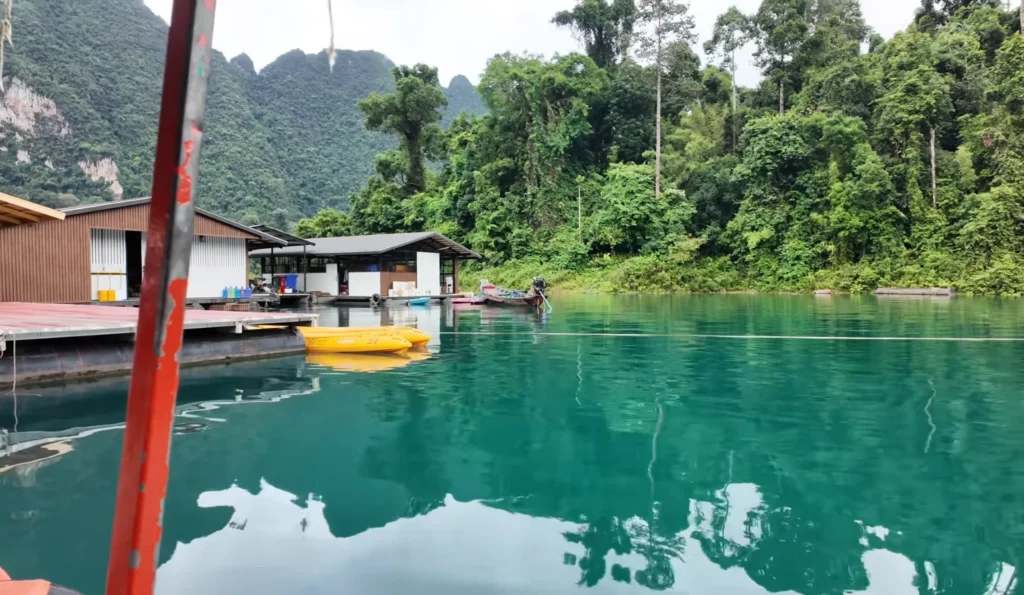
Six hours afterwards, standing on the slope of Cheow Lan Lake I realized what he was talking about. The water was a sheet of jade-like water, only broken by towers of limestone which had the air of being brought down to the planet by another space ship. No crowds. No beach vendors. Only rainforest and silence so such that you can hear fish jumping.
Hitchhiking: The Voyage Begins before You Can Arrive
Transportation Reality Check
As a means of getting to Khao Sok, most guides do not inform you of the actual goals of getting to Surat Thani Airport. The park is about 65km away that was an hour and half drive, not a bad one to Surat Thani town. It is no ordinary highway tour.
There were twelve words of English that my taxi driver, Somchai, could speak. Didn’t matter. The road cuts through rubber bushes over which the workers continue to tap trees at dawn and past roadside stalls selling rambutan so fresh the vendors picked them that morning. True Thailand, as my guide told me.
Transportation Options:
- Private taxi from airport: 1,800-2,200 THB ($50-60).
- Local bus to Khao Sok: 150 THB ($4) – takes 2.5 hours with stops.
- Tour company transfer: 1,500 THB ($42) with hotel pickup.
- Rental car: Starting 1,200 THB/day ($33) – if you’re brave enough.
The bus option sounds tempting until you’re crammed between a chicken coop and someone’s motorcycle parts for two hours. I learned this the hard way on day three when I decided to be “budget conscious.”
Where to Base Yourself
Here’s what nobody tells you about Khao Sok accommodation – there are really two different experiences, and picking wrong ruins everything.
You’ve got the mainland jungle lodges near the park entrance, perfect for hiking and cave exploration. Then there’s the floating accommodations on Cheow Lan Lake – completely different universe.
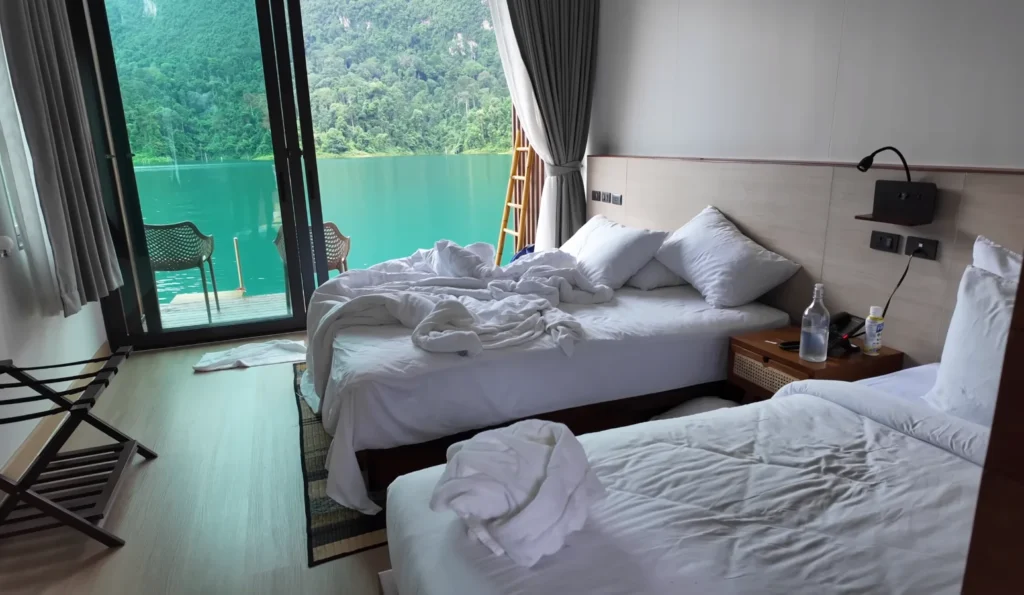
I did both. Had to. That floating bungalow experience? Waking up with nothing but emerald water and limestone cliffs outside your window – it rewires something in your brain. But you need the jungle base for the serious trekking.
The Lake That Changes Everything: Cheow Lan’s Emerald Paradise
First Glimpse
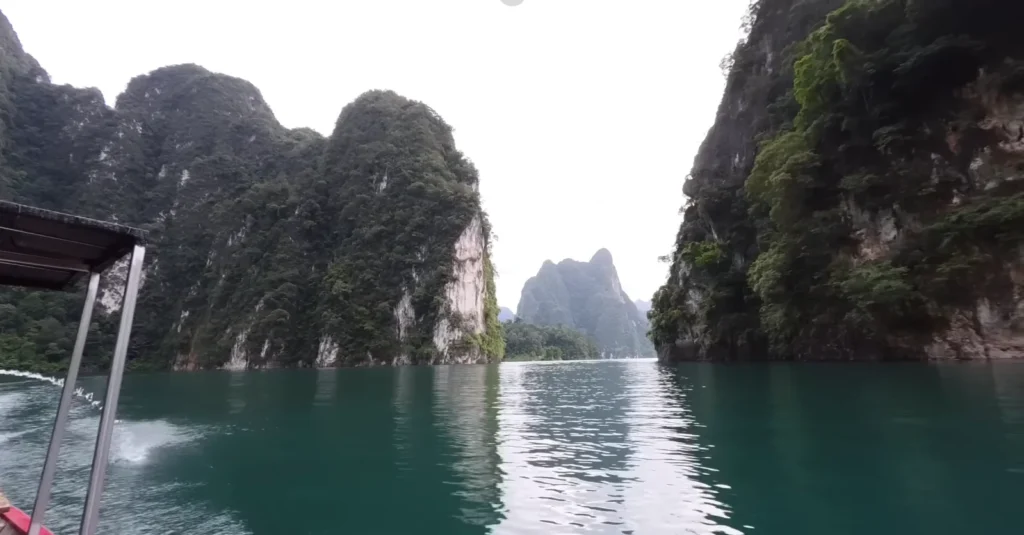
The boat ride out to the floating accommodations starts mundane. Standard longtail boat, life jackets that smell like they’ve seen things, the usual safety speech in broken English.
Then you round the first bend.
They do not just come out of the lake, those limestone karsts – some of them, 960 meters, straight up. They explode from it. and took Halong bay and turned on the drama to eleven. The water is so perfect in reflecting everything that you are left unable to determine where reality and reflection meets.
A rough-looking fellow looking like the weather-beaten sea-master known as Niran, who had been in charge of our boat twenty three years, threw the switch off and reduced the engine half-way through the lake. Obvious silence excepting some unheard bird on the cliffs.
“This where giants sleep,” he said in careful English, pointing to the karst formations. Thai folklore claims these mountains are sleeping giants, and honestly? Standing there in that cathedral of stone and water, you believe it.
The Science Behind the Magic
Lake Cheow Lan is not natural, it was created in the year 1982 when they constructed the Ratchaprapha Dam. This 165-square-kilometer reservoir was formed by the floods and engulfed one whole valley and formed 100+ islands.
The scenery is not the only thing that is exceptional about this place. It is because the flooding was able to save a 160-million-year-old ecosystem. Some entire forests remain underwater. Fish go through drowned tree branches. At times you may be able to see ruins of temples coming through the surface during low water seasons.
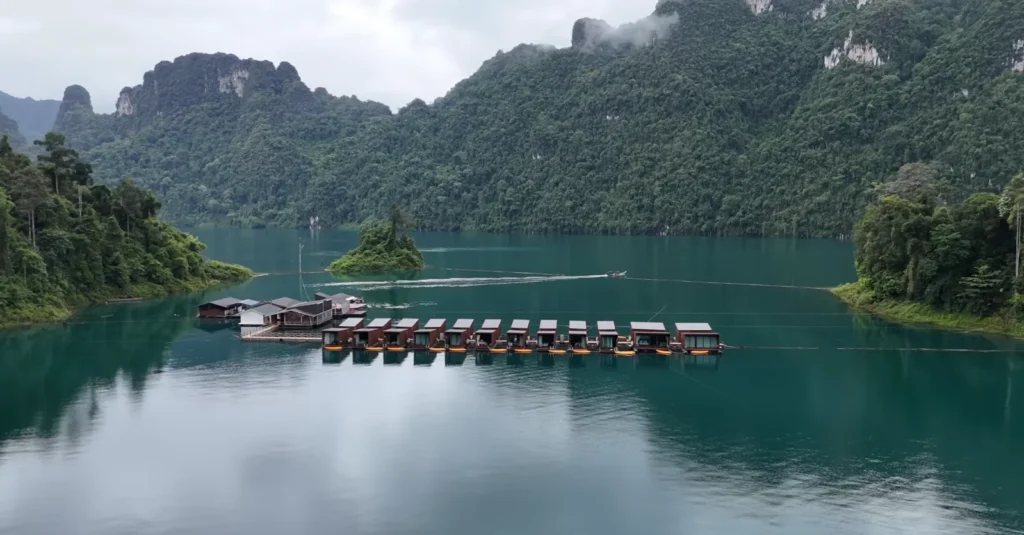
The floating rooms – or houseboats in deep water – will allow you to sleep in this drowned world. I spent all my first night lying in that floating bed thinking of the forest beneath me. Swimming of fish in what was once a backyard of somebody. Monkeys which previously inhabited trees are now twenty meters below the water.
Floating Life: A Different Rhythm
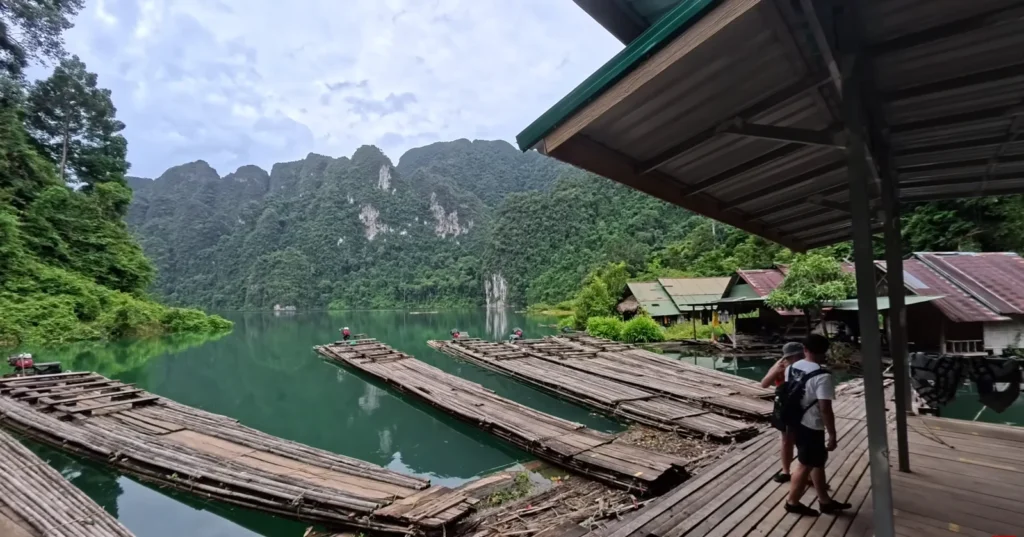
Life on the lake follows water rhythms, not land rhythms. Breakfast arrives by boat. Your bathroom waste gets composted on floating platforms. The restaurant? Also floating, connected to your accommodation by a network of bamboo walkways that creak and sway with every step.
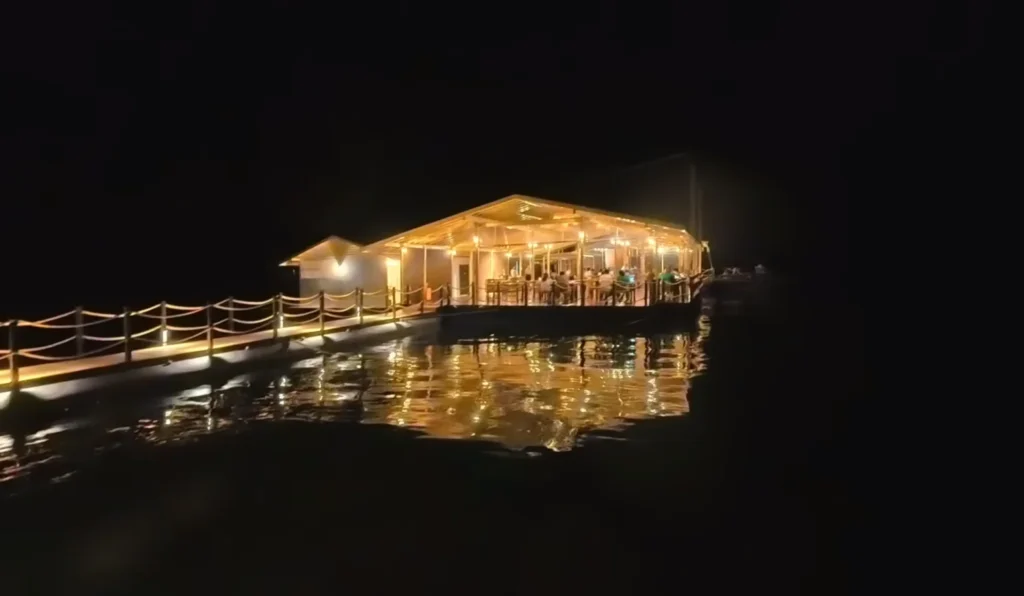
Dinner that first night was surreal. The floating restaurant lit up like a lighthouse in the darkness, our table right at the water’s edge. Fresh fish caught from the lake that afternoon, served while limestone giants loomed invisible in the black water around us. No light pollution for hundreds of kilometers – just stars reflecting in the lake surface until you couldn’t tell up from down.
The menu wasn’t extensive:
- Tom yum with lake fish – spicy, sour, perfect.
- Grilled river prawns – massive ones, sweet meat.
- Pad thai with morning glory – vegetables grown on floating gardens.
- Fresh fruit – rambutan and longan picked from mainland orchards.
Simple food, but when you’re floating in the middle of an ancient lake with no roads for kilometers, simple becomes profound.
Into the Underworld: Cave Exploration That Tests Your Limits
Coral Cave: When Claustrophobia Meets Wonder
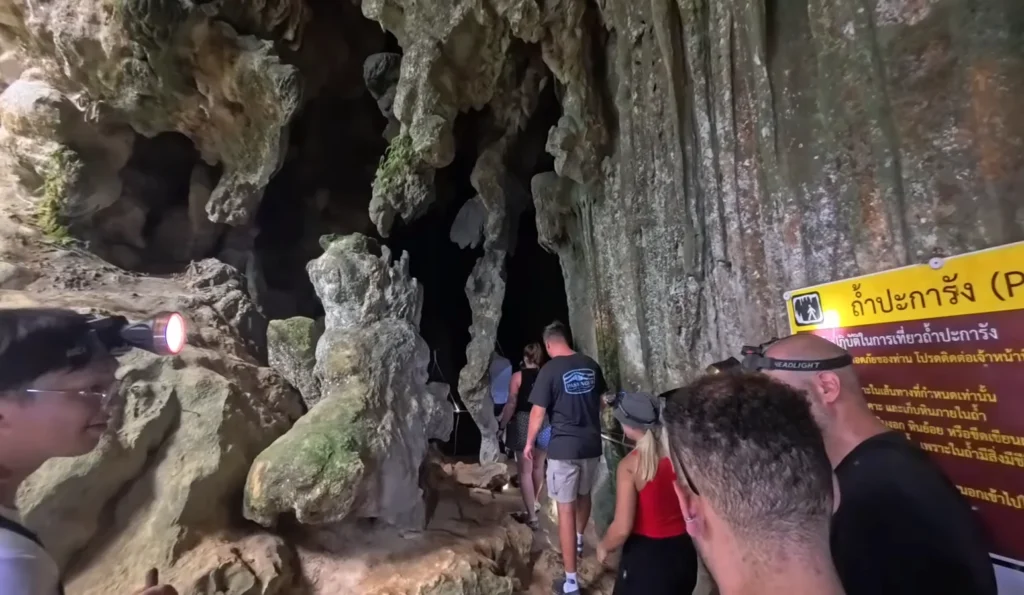
Day two, 6 AM. Our guide Krit announced we’d be exploring Coral Cave – one of the lesser-known cave systems in Khao Sok. “Bring headlamp,” he said. “Phone light not enough.”
He wasn’t kidding.
The cave entrance looks innocent enough – a crack in the limestone maybe three meters wide. Then you step inside and realize you’ve entered a completely different world. The temperature drops instantly. Your breath starts fogging. And the ceiling? It’s barely two meters high in places.
Following that Thai signage deeper into the cave, I had to crouch-walk for twenty minutes straight. My thighs were screaming. But then the tunnel opened up into this cathedral chamber where coral formations – actual ancient coral from when this was all seabed 300 million years ago – created sculptures that no human artist could match.
The Tourism Authority of Thailand doesn’t really promote these caves hard. Too dangerous, they figure. Insurance nightmares. But local guides know every twist and turn of these systems.
Cave Safety Reality Check:
- Never go alone – seriously, people die in these caves
- Proper headlamps mandatory – phone lights fail when you need them most
- Waterproof everything – cave streams appear without warning
- Inform someone of your route – cell service stops at the entrance
- Emergency whistle – sound carries in limestone chambers
Krit told me about a German tourist who got lost in this same cave system two years ago. Spent eight hours underground before rescue teams found him, hypothermic and panicked. The guy was an experienced caver, too.
Underground Rivers and Living Fossils
The deeper sections of Coral Cave contain underground streams that connect to the lake system. Crystal-clear water so cold it makes your teeth ache, flowing through passages carved over millions of years.
But here’s the weird part – these underground rivers contain fish species found nowhere else. Endemic cave fish that have lived in darkness for so long they’ve evolved without eyes. Marine biologists from Chulalongkorn University have identified at least twelve unique species in Khao Sok’s cave systems.
Bathing in that underground river – and, indeed, Krit persuaded me to wade in two feet deep into it – was like being baptized in pre-historic times. the water was clear enough to drink direct (but do not, the guides said there were bacteria in the caves, and they were old things), and all around these were limestone formations that were themselves old when the dinosaurs were on the surface.
Wild Life Adventures: When the Wilderness Bares Its Fangs
Dawn Safari: The Real Safari Jungle
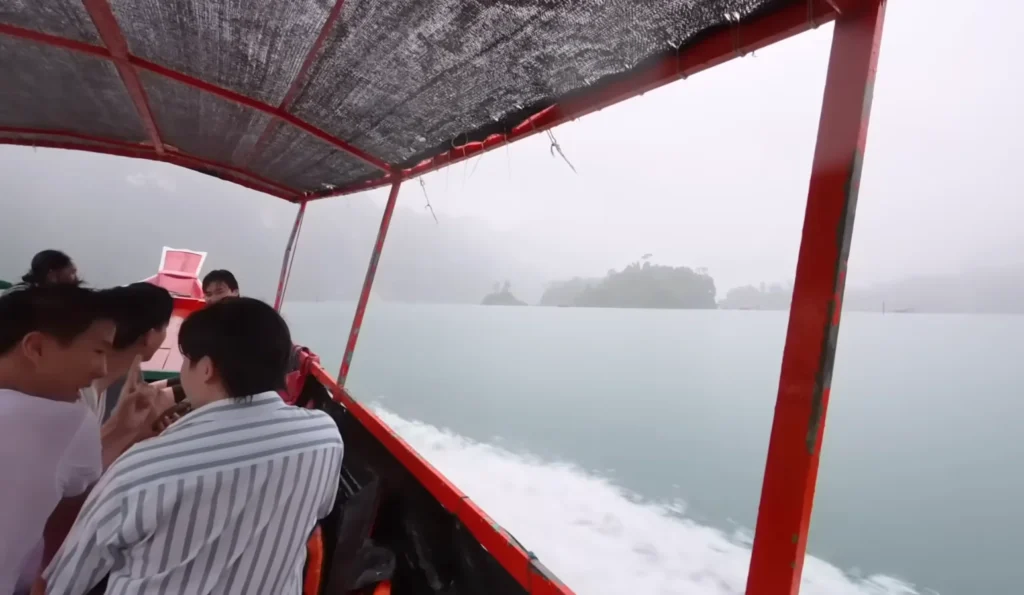
It was five-thirty AM, and pitch black, Niran was already starting the boat engine. Wildlife viewing at Khao Sok is done in the way nature wants you to.
This is achieved by the early morning mist emerging out of the lake to provide this ethereal atmosphere where the limestone peaks come and go like ghosts. But not only atmospheric, but functional. The animals also meet the water source in the morning and evening and such fog gives camouflage to hunting and foraging.
Our first sighting? On the water a troop of white-handed gibbons calling about half an hour up in the air, in the canopy. Their music on the karst walls produced this natural amphitheater effect that sent goosebumps along my arms.
But the real magic happened when we spotted a Malayan sun bear fishing along the shoreline. These bears are critically endangered – fewer than 10,000 left in the wild according to the IUCN Red List. Watching this one methodically turning over rocks, looking for crabs and insects, while completely ignoring our boat… it’s the kind of moment that makes you understand why people become conservationists.
The Elephant Situation: Managing Expectations
Here’s something tour companies won’t tell you straight: seeing wild elephants in Khao Sok is rare. Really rare. The Department of National Parks estimates maybe forty elephants roam the entire 739-square-kilometer park.
I spent three days looking for elephant signs. Found plenty of dung (surprisingly, elephant tracking involves a lot of poop analysis), some bark scraping on trees, and one set of tracks near a stream. But actual elephants? Zero.
This isn’t a failure – it’s success. These elephants avoid humans for good reason. Decades of poaching and habitat destruction have made them incredibly wary. The fact that they exist here at all represents a conservation victory.
Wildlife You’re Actually Likely to See:
- Macaque monkeys – guaranteed, sometimes aggressively curious about your snacks.
- Hornbills – spectacular birds, easier to hear than spot.
- Monitor lizards – up to 2 meters long, completely harmless to humans.
- Various kingfisher species – the lake supports incredible bird diversity.
- Wild boar signs – tracks and wallows, but the animals are mostly nocturnal.
- Otters – if you’re patient and quiet near the shoreline.
Night Sounds: The Jungle Never Sleeps
The floating accommodation gives you front-row seats to the jungle’s night shift. My first evening, lying in that floating bed, I started cataloguing sounds:
- Eight PM: Gibbons settling down for the night, their calls becoming sporadic then stopping entirely.
- Nine PM: Cicadas taking over, creating this wall of white noise that drowns out everything else.
- Ten PM: Something large moving through the water near the accommodation. Splashing, then silence. Our guide later said probably a monitor lizard hunting fish.
- Midnight: The real predators waking up. Distant leopard coughs from deep in the forest. Wild dogs yipping somewhere across the lake.
- Three AM: Hornbills starting their morning preparation calls. Sleep becomes impossible.
- Dawn: The whole cycle beginning again.
Jungle Trekking: Where Adventure Meets Reality
The Trail That Humbles You
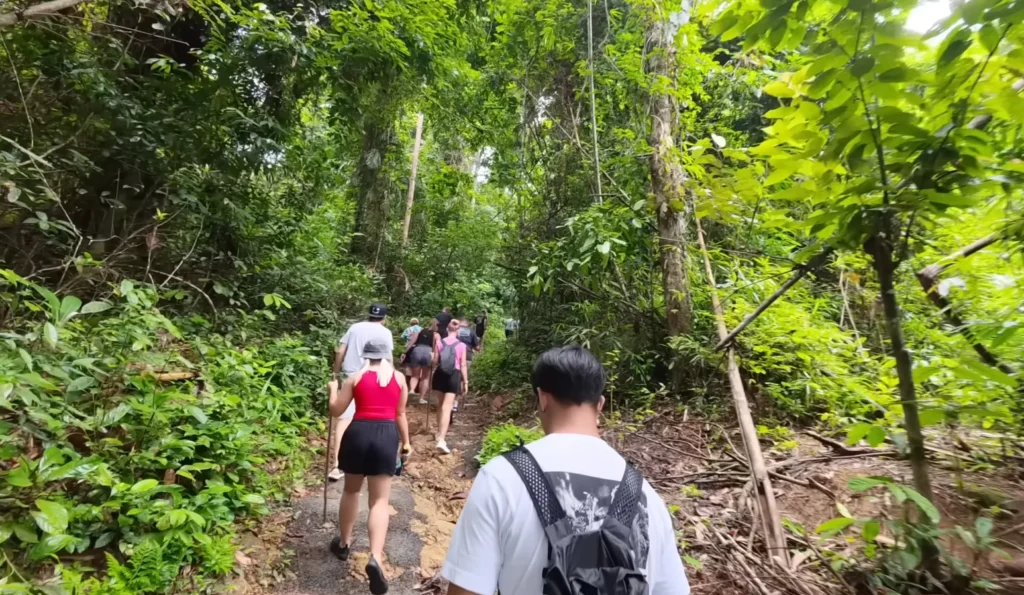
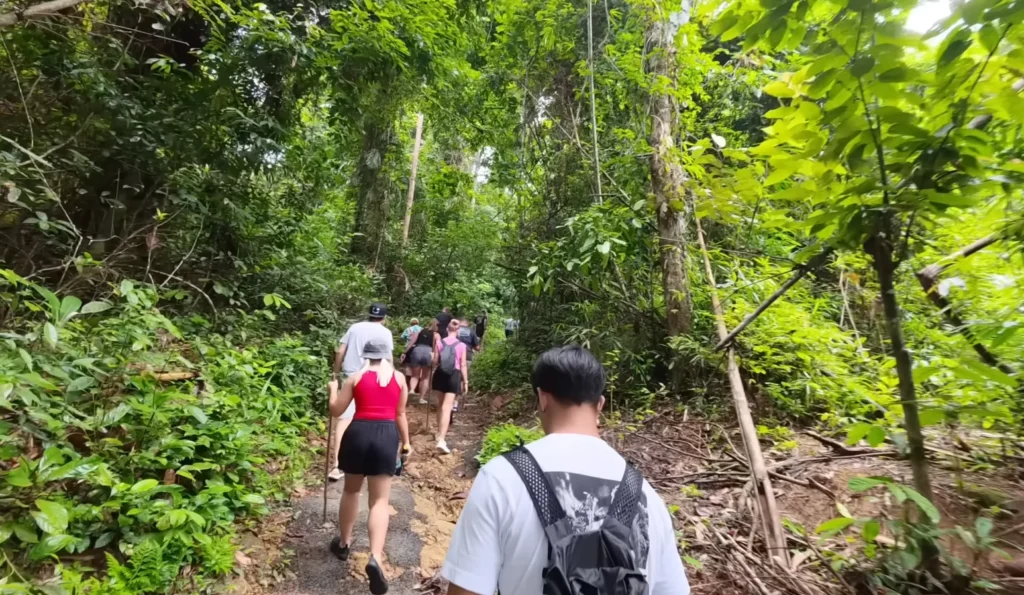
Hiking trails in Khao Sok do not play games. And that was what we were working with; muddy, root-tangled paths that never end and through which primary rainforest trees have been growing centuries.
The 4-kilometer road to the panorama looks like it is not difficult on paper. As a matter of fact, it is three hours of unceasing ascending, crossing streams and weaving about massive buttress roots. The dampness slaps you in the face – and in fifteen minutes all you have on you is wet.
Here, though, is where guide books fail, the jungle floor is an animated place that city dwellers can never envision. Each move is disruptive. Insects hatch out of leaf litter. Tree roots shift underfoot. The vines cling onto your backpack as though they are trying their best to pull you down.
The Leech Reality
No one had told me of the leeches.
Well, they mentioned them. “Bring salt,” the guides said. “For leeches.” I guessed it was as bad as mosquitoes, annoying, but you can live with.
After a half-hour of jungle walking, I checked the state of my feet and had seven leeches already crawling up to my ankles. These are not pond leeches with which you may be familiar in biology. And these are terrestrial leechers – energetic, violent, and unexpectedly nimble.
The salt thing works but it is only temporary. They fall, roll on the ground dramatizing, and perish. But more keep coming. By the day was over I was bitten by a dozen leeches and had a hearty admiration of the food chains in rainforests.
Necessary Jungle Gear (thus acquired):
- Good hiking shoes – sneakers cannot work in the mud.
- Gaiters or long socks – leech protection.
- Salt packet – in case of leech, to remove them.
- Lightweight clothing – cotton drowns in the jungle.
- Waterproof pack cover – unexpected rains are ensured.
- First aid materials – the wounds are quickly infected in this place.
How to Plan Your Khao Sok Adventure: The Actual Prices and Planning
Budget Breakdown: What No one will tell you about Pricing
Everybody wants to know about prices, and the figures you get online? Complete fiction. The followings are my actual expenses incurred during the four days in a truthful manner:
Accommodation:
- Jungle lodge (2 nights): 2,800 THB ($78) – basic but clean.
- Floating bungalow (2 nights): 4,200 THB ($117) – includes meals.
- Total accommodation: 7,000 THB ($195)
Activities:
- Cave exploration guide: 1,500 THB ($42).
- Wildlife boat safari: 2,200 THB ($61) – full day with lunch.
- Jungle trekking guide: 1,200 THB ($33).
- Total activities: 4,900 THB ($136)
Transportation:
- Airport to Khao Sok taxi: 1,800 THB ($50).
- Local boat transfers: 800 THB ($22).
- Total transport: 2,600 THB ($72)
Food (not included in floating stay):
- Jungle lodge meals: 1,800 THB ($50).
- Snacks and drinks: 600 THB ($17).
- Total food: 2,400 THB ($67)
Grand total for 4 days: 16,900 THB ($470)
That’s middle-range spending. You could do it cheaper staying in basic guesthouses and skipping guides, but honestly? The guides make or break this experience. They know where animals actually are, which caves are safe, and most importantly – they keep you alive in environments that don’t forgive mistakes.
Timing: When Mother Nature Cooperates
The Thai Meteorological Department will tell you about dry season versus rainy season. Reality is more complicated.
I came towards the end of March – technically dry season. Yet was twice soaked by unexpected downpours which had been formed out of clear skies. And then this is the point, the most impressive light shows were produced by those rain showers when the sun passed through storm clouds above the limestone karsts.
Best months of various experiences:
- December-February: The coldest weather, the clearest weather and the highest price of accommodation.
- March-May: Hot but dry, best wildlife viewing as animals seek water sources.
- June-November: Rainy season – fewer tourists, lush vegetation, some trails impassable.
- June-November: Rainy season – few tourists, green vegetation, some of the trails become impassable.
The rainy season gets dismissed by most travel sites, but locals told me it’s actually magical if you can handle the logistics. Waterfalls that barely trickle in dry season become thunderous cascades. The jungle explodes into impossible shades of green.
Pocket Reality Check: Less Instagram, More Survival
Addon the adorable safari clothes you admire in the blogs about travel. Khao Sok is a guy who needs work clothes or he will be a wretch.
What actually matters:
- Ankle support in the hiking boots – this is negotiable only in the jungle.
- Merino wool socks – it is the only fabric that does not turn into torture when wet.
- Quick-dry pants – it takes days to dry cotton in the jungle.
- Long-sleeved shirts – style of mosquito protection trumps.
- Rain poncho – umbrellas fail during the down pour in the jungles.
- Waterproof phone case – water kills electronics.
- DEET-containing insect repellent – natural substitutes cannot help in this case.
- First aid kit – closest hospital is an hour away.
What to leave home:
- White garment – reveals all stains and spurts of mud.
- Flip-flops – fatalities on muddy jungles paths.
- Golden necklaces – everything is ruined by humidity and salt water.
- Hair styling products – jungle humidity makes them pointless.
The Cultural Exchange You Don’t Expect
The floating restaurant staff became my unexpected teachers. Jira, who managed the kitchen, grew up in a fishing family before the dam created Cheow Lan Lake. Her grandfather’s village now sits twenty meters underwater.
“We adapt,” she told me while preparing tom yum with fish caught that morning. “Lake brings tourists, tourists bring money. Different life, not worse life.”
She taught me to identify different fish species by taste alone. Lake fish versus river fish have completely different flavors – something about mineral content in the water. The prawns from deeper lake areas taste sweeter than shallow-water ones.
These conversations happen naturally when you’re staying in floating accommodations. No rushing off to the next tourist site. Just time to actually connect with people whose lives intertwine with this landscape in ways tourists never see.
Final Reflections: Why Khao Sok Rewires Your Brain
The Silence That Changes Everything
My last morning, I woke before dawn and sat on the floating platform watching the lake come alive. No engine noise. No traffic. No human sounds at all except my own breathing.
Then the gibbons started their morning calls from across the water. Hornbills answered from different directions. Fish jumped, creating circles that spread across the mirror surface. The limestone giants emerged from mist like ancient spirits waking up.
In that moment, I understood something about why people become addicted to wild places. It’s not just the scenery – though those karst formations reflecting in emerald water do something profound to your visual cortex. It’s the complete sensory reset. Your nervous system, evolved for natural environments, finally gets to operate the way it’s designed to.