
Copenhagen, Tokyo, and Costa Rica consistently deliver for families — safe infrastructure, genuine kid-friendly culture, and enough to keep parents sane. For beach escapes, Turks & Caicos is hard to beat. Iceland is secretly brilliant for tweens. And if your kids are under three, Lisbon is criminally underrated. Every pick below is filtered through one question: does this place actually work when you’re travelling with someone who might cry because their sandwich was cut wrong?
Copenhagen: The City That Was Built for Small People
I keep coming back to Copenhagen in these conversations because it’s the rare city where you don’t feel like a problem to be managed. Wide, flat pavements. Harbour baths that are genuinely clean. Playgrounds tucked into parks that adults actually enjoy sitting in. The King’s Garden has this sprawling adventure playground where kids disappear for an hour and you get to drink coffee without doing anything dramatic.
Tivoli Gardens is the obvious draw — one of the oldest amusement parks in the world, opened in 1843 — but the rides are genuinely gentle enough for small kids without being boring. The Experimentarium is hands-on science done right. Every restaurant we walked into had high chairs waiting without us asking. That stuff matters more than it sounds when you’ve been travelling since 5am.
Best for: ages 2–12. The stroller years, specifically, are peak Copenhagen.
Tokyo: Surprisingly, One of the Best Family Destinations on Earth
This one surprises people. Tokyo feels overwhelming on a map — 14 million people, a transit system that takes adults a week to figure out. But travelling there with kids is oddly smooth. Crime is almost nonexistent. Public toilets are spotless, everywhere and half of them have changing tables. Department stores have entire floors dedicated to children, with free play areas and parental rest rooms that are genuinely restful.
teamLab Planets — the immersive digital art space in Toyosu — was the single moment on our trip where my daughter went completely quiet and just… looked. Kids wade through shallow water while light moves around them. It’s one of those rare experiences that works on children and adults simultaneously.
Tokyo Disneyland and DisneySea are, on a Tuesday in October, noticeably less crowded than their Florida equivalents. Weekday visits in non-peak season are worth planning around if that’s the draw.
The Ghibli Museum requires advance tickets booked through a lottery system — sort that out before you land, not after.
Best for: ages 3–15. Teens obsessed with pop culture will want to stay forever. Infants are the one exception — the walking volume is real.
Costa Rica: Where “Educational” Doesn’t Feel Like a Chore
Most nature destinations make you work for it. Costa Rica is the exception — the wildlife just appears. Manuel Antonio National Park has well-maintained, short trails where sloths hang visibly from trees and white-faced monkeys occasionally try to steal your lunch. My daughter considered the monkey theft attempt the highlight of the entire trip. No museum has ever competed with it.
The turtle nesting tours in Tortuguero are genuinely moving for kids old enough to understand what they’re watching. Hanging bridges in Monteverde work from around age four with a decent pair of shoes. The volcano-heated hot springs near La Fortuna — that’s the one parents tend to remember.
Practically: direct flights from most US hubs, no jet lag for North American families, and the food is simple enough that even the most resistant eaters manage fine. Rice, beans, fresh fruit. The Family Travel Association’s 2024 survey found 72% of parents now prioritise destinations with a relaxed pace over packed itineraries — Costa Rica fits that instinct almost perfectly.
Best for: ages 4–14.
Lisbon: The European City Break Nobody Talks About Enough
Lisbon doesn’t get the family travel press it deserves. Everyone rushes to Barcelona or Rome — both genuinely harder with small kids, narrower pavements, more crowds, higher prices. Lisbon is quieter, sunnier, and has this cultural softness around children in restaurants that you notice immediately. Nobody sighs when your toddler knocks something over.
The Oceanário de Lisboa is Europe’s largest indoor aquarium and legitimately one of the best I’ve been to anywhere. It’s compact enough that you don’t lose a three-year-old in it, but deep enough that older kids stay engaged. Tram 28 — the old yellow tram that rattles through the historic hills — is an adventure before you’ve even arrived anywhere. Kids treat it like a ride. It basically is.
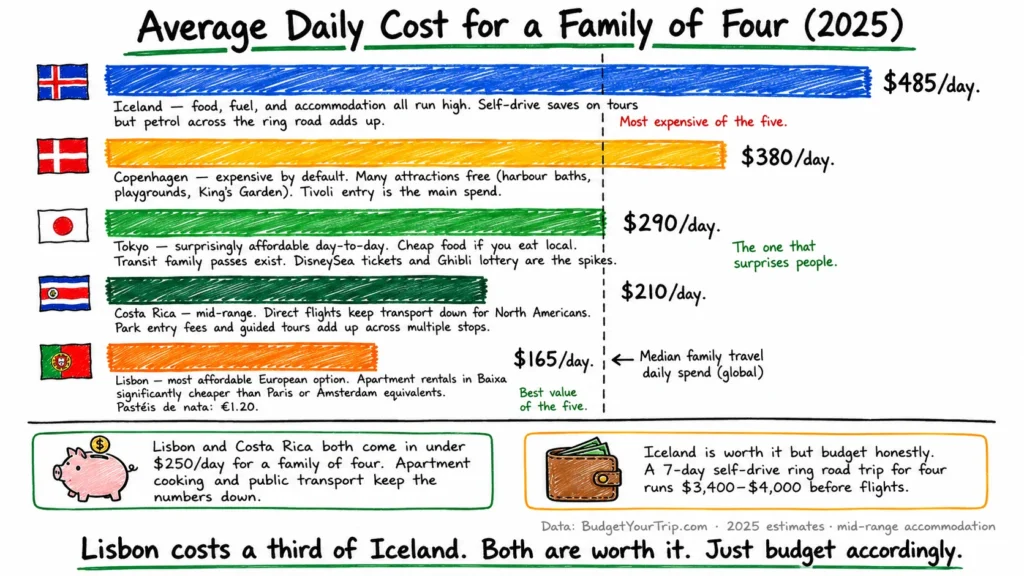
Day trip to Sintra takes about 40 minutes by train from Rossio station. The Pena Palace looks like someone built a fairy tale and forgot to stop. The beaches at Cascais are another 30 minutes in the other direction — calm water, easy afternoon. Pastéis de nata from any bakery window costs almost nothing and buys you approximately 15 minutes of peace. That’s not nothing.
Apartment rentals in Baixa or Chiado are central, stroller-navigable, and significantly cheaper than equivalent Paris or Amsterdam options.
Best for: ages 0–8. The infant and toddler years specifically — this city has patience built into its pace.
Iceland: The Secret Weapon for Tweens Who Are Already Bored
Eleven-year-olds are a specific travel problem. Too old for character meets, too young for wine tours, too cool for aquariums. Iceland solves this in a way almost nowhere else does.
Snorkelling in the Silfra fissure — literally between two tectonic plates, visibility over 100 metres — is available from age 12 with a guided tour. Glacier hiking on Sólheimajökull runs from around age 10. Descending into Thrihnukagigur, a dormant volcano, is the kind of thing that a teenager will actually talk about at school on Monday. ATV rides on black sand beaches. Whale watching from Húsavík. The Secret Lagoon when everyone needs to decompress.
The summer daylight situation — 20+ hours in June and July — is a genuine operational advantage. No scramble to get back before dark. The schedule breathes.
A 7-day self-drive along the southern ring road is the standard approach and it works well. Strong 4G coverage across most of the wilderness means the phone doesn’t become a conflict point. That sounds small. It isn’t.
Best for: ages 10–18. This is tween and teen territory almost exclusively.
The Southwestern USA Road Trip: Grand Canyon, Zion, Bryce — in That Order
Las Vegas as a family starting point sounds wrong until you’ve done it. Two days, Shark Reef Aquarium at Mandalay Bay, the Tournament of Kings dinner show — then you drive out into Utah and the scale of everything changes.
The suggested loop: Vegas → Zion National Park → Bryce Canyon → Page (Antelope Canyon, Horseshoe Bend) → Grand Canyon South Rim → fly out of Phoenix. Every national park visitor centre runs a Junior Ranger programme — kids complete an activity booklet and get sworn in as Junior Rangers by an actual ranger. My daughter took this more seriously than most things I’ve asked her to do voluntarily.
Book accommodation inside the parks 12 to 13 months ahead. Not 6 months. Twelve. Spring or autumn travel avoids the heat that makes canyon hiking genuinely dangerous for small bodies.
Toddlers need a sturdy backpack carrier for some trails. Worth buying before you go, not renting on arrival.
Best for: ages 6–17.
One Last Thing Before You Book Anything
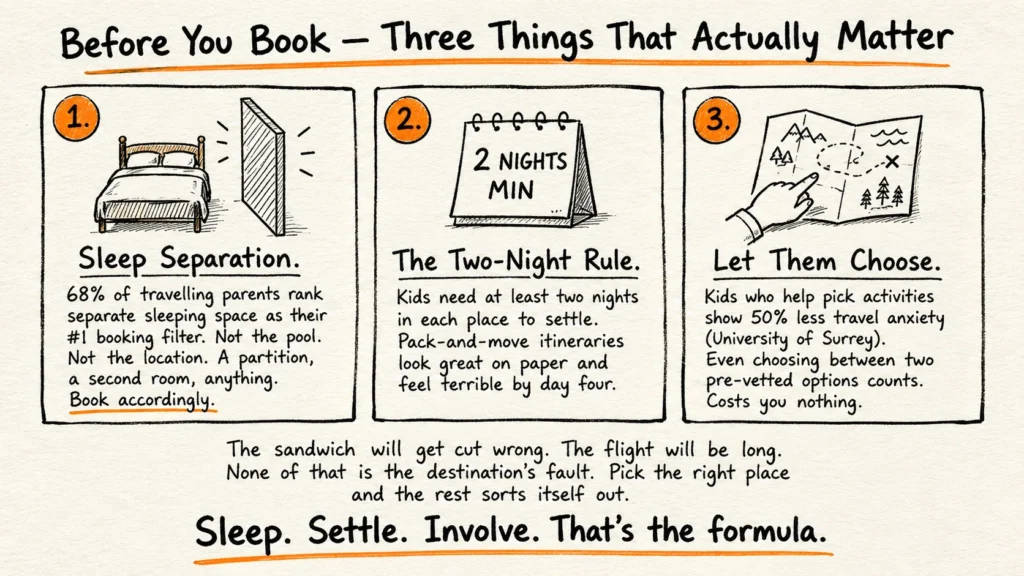
The Family Travel Association found that 68% of travelling parents rank separate sleeping space — a partition, a second room, anything — as their single most important booking filter. Not the pool. Not the location. Sleep separation. Book accordingly.
And the two-night minimum rule: travel researchers consistently flag that children need at least two nights in each place to settle. Pack-and-move trips look good on an itinerary and feel terrible by day four.
Involve the kids in the planning — even just choosing between two pre-vetted activities. A University of Surrey study found children who participate in trip decisions show 50% less travel anxiety. That’s not a small number for something that costs you nothing.