
What Even Is Norfolk? So Norfolk. The name comes from “North Folk” – literally just meant the people living north of Suffolk (who were, predictably, the “South Folk”). Back in Anglo-Saxon times, someone looked at a map and thought, yeah, that’ll do.
This county sits on England’s eastern bump, almost an island really. Water on three sides – the North Sea wrapping around the north and east, the Wash and Fens to the west, rivers Little Ouse and Waveney down south. It’s been shaped by invasions – Romans, Vikings, Normans all came through here because of that coastline position.
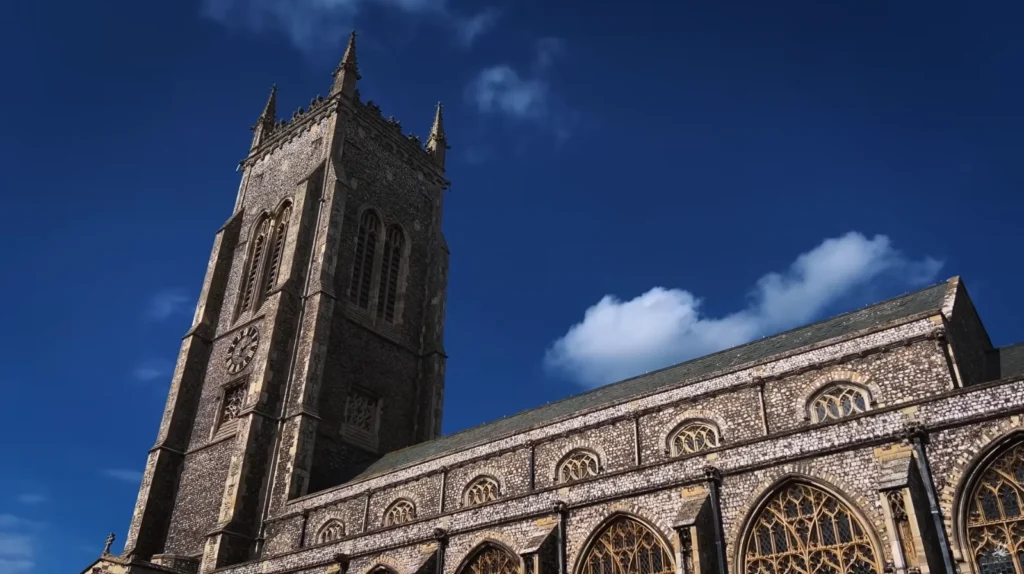
And here’s something wild: by 1086, when William the Conqueror ordered his Domesday Book survey, Norfolk was already one of England’s richest, most populated regions. Medieval wool money. Churches everywhere – Norwich alone had 62 at one point. Most have disappeared but enough remain that you can’t walk ten minutes without seeing another spire.
But wait. The oldest human evidence? 850,000-year-old footprints at Happisburgh. Not 8,500. Eight hundred and fifty THOUSAND. The earliest traces of mankind found outside Africa. An axe discovered near there pushed archaeologists’ timeline back 200,000 years. Norfolk’s been occupied longer than almost anywhere in Britain.
Modern Norfolk? Population around 940,000 as of 2024. Norwich is the capital – about 1.5 hours by train from London. And in the 2024 General Election, Norfolk became the only UK county represented by MPs from five different political parties, which tells you something about how diverse opinions run here despite the agricultural reputation.
Norwich: The City That Refuses to Die
I’ll be honest – I didn’t expect much from Norwich before arriving. Another English market town, right? Wrong.
Norwich has survived everything. Vikings in 840 AD sailing up the River Yare. Norman conquest in 1066. Major fires in 1412, 1413, 1505 and 1507 that leveled huge chunks of the city. The English Civil Wars (though Norfolk backed Cromwell so avoided the worst). World War II bombing raids – at one point 50,000 American airmen from the US 8th Air Force were stationed within 30 miles of Norwich.
The city just… rebuilt. Every time.
The Cathedral That Took 49 Years
Norwich Cathedral was started in 1096, using stone shipped all the way from Caen in Normandy because apparently local stone wasn’t fancy enough. Took until 1145 to finish. The spire? 315 feet tall – second highest in England after Salisbury.
Walking into Cathedral Close felt like stepping into a different century. The Close covers 44 acres and has more residents than any other cathedral close in Europe – about 80 listed historic buildings crammed in there. There’s a 15th-century Bishop’s Palace. Medieval shops that got converted into cafes.
The cathedral itself has over 1,000 carved roof bosses – more than any other Christian church. I tried counting. Got to maybe 40 before my neck hurt and I gave up. The cloisters are the largest surviving monastic cloisters in England.
They also have resident peregrine falcons nesting in the spire, which have become semi-famous locally. People set up cameras to watch them.
The Castle That Became a Museum
Norwich Castle sits on a hill William the Conqueror built as soon as he conquered the area. Originally completed in 1121 as one of medieval Europe’s most impressive royal palaces. Stone facing, massive keep, the works.
Now it’s a museum. In 2024, the Keep reopened after major redevelopment with the British Museum’s first medieval gallery outside London – over 1,000 artifacts. Interactive displays, immersive experiences, you can go from basement to battlements.
I spent three hours in there. Ancient Egyptian mummy. Viking jewelry. Victorian death masks, which are exactly as creepy as they sound. The views from the top though – you can see the whole city spread out, two cathedrals (Norwich has both Anglican and Catholic), medieval church towers poking up everywhere.
Elm Hill: The Street Instagram Dreams About
If you’ve seen “perfect medieval English street” photos, there’s a decent chance it was Elm Hill. The most complete medieval street in Norwich, cobblestones, timber-framed buildings leaning at weird angles because nothing’s been level for 500 years.
It’s become a bit touristy – antique shops, a few cafes – but early morning before the crowds? Worth it. The buildings survived the 1507 fire somehow. Stand there long enough and you start wondering about the thousands of people who walked those same stones over the centuries.
The Market That Never Stopped
Norwich Market is one of the oldest and largest outdoor markets in Britain – 190 stalls, running since medieval times. Monday through Saturday, same spot, century after century.
The Norfolk Broads: England’s Accidental Wetland Paradise
Right. So I thought the Broads were natural.
They’re not.
Someone told me this at a pub in Wroxham and I didn’t believe them until I looked it up later. The Norfolk Broads are medieval peat excavations that flooded. Between the 7th and 13th centuries, people dug up peat for fuel – millions of tons of it. Then sea levels rose in the 14th century, the pits filled with water and boom. 125 miles of navigable waterways, 63 named broads (lakes), Britain’s largest protected wetland.
In 1989, the Broads got the same protection level as a National Park without technically being called one. About 8 million visitors annually.
Arriving at the Water
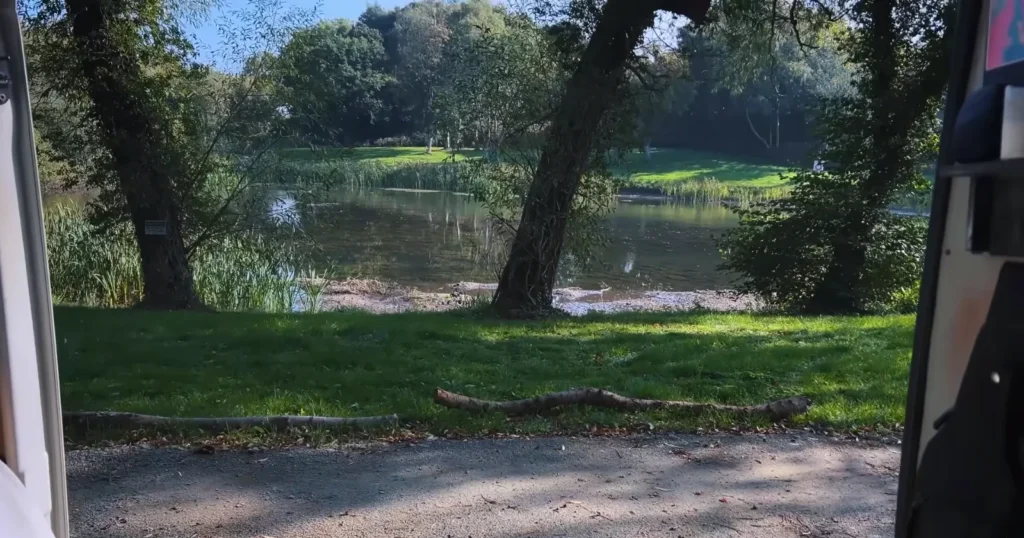
I stayed near Whitlingham Country Park, just outside Norwich. Woke up to that view in Image 1 – still water, reeds growing thick along the edges, trees reflecting perfectly because there wasn’t even a breeze.
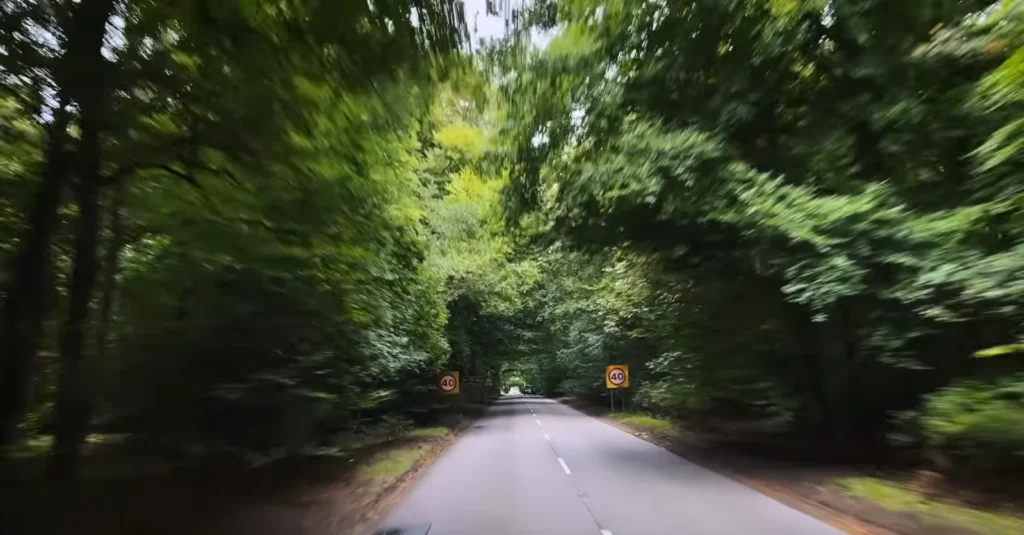
The drive in was through these tunnel roads – trees meeting overhead, 40mph signs that felt optimistic given the curves. Everything’s green. Aggressively green. The kind of green you don’t get in cities.

Passed active farms – saw a harvester working at dusk with what looked like a thousand seagulls following it. The birds were after whatever insects and grubs got churned up. Norfolk’s still heavily agricultural. Over 9,000 farms across the county, among the highest density in England.
The Broads Aren’t Just for Boats
Yeah, you can rent boats. Hundreds of companies will happily take your money for a day cruiser or weekly yacht charter. But I didn’t do that.
Instead: walking trails. The Broads has 200 miles of marked waterside paths. Cockshoot Broad, which is a nature reserve near Woodbastwick, has a floating boardwalk trail through the fen. You’re walking ON the wetland essentially. Reed beds on both sides. Marsh harriers overhead if you’re lucky – Norfolk’s got Britain’s largest breeding population of them.
I saw: coots, moorhens, grebes, at least two herons standing completely still like garden ornaments. One heron was in maybe 6 inches of water, hadn’t moved in the 15 minutes I watched. Then – strike. Gone. Fish didn’t stand a chance.
The Broads support over a quarter of Britain’s rarest wildlife. Swallowtail butterflies (Britain’s largest butterfly, only breeds here). Water voles – the species Ratty from Wind in the Willows was based on. Otters have made a comeback after being nearly wiped out in the 1970s.
How Mills End Up Everywhere
Norfolk has more medieval churches than any other English county AND once had over 700 working windmills. Most are gone. The survivors get converted into expensive homes or stand as historical monuments.
Saw one near Thurne – Thurne Dyke Windmill, white, massive sails, completely restored. These weren’t for grain milling like you’d assume. Drainage mills. Pumping water to keep the land usable, because without constant drainage the whole area wants to become swamp.
The Dutch influenced Norfolk’s drainage engineering heavily in the 17th century – brought over their expertise after similar projects in the Netherlands. Walk around the Broads now and you’re seeing the result of 400 years of humans fighting water.
Norwich Life: Food, Quirks and That Gonzo Restaurant
Gonzo’s: Where Pop Culture Ate Norwich
This place. GONZO’S.
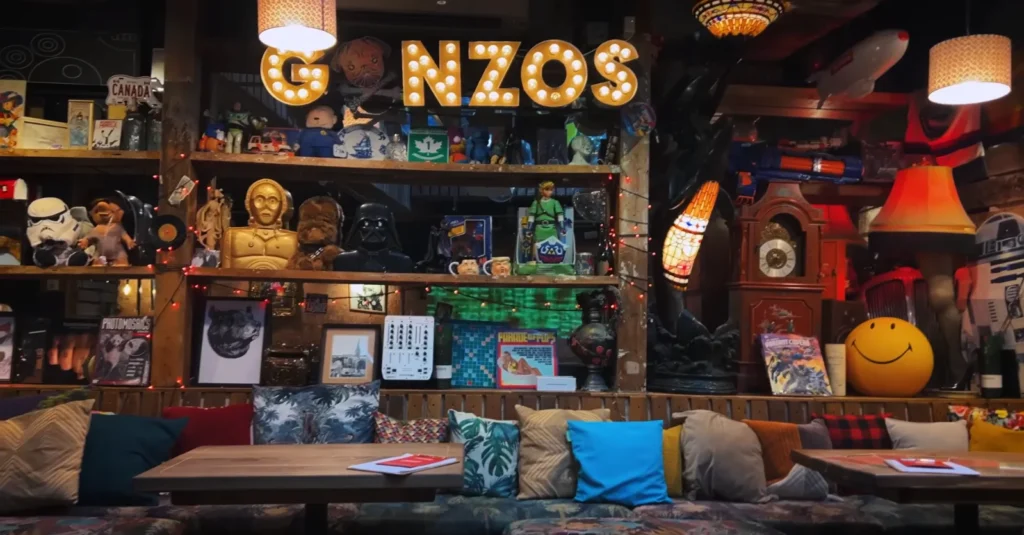
I ended up at Gonzo’s Tea Room in Norwich completely by accident. Was looking for lunch, saw the sign, thought “huh, Hunter S. Thompson reference?” Nope. Well, maybe. But primarily: a restaurant absolutely stuffed with pop culture memorabilia.
Image 10 doesn’t even capture the full chaos. Star Wars figures, old movie posters, vintage toys on every shelf, neon signs, random mannequins. The lighting’s warm and dim. Menu’s got everything from brunch to burgers to oddly specific cocktails.
I had their breakfast – proper Norfolk ingredients, locally sourced where possible. Norfolk’s big on local food culture – Cromer crabs, Brancaster mussels, samphire (which grows wild in the saltmarshes), game birds.
But Gonzo’s isn’t trying to be fine dining. It’s trying to be fun. And it works. The staff seemed genuinely into the vibe, not just tolerating it. Place was packed at 2pm on a Tuesday.
Mustard and More Mustard
Random Norfolk fact: Colman’s Mustard has been made in Norwich since 1814. That bright yellow mustard in the distinctive tin? Norfolk product. There used to be a Colman’s factory and museum – the factory’s still there, museum closed in 2024 for redevelopment, which annoyed locals.
The connection runs deep. Norwich City Football Club’s colors are yellow and green. Fans call them “The Canaries” officially, but sometimes “The Yellows” because of the Colman’s association.
The Church-to-Pub Pipeline
Norwich had one church for every Sunday of the year in medieval times. 52 churches. Population dropped after the Black Death and again after industrialization. Churches became redundant.
Some got demolished. Others? Converted into cafes, antique centers, climbing walls, art galleries. There’s a puppet theater in a former church. St. Mary’s Plain became a coffee shop.
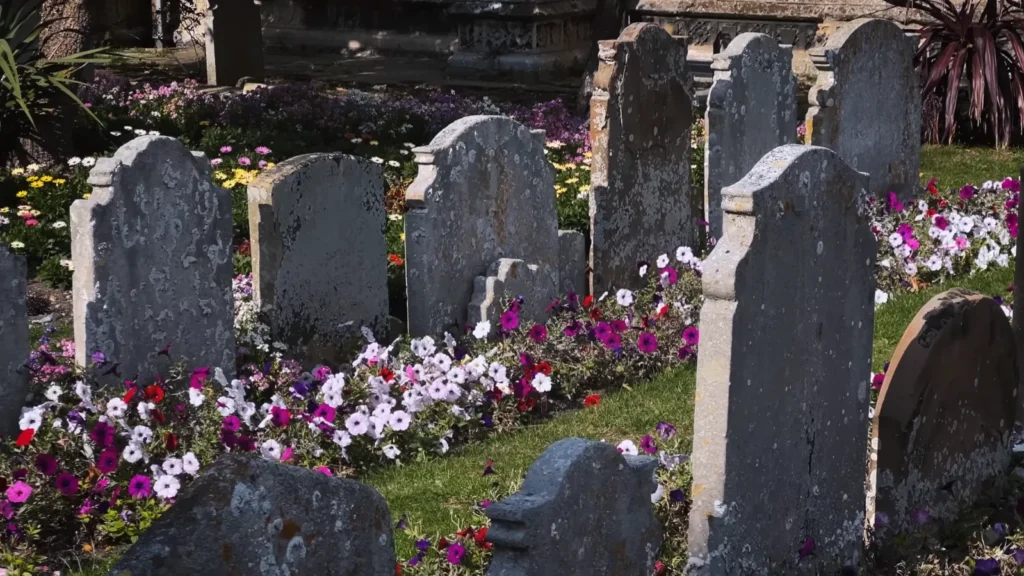
Walked through several old churchyards still maintained as public spaces. Image 7 shows one – slate gravestones from the 1700s and 1800s, completely covered in bright petunias and cosmos. Someone’s planting annual flowers in a graveyard. Very Norfolk energy – respectful but practical.
The Ice Cream Situation

July in Norfolk means ice cream. Found this machine outside a convenience store near Wroxham – self-serve soft serve. Put in your money, pull the handle, done. Classic swirl, perfect ratio.
Norfolk has several proper ice cream makers – Ronaldo’s in Cromer is famous for their massive portions. Breckland Orchard near Thetford does farm-made flavors. But sometimes a machine outside a shop at 3pm when it’s 25°C hits different.
Getting There and Actually Moving Around Norfolk
London to Norwich: Easier Than You’d Think
I took the train from London Liverpool Street. Direct trains run roughly every 30 minutes during peak times – 1 hour 45 minutes to 2 hours depending on stops. Greater Anglia operates the line. Ticket cost varies wildly (£15 if you book weeks ahead off-peak, £80+ same-day peak), classic UK rail pricing chaos.
The train passes through flat countryside – very flat – with wind turbines dotting the horizon. Somewhere past Diss the landscape shifts noticeably. More trees, water appearing in fields, that Norfolk green intensity.
Norwich station dumps you about a 15-minute walk from the city center. Not bad. There’s also buses and taxis if you’ve got luggage.
By car from London: roughly 2 hours via M11 and A11. The A11 is mostly dual carriageway, decent road. Gets you to Norwich, then everything spreads from there.
The Car Question for the Broads
Here’s the thing about Norfolk outside Norwich: public transport exists but is patchy. Buses connect major towns and tourist spots, but trying to reach specific Broads villages or nature reserves without a car means checking timetables constantly and accepting that some places just aren’t accessible.
I rented a car. Took it on those tree tunnel roads in Image 9, navigated narrow village lanes where passing an oncoming vehicle means one person reversing 50 meters to a passing point, dealt with temporary 40mph speed limits that suddenly drop to 30 through villages.
Norfolk drivers have a particular style – they’ll wave at you when you let them pass, they assume you know local shortcuts and they treat 60mph country roads like racetracks while tourists (me) nervously do 45.
Parking in Norwich city center: several multi-story car parks. Chapelfield charges about £2.50/hour, Castle Quarter similar rates. Park and Ride exists on the outskirts if you want to avoid city parking fees – about £4 return including bus.
Cycling: Norfolk’s Obsession
Norfolk is one of the flattest counties in England. Highest point is Beacon Hill near Sheringham at 105 meters. Most of the county is under 50 meters elevation.
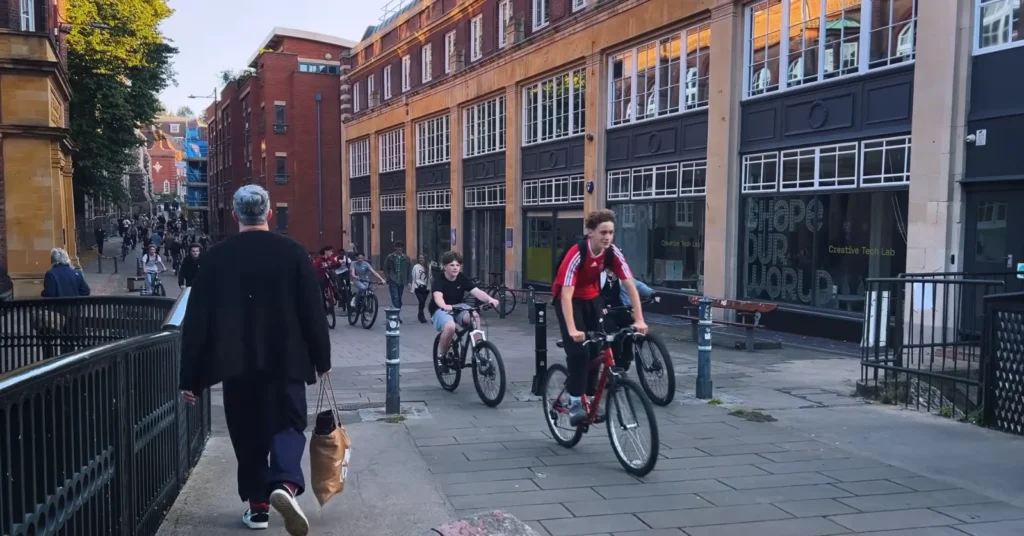
This makes it cycling paradise. Norwich has extensive cycle paths, including routes that follow old railway lines. Saw more bikes than cars in some parts of the city center. The Broads Cycle Hire network lets you rent bikes at various locations around the waterways.
Marriott’s Way runs 26 miles from Norwich to Aylsham – traffic-free, flat, follows a disused railway. Weaver’s Way goes 61 miles from Cromer to Great Yarmouth through the Broads. Absolutely packed with cyclists in summer.
I didn’t cycle. Regret that slightly. Would’ve been perfect weather.
Where I Stayed (And Where You Might Consider)
The Campervan Experiment
I stayed in a campervan at a campsite near Whitlingham. Woke up to Image 1’s view. Cost was about £25-30 per night depending on facilities – some sites charge extra for electric hookup, shower access, etc.
Norfolk has dozens of campsites ranging from basic farm fields (cheap, minimal facilities) to glamping resorts (expensive, hot tubs and restaurants). High season (July-August) books up fast. I reserved mine six weeks ahead.
The campsite had:
- Shower block (clean, acceptable water pressure)
- Laundry facilities (£4 wash, £2 dry)
- Small shop selling basics (milk, bread, tinned goods, overpriced batteries)
- Dog walking area (every campsite in Norfolk assumes you have a dog)
Whitlingham Country Park was maybe 400 meters away on foot – great for running or walking. Two broads, visitor center, cafe.
Hotels If You’re Not Into Camping
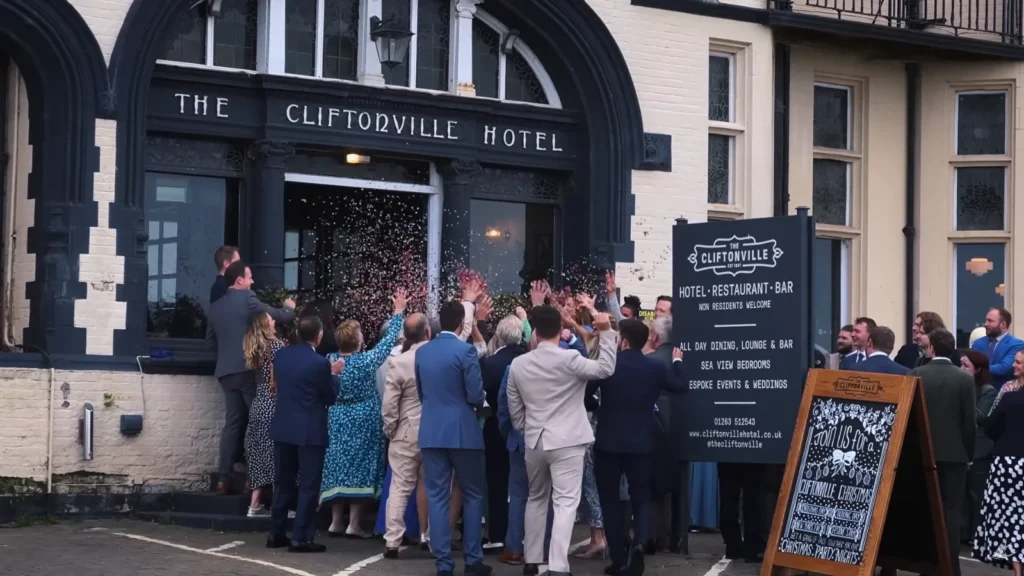
Saw The Cliftonville Hotel in Norwich – boutique place with sea-view rooms, restaurant, bar, hosts weddings apparently (hence the confetti scene in Image 4). Looked nice but pricy – rooms start around £120-150/night for central Norwich hotels.
Budget options exist: Premier Inn, Travelodge properties on the outskirts run £50-70. Several B&Bs in villages around the Broads charge £60-90 including breakfast.
I met someone staying at The Assembly House – historic building in Norwich city center, luxury rooms, afternoon tea service. They paid £200/night and said it was worth it. Georgian townhouse, original features, the works.
Broads Cottage Rentals
Week-long cottage rentals are huge in Norfolk. Families book them for summer holidays – waterside properties with private moorings, hot tubs, multiple bedrooms. Prices range wildly: £600/week for a basic 2-bedroom place inland, up to £2,500+/week for riverside luxury cottages sleeping 8+.
Peak season (school holidays) they get booked a year in advance sometimes. Off-season (November-March) prices drop by 40-50% but weather’s grim.
What It Actually Cost Me
Let me break down the real numbers for 4 days in Norfolk:
| Expense | Cost |
| Train London-Norwich return | £42 (booked 3 weeks ahead) |
| Campervan rental (4 nights) | £110 total |
| Campsite fees | £28 per night x 4 = £112 |
| Car rental (3 days) | £95 including insurance |
| Petrol | £40 (drove maybe 150 miles total) |
| Food/restaurants | £120 (mixture of supermarket and eating out) |
| Castle museum entry | £16 |
| Cathedral donation | £5 (suggested, not required) |
| Various coffees/snacks | £35 |
| TOTAL | £575 |
That’s solo travel. Split between two people drops it significantly. Going full budget (no car rental, camping only, supermarket food, free activities) could probably do it for £300-350 for 4 days.
Going luxury (nice hotel, restaurants for every meal, boat hire, attractions) could easily hit £1,200-1,500.
When to Visit: The Brutal Truth
July-August: Peak season. Weather’s best – average 20-23°C, longest days, everything’s open. Also: most expensive, most crowded, accommodations booked solid, Broads packed with boats.
May-June or September: Sweet spot. Weather’s still decent (15-20°C typically), fewer crowds, prices drop 20-30%. September has harvest season energy – farm shops loaded with local produce.
October-March: Cold, often rainy, many seasonal attractions close. Average temperatures 5-12°C. But: dramatic winter light, empty beaches, rock-bottom prices. Norfolk in November is beautiful if you embrace bleakness.
April: Wildcard. Can be gorgeous or miserable. Easter holidays bring crowds. Late April sees spring blooming – Norfolk’s rapeseed fields turn bright yellow, worth seeing.
I went in July. No regrets despite the crowds. The long summer evenings meant daylight until 9:30pm – more time for everything.
What I’d Actually Recommend (And What You Can Skip)
The Must-Do List
Look, everyone’s trip is different. But if someone asked me “I’ve got 3 days in Norfolk, what’s non-negotiable?” – here’s what I’d say:
Norwich Cathedral and Close – Even if you’re not religious, even if you’ve seen cathedrals before. The scale, the bosses, walking through 900+ years of history. Free entry though donations encouraged. Go early morning when tour groups haven’t arrived yet.
At least one Broads walk – Doesn’t matter which. Whitlingham if you’re near Norwich, Hickling Broad if you want bigger water, Ranworth for the church tower view. Just walk beside water for an hour. That’s the point of Norfolk.
Norwich Market – Runs Monday-Saturday. Grab lunch from one of the food stalls. I had a jacket potato with pulled pork from a stall that’s been there 20+ years apparently. £5.50, massive portion.
Elm Hill photo – Yeah it’s touristy. Still worth the 10-minute walk. Go at 7am if you want it empty.
The “Worth It If You Have Time” Tier
Norwich Castle Museum – Reopened 2024 with new galleries. £16 entry but you get 12 months of return visits. British Museum partnership means the medieval collection is genuinely world-class now. Budget 2-3 hours minimum.
Cromer – Seaside town 40 minutes north of Norwich. Victorian pier, beach, famous for crabs. If you want traditional British seaside, this is it. August sees Cromer Carnival week – parade, fireworks, the works.
Sandringham Estate – The Queen’s Norfolk residence. Open to public when royals aren’t there (generally April-October). House, gardens, museum. About 45 minutes west of Norwich. £20 entry. Very “British monarchy experience” if that’s your thing.
Blickling Estate – National Trust property, Jacobean mansion, supposedly where Anne Boleyn grew up. £15 entry or free with NT membership. The gardens are spectacular – 55 acres of formal planting. Gets Instagrammed constantly.
What I’d Skip (Controversial Takes)
Great Yarmouth – Norfolk’s other major seaside resort. It’s… fine? But it’s more amusement arcades and chips than anything else. Has a Pleasure Beach theme park if you’re into that. Felt very different energy from the rest of Norfolk – more Essex coast vibes. Unless you specifically want traditional British seaside amusements, your time’s better spent elsewhere.
Boat hire if you’re solo – Hiring a day boat on the Broads costs £80-150 depending on size and season. If you’re with family or a group, worth it. Solo? Expensive and honestly a bit lonely puttering around for 8 hours. The walking trails give you the same scenery for free.
Peak summer weekends – If you can avoid visiting Saturday-Sunday in July-August, do. The Broads turn into a traffic jam of boats. Norwich city center gets overwhelmed. Prices spike. Go weekdays or shoulder season.
The Day Trips I Didn’t Take (But Probably Should Have)
The Coast
Norfolk has 90 miles of coastline and I barely saw any of it. Holkham Beach apparently has miles of empty sand backed by pine forest, regularly ranks in UK’s best beaches lists. Blakeney Point has seal colonies you can boat out to see.
The North Norfolk Railway – heritage steam railway running between Sheringham and Holt through countryside. Very nostalgic British thing. Didn’t have time but heard good things.
Thetford Forest
Britain’s largest lowland pine forest, southwestern Norfolk. 47,000 acres of forest trails, bike paths, Go Ape high ropes course. Completely different landscape from the Broads – feels Scandinavian almost. About 45 minutes from Norwich.
Bury St Edmunds
Technically Suffolk not Norfolk, but only 40 minutes from Norwich. Medieval market town, ruined abbey, Greene King brewery tours. Several people told me it was worth a day trip. Ran out of time.
Things Nobody Tells You About Norfolk
The sky is massive – Norfolk’s nicknamed “big sky country” because it’s so flat. Sunsets last forever. Cloud formations stretch for miles. Photographers love it here for a reason.
Bring layers – Even in July. Mornings were 14°C, afternoons hit 24°C, evenings dropped back to 16°C. The breeze off the water cuts through. I lived in a hoodie.
The accent is real – Norfolk dialect still exists in villages. Older residents say “bor” (boy) as a greeting, use words like “squit” (nonsense) and “mardle” (chat). Not thick enough you won’t understand, but distinct enough you notice.
Pub food hits different – Norfolk pubs still do proper British pub meals. Locally shot game, North Sea fish, vegetables from surrounding farms. Not London gastropub prices either – £12-16 for mains typically.
It’s quieter than you expect – Even in peak season. Stand on a Broads path mid-afternoon and you might not see another person for 20 minutes. Norfolk absorbs tourists well – there’s enough space that crowds disperse.
My Actual Take After 4 Days
I went to Norfolk expecting… honestly I’m not sure what. Boats? Water? Old buildings?
Got all that. But what stuck was the pace. Everything moves slower. Conversations at campsite reception last 10 minutes because people actually talk. Drivers wave. Shop staff chat instead of rushing you through.
Norwich surprised me most. It’s England’s only UNESCO City of Literature – something about the number of writers per capita being absurdly high. Walking around the city there’s this weird mix – medieval buildings next to modern offices, students cycling past elderly shoppers, tourists photographing churches while locals ignore them completely.
The Broads though. That’s what I’ll remember. Early morning at Whitlingham, mist still on the water, herons fishing, absolute silence except for coots making their ridiculous noises.
There’s something about being in a landscape humans half-created – those flooded medieval peat diggings – that’s now managed as “wilderness.” It’s not wild. It’s maintained, dredged, controlled. But it feels wild when you’re standing on a boardwalk surrounded by reeds watching marsh harriers hunt.
Would I Go Back?
Yeah. Definitely.
There’s chunks I missed – the entire north coast, Thetford Forest, half the historic houses. Norfolk has 659 scheduled ancient monuments, over 12,000 listed buildings. I saw maybe 2% of what’s there.
But more than that – I’d go back for the pace. For the big skies. For sitting outside a pub in some village I can’t pronounce watching the sun set at 9pm over barley fields.
London is 2 hours away. Feels like a different country.
Practical Final Bits
Best resource I found: Visit Norfolk’s official site is actually comprehensive. Not just the glossy tourist stuff – real transport info, event listings, accommodation databases.
Download offline maps – Phone signal in Broads villages can be patchy. EE has best coverage, but even then you’ll hit dead zones.
Book ahead in summer – Anything popular (Blickling Estate, boat hire, restaurants in Norwich) gets busy July-August. Either book online or accept you might wait.
Cash still matters – Most places take cards now but some farm shops, smaller cafes, campsite laundry machines are cash only. I used maybe £40 in cash total.
Dogs are everywhere – If you’re nervous around dogs, Norfolk might stress you out. Every campsite, most cafes, many attractions are dog-friendly. I saw more dogs than children some days.
The Last Thing
Norfolk doesn’t sell itself aggressively. It’s not the Lake District with dramatic mountains. Not Cornwall with surf beaches. Not London with monuments.
It’s flat. It’s quiet. It’s got weird flooded medieval holes and 900-year-old buildings and more churches than any county should reasonably have.
And that’s exactly why it works.
If you want flashy, go somewhere else. If you want to walk beside water at 7am watching herons hunt while listening to absolutely nothing, come to Norfolk.
Just… maybe skip Gonzo’s if you’re overwhelmed by pop culture memorabilia. Or don’t. Honestly it kind of sums up Norfolk – unexpected, slightly chaotic, completely genuine.